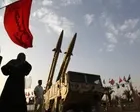
Iran launched multiple ballistic missiles at US forces in the Middle East late on Tuesday, shattering a brief pause in fighting as mediators tried to get both sides back to negotiations and toward a ceasefire, the US military said.
“At 5.45pm ET today, Islamic Revolutionary Guards Corp forces launched multiple ballistic missiles from Iran in an attempted surprise attack on US forces based in the Middle East,” US central command (Centcom) wrote on X.
All Iranian missiles were successfully intercepted, Centcom said in the statement, adding that US forces “remain vigilant and at a high state of readiness”.
Iran’s target was a US base in Jordan, Axios cited a US official as saying.
Both sides had held fire over the weekend, after nearly two weeks of nightly strikes by the United States on Iran, and repeated missile and drone salvoes by Tehran targeting Washington’s allies around the Gulf.
The latest flare-up in fighting came after Iran attacked several ships in the strait of Hormuz, the narrow waterway through which 20% of the world’s oil normally flows. Following the signing of an interim ceasefire deal in June, a battle for control over the strait has erupted.
Iran is demanding that ships use a route near its coastline and says it can charge fees. Ships were increasingly navigating a southern route along the coast of Oman under a US operation when Iran attacked some vessels.
Oil prices had plummeted after the weekend lull in fighting and Donald Trump said there was a “good chance” of progress in negotiations to end the war.
Saudi Arabia said earlier on Tuesday that it shot down drones fired by Iran-backed militias in Iraq for a second day.
Iraqi prime minister Ali al-Zaidi ordered security agencies to investigate after the Saudis alleged a similar attack on Monday. The Iraqi military said in a statement that Iraq is committed to “preventing Iraqi territory from being used as a route or launching point for any attack targeting brotherly or friendly countries.”
The Iraqi militias have denied any role in the drone attacks. The Islamic Resistance in Iraq, an umbrella group of Iran-backed armed groups, called the Saudi claims “fabrications” and implied that Monday’s attacks were carried out by the Houthis, who had themselves claimed to have attacked Saudi oil facilities.
The Iran-backed Houthis in Yemen claimed to have forced a Saudi oil tanker to turn around as part of their self-styled blockade. Last week, they announced a blockade of Saudi shipping, putting another key Middle Eastern waterway – through the Bab el-Mandeb strait leading to the Red Sea – at risk.
The United Kingdom Maritime Trade Operations Center said a tanker reported hearing explosions while travelling in the southern Red Sea. It did not name the tanker but said the crew and vessel were safe.
The Houthis also fired on at least one Saudi tanker in the Red Sea last week.
Iran’s surprise attack came as Israeli prime minister Benjamin Netanyahu visited Washington. Israel has been notably absent from the recent fighting with Iran Netanyahu said he had an “excellent” meeting with Trump at the White House, their first sit-down since launching the war, which offered Netanyahu a chance to smooth out strains in their relationship.
The closed-door meeting lasted nearly an hour and a half and was “positive and productive,” White House press secretary Karoline Leavitt said.
It comes as both leaders face growing pressures at home. Netanyahu is up for reelection and is embattled in part because of his deteriorating relationship with Trump. Trump is under pressure to end an unpopular war that has wreaked economic havoc and driven prices higher ahead of midterm elections this November.
With the Associated Press and Agence France-Presse