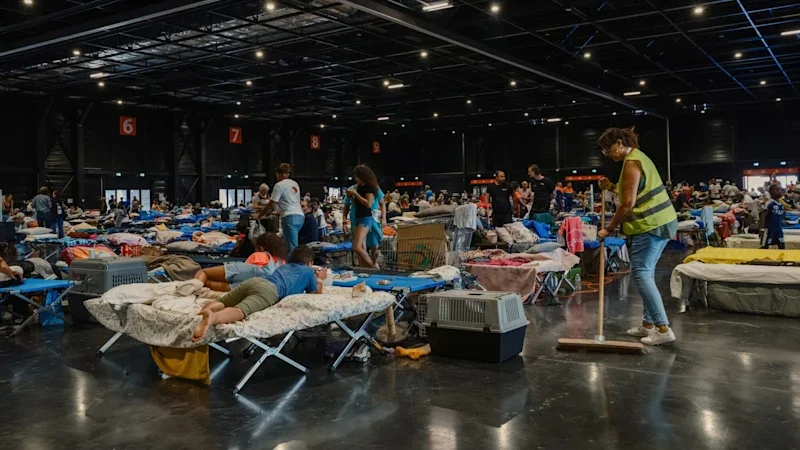
Bordeaux: The cheers erupted across the cavernous hall when a voice came over the loudspeaker to tell hundreds of evacuees some good news.
“The residents of Le Haillan, Eysines and Mérignac can return home,” said the organiser at the front of the hall.
Suddenly, there was a moment of hope for some of those who had fled the Bordeaux wildfires and spent much of the past week sleeping on camp beds in exhibition halls that usually host trade fairs.
Here in Hall 2, one of three vast spaces with rows of beds and trestle tables, the applause signalled the relief for families that knew their homes were considered safe – at least for now.
For other families, however, the anxious wait continues because emergency authorities fear that new areas are in danger as the wind shifts, even as some villages emerge unscathed.
The air was cool inside the Parc des Expositions de Bordeaux at dinner time on Tuesday (about 2am on Wednesday, AEST) as volunteers sorted pillows and sleeping bags, while others served food to people who lined up calmly with their plates.
Outside, however, the temperature climbed to 35 degrees and the wind picked up as the day wore on, bringing the smell of wildfire into the hall for anyone standing near the door.
After five nights here, some families seemed to have settled into the emergency conditions. A mother and father sat at a trestle table with three children, two grandparents and a small brown dog. Two young girls danced to pass the time. A young boy raced by on a tricycle.
The city authority, the Bordeaux Metropole, raced to find shelter to deal with the biggest evacuation of its kind in France since the Second World War. About 60,000 residents were told to leave their homes in Le Haillan and parts of Mérignac and Eysines to the west of Bordeaux.
But there could be no privacy in this open space, with every camp bed on public view. The toilets were in a series of demountables outside the hall.
Visiting media were told not to walk through the beds and chairs to chat to people about how they escaped the firestorm. “They’re fed up with being asked,” said one organiser.
Alexia Bacquet, 38, an English teacher, volunteered to help after the evacuees flooded into this temporary town. She has been making coffee for three days.
“It’s really crazy – we needed many, many people to help us,” she told this masthead.
“My job is to help them to have just a little moment with a smile, and to ask them: ‘Did you eat something today, did you drink some water, how are you?’ It’s really important.”
Her sister, Chloé, 28, is a psychologist who has been volunteering with a group that has helped evacuees deal with the stress of leaving their villages and fearing the loss of their homes.
“It’s been horrible for them to leave their homes because they don’t have any time to pack up their boxes or to take clothes,” she said.
“They are doing their best to survive the situation.
“I thought it was really important to be here to help people and just be there for them – and to bring flowers, because we have flowers here to just bring them joy.”
Another psychologist, Lysa Guinle, 26, said organisers were asking some of the volunteers to stay overnight because the need for support was so great.
“All the people are telling me that they are tired and exhausted, and a bit disoriented,” she said.
“They are very happy and glad to have the people here to stay with them, to just talk. It’s very helpful.”
Authorities have evacuated 220,000 people across the Gironde region in south-western France, but that number may fall as people return to some communities.
The shift in the wind on Tuesday, however, increased the danger to the north of the fire and led authorities to evacuate 4000 people from the beach resort of Lacanau Lake, as well as nearby Lacanau.
Two firefighters died last week in the effort to douse a blaze near Bordeaux’s airport, just near the evacuated neighbourhood of Mérignac. Four were injured on Monday. More than 2000 firefighters are now battling the Gironde fire, which has destroyed about 240 homes.
Some people have refused to evacuate areas close to Bordeaux, amid a debate about whether the historic city is in danger from a fire that is only 15 kilometres away.
While conditions in the city were hot and dry on Tuesday, the blue sky was visible and daily life continued. This was an improvement on Sunday, when a westerly wind brought thick brown smoke through the city.
Inside the exhibition halls, a different kind of daily life has taken hold. Some families may have to remain for many more days. The forecast for Wednesday, when temperatures could reach 39 degrees, has officials worried about more fires breaking out.
Alexia Bacquet said she would volunteer again on Wednesday. She also seemed ready to keep serving coffee if it would help in the days beyond. “We will see what they need.”