Fatima listens to old speeches of the student-activists Umar Khalid and Sharjeel Imam before going to the gym these days. “They are like my pre-workout supplements,” the 28-year-old working for a media organisation in Delhi said jokingly.
Both Khalid and Imam had risen to prominence during the nationwide protests against the Citizenship Amendment Act in 2019-’20 and have been in prison since then for their purported role in organising the 2020 Delhi riots.
Fatima, who like most people interviewed for this piece requested to not be identified by her real name, was a student at the Jamia Millia Islamia University in Delhi during the anti-Citizenship Amendment Act protests. When Delhi Police officials stormed into the university’s library with batons and tear gas on December 15, 2019, she was inside.
That is why she had been itching to go to the Jantar Mantar protest site ever since the police used excessive force to stop protesters from marching to Parliament on July 20. The Cockroach Janta Party, which started as a satirical meme page, had been leading protests against question paper leaks since June 6. However, for Fatima, questions about the ideology of those leading its protest came in the way.
“They don’t have clarity and they have no spine,” she complained, pointing to the photograph of Sonam Wangchuk, the climate activist and educationist, breaking his 26-day fast with Union Health Minister JP Nadda by his side. “Every day I used to think about going to Jantar Mantar, but then something like this would happen and I would not go.”
Other young Muslims who took part in the anti-Citizenship Amendment Act protests over six years ago share this ambivalence.
“Umar and Sharjeel should have been on that stage,” rued Zehra, a 30-year-old artist who also did not go to Jantar Mantar even though she felt sympathy for the protesting students. In her view, the cockroach campaign had sidestepped the issue of communal hatred against Muslims and other minorities by keeping too narrow a focus on paper leaks.
“It was about education, and rightly so, but the movement would be hollow if it did not raise questions about the wrongful and prolonged incarceration of political prisoners,” Zehra added, referring to the imprisonment of the leaders of the 2019 anti-Citizenship Amendment Act protests. “They, too, were students. I don’t know if anything will change for Muslims with him [Union Education Minister Dharmendra Pradhan] resigning.”
Both Fatima and Zehra contrasted the cockroach campaign with the 2019 anti-Citizenship Amendment Act protests to make the point that the latter had allowed Muslims to participate as themselves as well as raise issues that mattered to them. In the recent protests, on the other hand, leaders attempted to police slogans used by protesters and justified their decision to not talk about political prisoners such as Khalid.
Memories of the anti-Citizenship Amendment Act protests and the subsequent police crackdown were two big factors that kept many young Muslims away from the protests this time. Those whom Scroll spoke to said there was apprehension among members of the community that they might be scapegoated by the government for participating in the protests – and this when the campaign did not even address them directly.
Some of these fears came true just before the Cockroach Janta Party withdrew its protest on July 25. Three members from the family of Muhammad Junaid, a volunteer with the campaign in Delhi, were picked up by the police in Uttar Pradesh even though there were no cases against him or his family. In Kolkata, most of those arrested for participating in the protests were Muslim.
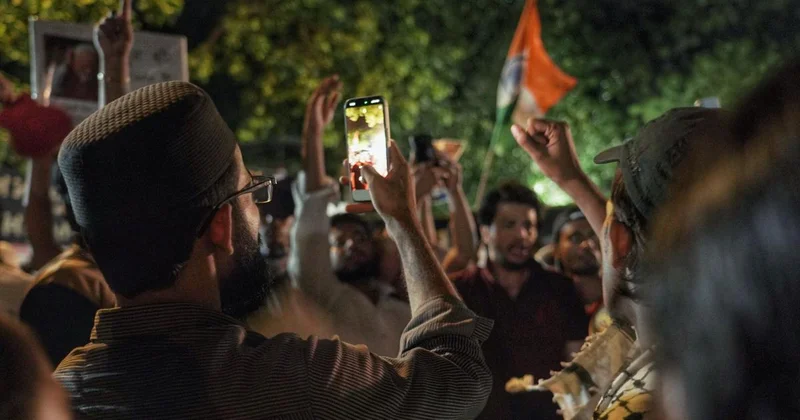
Despite that, Scroll met many Muslims at the protest site in Delhi. They said that they had set aside all other considerations to lend their support to a rare mass mobilisation against the Modi government.
‘Focus on education’
One such protester was Arif, a student from Uttar Pradesh who had come to Delhi to attend college. The 22-year-old saw up close the impact that the leak of the undergraduate medical entrance exam question paper had – an incident that was the major spark for these protests.
“My sister appeared in the NEET [National Eligibility cum Entrance Test] exam in May,” he said. “After the exam was scrapped, she went into depression.”
Arif was accompanied by his friend and classmate Ajaz, also from Uttar Pradesh. “I am here because more than 20 students committed suicide after the NEET exam was scrapped and there is no accountability over their deaths,” he chimed in.
Both said that they were participating in the protest as students. They had turned up at Jantar Mantar only in the final week of the protest, when the campaign started spreading to other parts of the country. “We would have come earlier but we had gone home for holidays,” Ajaz explained. They decided to join the protest as soon as they were back in Delhi.
Neither had informed their parents about visiting the protest site. “They would have never allowed us because they are worried about our safety,” said Arif. “They are more worried because of our religious identity.”
Ajaz worried that his family would get even more anxious if they found out that he had gone to the protest wearing a kurta pyjama – attire seen as traditionally Muslim. “I am due for a very harsh scolding if they come to know,” he admitted.
That the Cockroach Janta Party appeared to be dodging questions about their vulnerability as Muslim protesters did not bother the two friends. “That's a discussion for later,” Arif reasoned. “At this moment, the protest is for the NEET paper leak and resignation of the education minister.”
Ajaz, his friend, echoed him. “This time, the focus should be on education,” he said.
Despite its success in getting Dharmendra Pradhan to resign, the cockroach campaign continues to be criticised for its approach to questions about Muslims. One recurring issue that keeps coming up in such criticism is its position on the prolonged incarceration of student-activists Umar Khalid and Sharjeel Imam.
When asked about this issue, Aafreen Nawaz, one of the Cockroach Janta Party’s spokespersons, told Scroll that the outfit had a “limited goal”.
“Our main agenda has been reform in the education system and the resignation of Pradhan,” she said. “We are refraining from raising other topics. It's a conscious decision.”
Talking about issues like communal politics and discrimination on the basis of religious identity may not resonate with the public at large, Nawaz added. However, she also pointed out that the party had only come into being two months ago and was in the process of “building our stance” on a range of issues.
“Education is a topic which is common and has resonance among vast sections of society,” she contended. “From day one, our leader Abhijeet Dipke has been saying that we won't allow the politics of Hindu-Muslim in these protests. If we were to be distracted by communal politics then we will never be able to concentrate on the problems we are facing.”
Practical politics?
Even so, many Muslims who took part in the protest were drawn to it because of the very issues that the campaign had avoided confronting.
Until about a week back, Wahid, a 28-year-old doctor in Indore, Madhya Pradesh, had no plans of showing up at Jantar Mantar. Though he had been following news about it closely on social media, making the 700-km journey from Indore to Delhi just to attend the protest seemed difficult, given his busy schedule.
But a chance encounter with a heart-attack patient compelled him to change his mind. “I was on emergency duty in my hospital when the patient was brought in for treatment,” Wahid recalled. “We immediately thrombolysed [method of dissolving blood clots in veins or arteries] him and saved his life.”
While the patient was recuperating, Wahid began talking to a fellow Muslim colleague about how the Delhi Police had beaten up protesters in Delhi. At one point, the patient apparently removed his oxygen mask and butted into the conversation to blame Muslims for the protest and praise the prime minister.
Wahid remembered feeling taken aback by the hold that misinformation had on common people like the patient. “I told him ‘Sir, you are not well. Whatever you are saying is right. Please wear the mask.’,” he recollected.
But the exchange left Wahid feeling disturbed. “I decided that now I have to go to Jantar Mantar,” he underlined. “I am here after cancelling all my patients’ appointments for three days. I will volunteer as a doctor here for some time before heading back.”
What did Wahid make of the Cockroach Janta Party’s decision to avoid talking about issues pertaining to Muslim identity? In his view, it was a practical call.
“The fact is that whenever the name of Muslims comes up, it distracts from everything else,” he argued. “If they bring the Muslim angle into it, it will be easier for the government to crack down on these protests.”
For other young Muslims who decided to join the protest in the final week, questions about the sincerity of those leading the cockroach campaign still persisted. But they took a backseat because, in their view, the issue had become much bigger than Sonam Wangchuk or the Cockroach Janta Party.
“The turning point for me was the police brutality in Delhi,” said Akhtarista Ansari, a 26-year-old researcher who attended the protest in Goa. “Yes, I will continue to question this party for not speaking about political prisoners. But how can I not participate in a movement like this? We cannot stop hoping.”
Questions that remain
Those from the community who kept their distance from the protests recognise why others decided to set aside their inhibitions. Zehra, the Delhi-based artist, said she saw how this had become a moment of “catharsis” for many young Indian Muslims who were “letting off some steam” at Jantar Mantar. But she could not bring herself to do the same.
“People like me are cynical for a reason,” she contended. “The wound from CAA [Citizenship Amendment Act] is so fresh. And then you keep scratching it every time you read the news.”
If the campaign had some sincere Muslim leaders who did not shy away from confronting the problem of communalism, Zehra reckoned that she, too, would have joined the protesters in Delhi.
Other Muslims Scroll spoke to were even willing to settle for less.
Former journalist Kainat S, 34, said she would participate in any protest irrespective of who was leading it as long as it was inclusive and raised the issues of those she saw as the oppressed sections of Indian society. But she had skipped going to the protest which took place in Kolkata, her city, last week because it did not meet those conditions.
“My grief is that the suffering of the country’s oppressed people – not only Muslims, but also the Other Backward Classes, the Scheduled Castes and the Scheduled Tribes – deserved much more rage than what is happening right now,” she complained. “A bulk of the people who make up this country are not upper-middle class. Their protests don’t get this kind of attention.”
One example which Kainat offered to buttress her point was the disenfranchisement caused by the special intensive revision of voter rolls in West Bengal earlier this year. Most of those affected during the exercise were Bengali Muslims, according to a recent analysis conducted by the Sabar Institute, a Kolkata-based public policy research organisation.
For Fatima, the woman quoted at the start of the piece, the roll revision process in Bengal and elsewhere in the country underscored how little had changed despite the massive protests led by Muslims in 2019-’20. “This is the NRC [National Register of Citizens] that Umar and others had warned about,” she noted.
That so many fellow Indians had not heeded those warnings has left young Muslims like Fatima feeling bitter. And after the recent protests, when some of her Hindu friends lauded the courage of the Gen Z protesters, it felt like they were rubbing salt into her wounds.
“Don’t they realise that we did all of this before?” asked Fatima. “Is our blood less important than theirs? They are so hurt at being called cockroaches today. But where was this sense of hurt when we were called termites?”
We welcome your comments at letters@scroll.in.