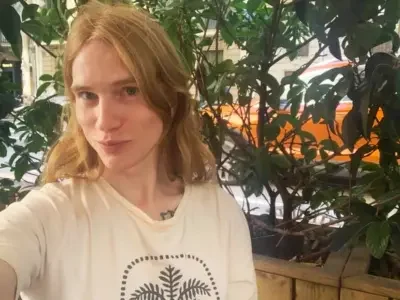
This post is part of Global Voices’ July 2026 Spotlight series, “Statelessness.” This series offers insight into the issue of statelessness and how it hinders people’s freedom of movement, educational opportunities, political access, and more. You can support this coverage by donating here.
For the last two years, Russia has been rated last in LGBTQ+ rights in Europe by Rainbow International, a global LGBTQ+ rights watchdog. For transgender people living in Russia, this translates to a life of risk, danger, and often exile. Global Voices spoke to Isabelle, a transgender woman from Magnitogorsk, Russia ab0ut her experience in Russia, her eventual decision to flee the country for her own safety, and the tumultuous European asylum process.
Magnitogorsk is a large industrial city in the Urals. It is a so-called monocity: the entire community is based around one industrial plant, the Magnitogorsk Metallurgical Plant, where steel is produced. The community only exists because the plant exists.
As in most places in Russia, apart from some communities in bigger cities, people tend to be very homophobic. Isabelle shared:
I realized I was a trans girl around the age of 16–17, though at that time I didn’t know what this meant. I didn’t dare to transition because I was living in a dorm in Magnitogorsk, and it was scary: Society in Russia, especially in smaller cities, is quite unfriendly, let’s put it that way.
In the summer of 2022, with the help of Center T, I received a ‘diagnosis’ and officially started hormone replacement therapy: back then it was still possible. Then, gradually, things started getting banned, and eventually everything was prohibited completely with the ‘law banning gender transition’ in 2023.
Center T is an NGO from Russia that has been helping trans people and their families since 2020. In March 2026, it was declared an “extremist organization” in Russia. Assigning extremist status means anyone directly connected to the organization is criminally liable, including those employed by it or listed among its founders.
Under the logic of the Russian authorities, a case can be opened against anyone who “participated” in the activities of such organizations. This means that donations to the organization, providing consultations for the project or within its initiatives, any form of assistance, and even a simple approving comment on social media, may be treated as crimes.
Since this political attack, Center T issued a warning on their social media channels urging their followers to take precautions, delete everything, including reposts, likes, and any queer imagery on their profiles, and be ready to run from the country. However, they have continued supporting trans people in Russia, anonymously, now mostly on issues of how to leave the country or help a person in crisis. Isabelle said:
Since then, the situation has only gotten worse every year. I was repeatedly insulted on the streets (long hair and small breasts were enough to look at least androgynous, which already made you a target in modern Russia). I lived in Moscow and in the small town of Nytva (Perm region).
Already in 2013, the anti-LGBTQ+ campaign was so pronounced that some experts suggested it had become part of the nation’s DNA, the official ideology and strategic narrative of the government and the country. It has also led to more murders and torture of LGBTQ+ people.
Isabelle explained how the situation in Russia deteriorated, and why she eventually decided to flee the country and seek asylum:
I could no longer live [in secret], so I started running social media using my pronouns (she/hers). I understood that I could be imprisoned for that, and in the realities of Russia, for me, that would be a death sentence. I realized I could no longer stay in Russia because it wasn’t safe (both in everyday life and politically).
I started looking into what I could do and found out that I could apply for asylum in Spain. I began learning Spanish and got in touch with Russian-speaking organizations.
I tried to get a visa in September 2025, but it was denied, so I decided to use the Balkan route. That was quite an adventure. Me and two other trans people, we went to Serbia, and crossed the bridge to Croatia, where we immediately asked for asylum.
We were put in the system of asylum seekers by the Croatian police but were not detained. And because we knew that Croatia would probably refuse to give us the status, we went to Hungary, a small town near the border, from where we planned to fly to Spain.
All EU countries can legally grant refugee status or subsidiary protection to LGBTQ+ people fleeing Russia when the person can show a well-founded fear of persecution because of their sexual orientation, gender identity/expression, or sex characteristics.
Under EU asylum law, approved LGBTQ+ claims are generally treated as persecution of a “particular social group.” But no EU state grants refugee status automatically just because someone is LGBTQ+ and Russian. Practically, LGBTQ+ Russians often aim for countries with more developed asylum practices and support networks.
Spain is especially well regarded by the International Lesbian, Gay, Bisexual, Trans and Intersex Association (IGLA) Europe as a 2026 asylum destination because it is the only country where sex characteristics are expressly included in positive asylum-related measures. For many queer Russian asylum seekers, the process of seeking safety can be a long and harrowing experience. Isabelle shared:
In Hungary, before our flight to Barcelona, we were detained by Hungarian police, and we spent 50 days in a Hungarian immigration detention center.
To be honest, at first it was horribly scary. For the first two days we were promised that everything would be OK. But we were handcuffed, and slept on benches in common rooms at the airport detention center.
But then we were even more terrified when we went to Nyírbátor close to the border in Hungary, and they brought us to a real jail. There were nine police officers and only three of us queer persons. Maybe it would have been easier for Hungary actually, and cheaper, to accept refugees than to pay for all these security measures to detain queer people and put them in jail.
At least I was put on the floor where there were women and families (men, women, and children), not the floor for men only. Still, I had been harassed in this jail but did not dare to file a complaint because all I wanted to do was to get out of there.
Interestingly, we have met a lot of awesome people here. Because it is immigration jail, there were people from all over the world: Iran, Russia, Chechnya, and many others.
After two months, because things are slow over there, they received a confirmation from Croatia that they would accept us back (for the process of asking for refugee status). So we were sent back to Croatia.
From there I eventually managed (it was a very, very stressful 30 hours) to reach Spain in December 2025. The whole journey, thus, took almost three months. I applied for asylum as an LGBTQ+ person in January 2026 in Spain.
When I got to Barcelona, I was a bit in shock that the local LGBTQ+ NGOs could not or did not want to help me. At first I went to ATHACHI NGO (which is supposed to help LGBTQ+ refugees) and asked for help to get the hormones I needed for my continuing transition, and they never gave me any advice or anything — never called me back.
The same situation happened with other organizations, Red Cross and CAER [the Spanish Commission for Refugees]. Fortunately, I could buy the medicine in pharmacies because they took pity on me and did not ask for prescriptions.
Overall, it is a difficult situation for all refugees: you need to find an apartment, register there and only then can get into the national medicine system. However, it is very difficult to find a place to live where you could also register when you are a refugee. But the organizations do not help to find a solution. They also gave me and some people I know, also LGBTQ+ refugees, wrong and harmful legal advice. For instance, they advise people to go back to Croatia. But Croatia does not accept that LGBTQ+ people are in danger in Russia, and are actually sending them back.
And I am a very public person, I have a popular Instagram blog which is serving to give support and advice to Russian-speaking trans people. I have around 3 million views per 30 days but because the blog is open and not private (I want all the trans people who need support to be able to find it), I get hundreds of threats and hateful comments from the people in Russia. One person promised that if I ever came back, he would cut my head off. It is simply impossible for me to go back to Russia now. So now I am waiting on my decision of refugee status in Spain.
Isabelle’s Instagram blog is a safe, positive, and joyful corner of the internet: She shares her love of life and optimism. Despite her harrowing ordeal, she continues to share her happiness with the world and, in her own cheerful way, educates the public about the rights of transgender people.