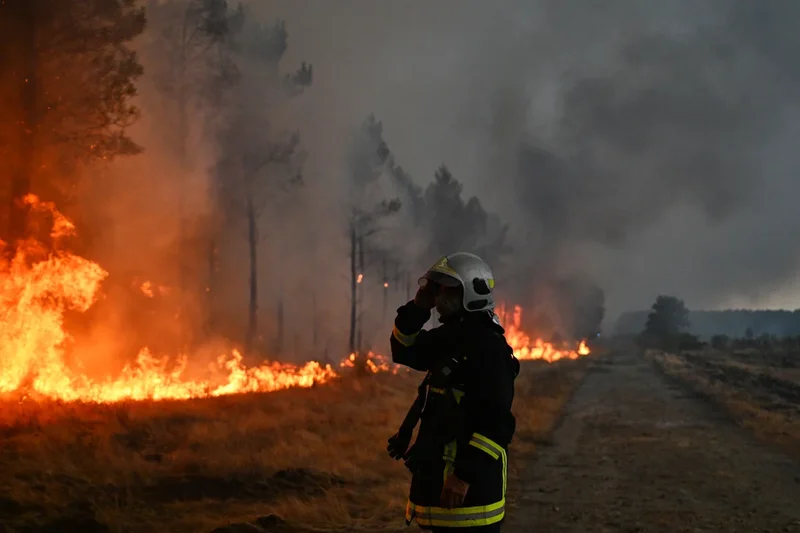
France has warned that the latest intense heatwave hitting the country will peak today, as more towns near Bordeaux were evacuated in the face of raging wildfires.
Temperatures could reach up to 44C in some parts, according to Meteo France, while forecasters in Spain said the heatwave there is expected to continue until Sunday.
French authorities have ordered 4,000 more people to leave tourist sites along the country’s Atlantic coast, expanding what may be France’s largest peacetime evacuation as a vast wildfire west of Bordeaux raged.
The Gironde fire has burned an area four times the size of Paris and forced 220,000 people to leave their homes.
A renewed heatwave was threatening firefighters’ fragile hold on the blaze, and fresh flames have erupted near Grand Crohot, a popular Atlantic beach on the Lège-Cap-Ferret peninsula, local authorities said.
President Emmanuel Macron said France was facing its most difficult situation since the Second World War, urging fire crews to “stay strong”.
Spanish authorities say more than 63,000 people have been evacuated from their homes near Madrid.
Wildfire response must evolve to keep pace with climate change, EU says
The European Union's response to wildfires needs more funding, greater focus on forest management and enhanced education about fire risk as the climate changes, the head of the bloc's crisis response said, as France and Spain battle deadly blazes.
Wildfires have forced unprecedented evacuations of tens of thousands of people across France and Spain, and torn through a region already battered by a blisteringly hot and dry summer.
"Climate change is accelerating. So our response must evolve just as quickly," Hadja Lahbib, the EU's Crisis Management Commissioner, told Reuters.
"We must prepare for risks before disasters strike, and not simply react afterwards."
Lahbib said it was not enough to just purchase more firefighting equipment, and that countries should also be investing more of their EU funding in forest management practices that reduce wildfire risk, and should better educate citizens on "what behaviour they absolutely must avoid", to reduce fire risk. Around 90 per cent of wildfires are started by human activities, such as campfires or discarded cigarettes.
Firefighters say they've never seen anything like Spain's record blazes
Spanish firefighter Javier García has never faced anything like the record blaze raging near Madrid in his two decades protecting woodlands and rural communities.
“This doesn’t have a precedent,” he said.
Spanish prime minister says 'end of the tunnel' is near
Prime minister Pedro Sánchez said on Tuesday that Spain is beginning to see "light at the end of the tunnel" in its battle against the wildfires, although some fires continue raging and he warned the next few hours remain crucial.
Authorities allowed most people in the central Toledo province to return to their homes, lifting a state of emergency introduced on 23 July. Fires still raged in the Madrid region nearby.
“We are starting to see the end of the tunnel in the fight against these fires," Mr Sanchez told reporters.
Black thundercloud creates own lightning, wind and new blazes
At its most violent, the Gironde blaze created a gargantuan black thundercloud, electrified and lit from within. It generated lightning, violent winds and new fires beyond the original front.
The phenomenon, known as a pyrocumulonimbus cloud, was the first recorded in France.
France's national weather service placed Gironde under a yellow heat warning, forecasting inland temperatures of 33 to 35C.
Why Europe is warming more quickly than global average
Europe is the world's fastest-warming continent, heating at more than twice the global average, according to the European Union's Copernicus climate service.
The continent has warmed by around 2.5C compared with pre-industrial levels, the experts say, and Western Europe recorded its hottest June on record.
Changing weather patterns, increasing solar radiation, reduced air pollution, decreasing snow cover and geography are all factors.
More than 1,160 sq km (448 sq miles) of land have burnt across France this year, according to the interior ministry.
A Spanish firefighter invited climate-change deniers to work alongside his crews.
French military patrols evacuated communities to deter burglars
France's armed forces are patrolling evacuated communities amid fears of burglaries in empty homes, as authorities ordered the evacuation of nearly 4,000 more people along the Atlantic coast west of Bordeaux.
The Gendarmerie Nationale shared footage on X of military police driving through deserted streets and checking doors of abandoned properties in Lege-Cap-Ferret in the Gironde region.
"The gendarmes carry out community policing missions and patrol evacuated areas, particularly to prevent any attempted burglaries," the force said.
France orders 4,000 more evacuations as fires displace a third of a million across southwest Europe
French authorities ordered 4,000 more people evacuated from tourist sites along its Atlantic coast yesterday, widening what may be France’s largest peacetime evacuation as returning heat threatened firefighters’ fragile hold on a vast wildfire west of Bordeaux.
Fresh flames erupted later yesterday near Grand Crohot, a popular Atlantic beach on the Lège-Cap-Ferret peninsula, local authorities said. A fleet of 23 planes and helicopters, up from 18 earlier, dropped water and fire retardant as crews fought to keep the renewed flames from spreading.
“The situation remains complicated. That’s clear. We’re not out of the woods,” Gironde prefect Sophie Brocas said.
She said that about 60,000 residents who were evacuated as a precaution from Le Haillan and parts of Mérignac and Eysines outside Bordeaux’s ring road could return on Tuesday. No fires had broken out in the three areas, but residents were told to keep their mobile phones on and emergency bags packed.