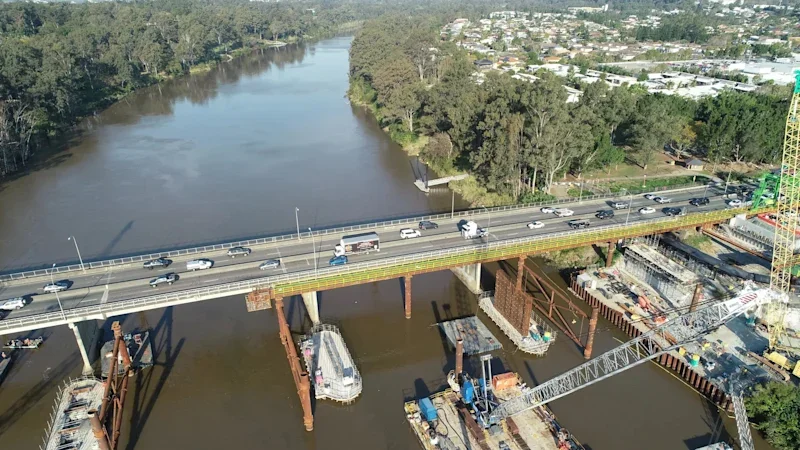
The CFMEU targeted the homes of company directors as part of a sustained $60,000 national campaign against the Queensland construction giant BMD, a commission of inquiry has heard.
Evidence on Wednesday revealed the union’s campaign against BMD extended far beyond industrial disputes on major projects; it also encompassed billboards across Brisbane, social media operations, sporting sponsorship protests, targeted text messages, a dedicated anti-BMD website, and plans to distribute flyers in neighbourhoods linked to company board members.
Senior counsel assisting the inquiry, Eddy Gisonda, KC, described the Centenary Bridge project as the focus of four overlapping campaigns: a “desire to target” the project itself, a campaign against the Australian Workers’ Union, another against Queensland government procurement policies, and a fourth directed at BMD.
Documents tendered to the inquiry showed senior CFMEU officials discussing a national strategy against BMD from late 2023.
In one May 2024 email, national assistant secretary Andrew Sutherland proposed “hitting” BMD with a letterbox drop in suburbs in which board members lived. The proposal involved distributing almost 37,500 flyers.
“It’s perhaps a more usual tactic to put political flyers in the electorate of the local representative, but this is now putting these flyers solely around the homes of the directors,” Gisonda said.
Records tendered to the inquiry showed the billboard campaign and letterbox drop ultimately cost $61,652.
The inquiry heard the anti-BMD campaign was formally endorsed at a CFMEU divisional conference in October 2023, with delegates resolving to organise a national campaign targeting the contractor.
The commission heard the campaign included anti-BMD posters and stickers, the creation of an anti-BMD website, billboard advertising across Brisbane, and flyer distributions at matches by BMD-sponsored rugby league clubs North Queensland Cowboys and Wynnum-Manly Seagulls.
The inquiry heard the Centenary Bridge project became a flashpoint after a BMD-Georgiou joint venture secured the contract in December 2022.
Giving evidence on Wednesday afternoon, Georgiou Group senior project manager Leigh Hahn told the commission the CFMEU campaign ramped up, with a marked increase in “aggressive and assertive” union visits to the Centenary Bridge site, between 2023 and 2024.
“For most of 2023, we might have one a month, maybe a couple a month sometimes,” he said. “But by 2024, we were getting many a week.”
Earlier evidence revisited the procurement process for the project, which was the first major Transport and Main Roads undertaking to apply the state’s controversial Best Practice Industry Conditions framework during tendering.
Internal departmental documents suggested officials were grappling with the cost implications of the policy as early as 2021.
One briefing from November 2022 stated an additional $54.5 million was required for the project due to escalating costs and the implementation of procurement requirements. Of that increase, about $22 million was attributed to BPIC-related measures, the inquiry heard.
The hearing also revisited allegations that information about shortlisted tenderers had found its way into the hands of CFMEU officials during the procurement process, although counsel said it remained unclear how that occurred.
The most dramatic evidence concerned events at the Centenary Bridge site on April 23, 2024.
Body-worn camera footage from private security officers showed CFMEU organiser Hayden Turner-Davey and other union representatives arriving at the site and engaging in lengthy disputes over site entry requirements.
The videos showed security staff insisting union officials comply with sign-in procedures, while police later attended.
Officers could be heard telling security personnel they would generally not intervene unless criminal conduct occurred, characterising the dispute as a workplace health and safety or industrial matter.
“There is no need for us to be here any more, unless there’s any assault complaints coming from any of your staff,” an attending police officer tells the company representatives.
“If it starts getting argy-bargy again, and there are assaults, that’s when we get involved.”
Gisonda said the footage illustrated the difficulties contractors faced managing union campaigns after the abolition of the Australian Building and Construction Commission.
“There’s a general view that [Workplace Health and Safety Queensland] is captured,” he said.
“There’s a general view that the police either cannot or are unable to assist, and the court system is slow and … when it does get to resolution, two or so years after the fact, the remedies lose effectiveness, and sometimes the case is dropped anyway.
“Mr [Tom] Ellis [workplace health and safety manager at civil construction firm JF Hull Holdings, who gave evidence on Tuesday] said that one of the things you can do is you can engage in reasonable measures to prevent someone coming onto the site, but how on earth do you do that when the CFMEU … [has] a full-fledged campaign on your site?”
The inquiry also heard evidence about a separate February 2024 incident in which a convoy of CFMEU supporters confronted AWU officials in a vehicle near the Centenary Bridge project.
Gisonda tendered photographs identifying nine CFMEU organisers and delegates allegedly involved in that protest – Turner-Davey, Christopher Clarkin, Brodie Wood, Clinton Davis, Bon Maui, Stephen Garbutt, Michael Hawkins, Shannon Hall and Trent Oliver.
“Those were the nine at the front of the pack,” Gisonda said.
“There were more towards the back who were there – they were supporters – but they weren’t as actively involved as these people here.”