- See more This is Money on Google - save us as a Preferred Source
Andy Burnham's decision to create a No10 North has courted plenty of controversy, not least because it raises questions about whether the taxpayer is funding the move.
But another major unknown is how the new Prime Minister plans to commute between his new northern base in Manchester and Westminster – and who foots the bill for the travel costs?
This has become even more of a talking point after Burnham used a Government jet three times within the space of five days.
The Prime Minister, who has built much of his political identity around championing public transport as Mayor of Manchester, took the VIP Airbus A321 from London to Glasgow on Thursday afternoon for the opening ceremony of the Commonwealth Games.
He then flew into Manchester to head directly to his new Heron House office – a government building in the city centre used as the Government Communications Headquarters – on a 38-minute flight on Friday morning.
On Monday, he set to the skies once more for a 37-minute trip to meet Ukrainian President Volodymyr Zelenskyy at Portsmouth Naval Base.
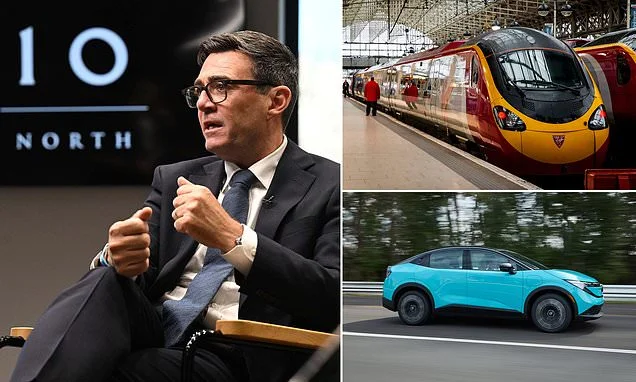
How will Andy Burnham commute between his new No10 North base in Manchester and Westminster? For a man who has championed public transport, rail travel will be expensive
If the new PM is to bat away accusations of hypocrisy and avoid creating an enormous carbon footprint by using air travel, rail is the most obvious option.
However, the average train journey from London to Manchester takes two hours and 46 minutes – assuming there are no delays or cancellations – and comes at a rather steep cost.
Carwow has calculated that Burnham could cover the same journey for less than half the amount if he used an electric car.
The car buying-and-selling website says the PM could save more than £27,000 in commuting costs by using an EV between now and when the next general election must be called in summer 2029.
It highlights the staggering cost of travelling by train in Britain, despite Labour's landmark nationwide fare freeze until March 2027. It is the first fare freeze in 30 years and will reportedly save passengers £600million.
Carwow calculated that travelling from Manchester Piccadilly to London by train 40 times a year (once a week to attend PMQs) would cost £15,840 per annum
The car buying and selling website says the PM's travel costs could be halved if he used an electric car, like the UK-built Nissan Leaf (pictured)
How much is the train from Manchester to London?
For unlimited travel back and forth to the capital, an annual season ticket from Manchester Piccadilly, Manchester Victoria, Manchester Oxford Road or Deansgate to London – including unlimited travel within London Zones 1-6 – costs £20,560 per year. That's £61,680 over three years.
Alternatively, buying a day return ticket (without a railcard) would cost £396 per journey.
Making the trip 40 times a year (once a week for PMQs) would cost £15,840 per annum – or a total of £47,520 over three years.
How expensive is the journey in an EV?
In contrast, an EV would deliver a significant cost saving.
Carwow used the UK-built Nissan Leaf – which is manufactured in Sunderland – as the EV commuting benchmark.
The new third-generation model, which arrived last year, provides a real-world range of around 315 miles on a single charge.
With the round trip covering approximately 408 miles, the car would require a rapid-charging stop before the PM made his return journey to Manchester.
The analysis found that leasing the Nissan Leaf for three years, with a 20,000-mile annual allowance, would cost £17,961, including road tax.
Adding the cost of charging the car for the weekly journeys – using a combination of public rapid charging and cheaper home charging – brings the total to £20,265 over three years.
This is a £26,985 saving compared to the £47,250 cost of taking the train once a week, or £8,995 per year.
Buying the car on finance would cost £26,913, including road tax and charging.
The Sunderland-made Leaf provides a real-world range of around 315 miles. Carwow says the cost to lease and charge one for journeys between Manchester and London would be half the price of travelling by train
That said, the move comes with a time penalty.
The average journey time by road, excluding traffic jams and delays en route, is around four hours each way – well over an hour longer than by rail.
Siobhan Doyle, consumer reporter at Carwow who helped crunch the commuting cost numbers, said: 'Rail is often seen as the obvious choice for business travel, yet for someone making the journey every week, an electric car can work out tens of thousands of pounds cheaper over a Parliament.
'While not everyone has access to charging at home or wants to drive long distances, this highlights just how competitive EV running costs have become compared with other forms of transport.'