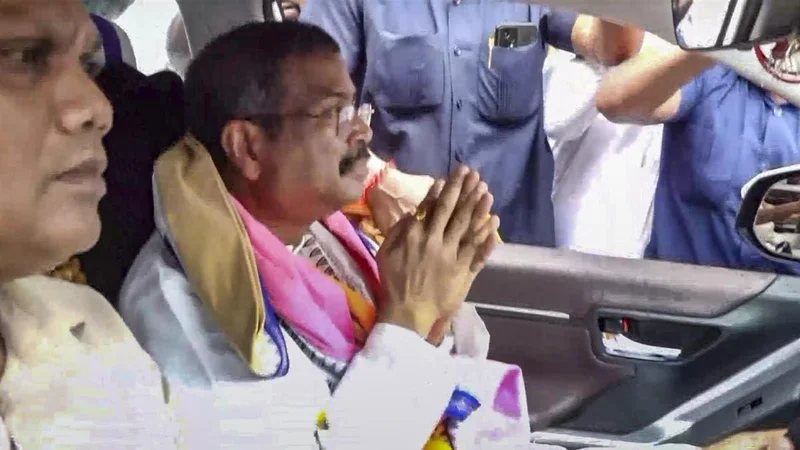
Will the resignation of Dharmendra Pradhan as the Union Education Minister bring back demands that the political leadership take moral responsibility when a serious policy failure impacts ordinary citizens and causes lives to be lost? If the resignation is not to be forgotten as a one-time victory against an intransigent government, then we must debate why Mr. Pradhan had to go and what his resignation might achieve.
India boasts of being the largest democracy in the world. A democracy is tested not merely by the elections but by the manner in which the elected accept responsibility when public institutions fail. This is at the heart of the repeated crises surrounding national competitive examinations. Leakages, failures of systems and other irregularities in key competitive examinations affect millions of young people whose careers, years of preparation, family resources, and mental well-being are tied to the credibility of public examinations.
The central question, therefore, is not whether the Education Minister personally leaked an exam paper. The question is whether the political head of the Ministry responsible for the examination system should accept political and moral responsibility when the system under his authority repeatedly fails. This distinction between criminal guilt and political accountability lies at the heart of democratic governance. The Union government itself has enacted the Public Examinations (Prevention of Unfair Means) Act, 2024, recognising the gravity of unfair means and the need to protect the integrity of public examinations. If the examination system is sufficiently important to require a special national law, it is surely important enough to require ministerial accountability when its credibility is seriously compromised.
Shastri’s example
The most powerful Indian precedent is Lal Bahadur Shastri. In 1956, as Railway Minister, he resigned after a railway accident in which many lives were lost. Prime Minister Jawaharlal Nehru made it clear that he did not accept Shastri’s resignation because Shastri had personally caused the accident. He accepted it because Shastri believed that the political head of a department must accept responsibility when a grave failure occurs within the system under his charge. Nehru described the resignation as an example of constitutional propriety. Shastri thus established a principle far more demanding than the narrow question of personal culpability: a Minister may be innocent of a crime and yet responsible as the political head of a failed system.
This principle is not uniquely Indian. In New Zealand, Labour Minister Kate Wilkinson resigned after the Royal Commission investigated the Pike River mine disaster in 2010, in which 29 miners died. She said the tragedy had occurred “on my watch as Minister of Labour”, and that resigning was “the right and honourable thing to do”. She did not claim that she had personally caused the deaths. She accepted the moral responsibility attached to the office she held. Such examples demonstrate that resignation need not be an admission of criminal guilt. It can be an acknowledgement that public authority carries public responsibility.
Measured against this standard, the case for the resignation of the Union Education Minister was anyway compelling. The delay in asking him to go was nothing more than the government seeing the protest as a challenge in which it did not want to blink first. For the protesting students, it was a way of establishing that their voice must be heard. For the government resisting the demand and using force to stop the students, it was a way of showing power, strength, and invincibility. What did not come up that openly though the students did highlight it was the principle of accountability, the principle that say that the buck stops at the table of the boss.
A Minister’s responsibility
Disaster in the education system is a special case of a more generalised problem of the nation. Repeated institutional failures raise a question of governance. An individual criminal may be arrested, an official may be suspended, and an agency may announce reforms. But none of these actions answers the central question of accountability in a democracy: who was politically responsible for ensuring that the system was secure, competent, and trustworthy? A Minister cannot be expected to supervise every examination centre. But a Minister is expected to ensure that the institution responsible for national examinations possesses adequate systems of security, accountability, oversight, and crisis management. When failure becomes sufficiently grave and repeated, responsibility cannot simply be pushed downward.
The refusal to accept this principle creates a dangerous culture of impunity at the top. Ministers are eager to claim credit for successful schemes and national achievements. They cannot, by the same logic, disclaim all responsibility whenever a system under their authority collapses. To what level have we stooped? A simple principle in democracy is that authority and accountability must travel together. This is hubristic and rank callousness.
The matter becomes even more serious when students who demand accountability are treated primarily as a law-and-order problem. Students are not merely petitioners; they are citizens whose futures have been directly affected. A peaceful protest demanding an explanation, an investigation or the resignation of a Minister should ordinarily be met with dialogue and transparency. The use of coercive state power against students — particularly when their grievance concerns the failure of the state itself — deepens the sense of injustice. The government cannot first fail to protect the integrity of an examination and then respond to the victims of that failure as though they were the problem.
In this particular case, the accountability rises beyond the Education Ministry. The Prime Minister is the head of the Union government and is responsible for the overall political direction of the Cabinet. The Home Minister is responsible for the Union’s internal security machinery and, where central forces and policing responses are involved, for the political environment in which public protest is handled. If the Cabinet is protecting the Education Minister despite repeated failures, accountability has failed at the apex as well. It denies political responsibility, attributes failures to subordinate officials, and treats protesting students as a threat to public order.
Gandhiji believed that leadership must be exemplary: those who hold public office must be the first to accept responsibility. Remember Chauri Chaura in 1922. Gandhiji withdrew the Non-Cooperation Movement. He was not in any office. If the Minister refuses, the Prime Minister, as head of the Cabinet, must answer. Democracy is strengthened not when leaders never resign, but when power accepts its duty to be accountable. In this, the government has failed miserably. The resignation of Mr. Pradhan, which came because of the immense pressure of the protests, earns it no credit.
Citizens’ responsibility
If leadership must be exemplary, then citizens too have a responsibility. When those in power fail to accept accountability, we cannot, as citizens, remain silent. Citizens have the constitutional right — and, in the Gandhian sense, the moral duty — to appeal, question and protest peacefully. This protest is not against democracy; it is an act of faith in democracy. We must speak because those who govern must answer to those whom they govern.
Dr. Sudarshan Iyengar is the former Vice-Chancellor of Gujarat Vidyapith, the university founded by Mahatma Gandhi in 1920, and is a co-author of the book Abundant Love, a long-form conversation with Satish Kumar
Published - July 29, 2026 12:27 am IST