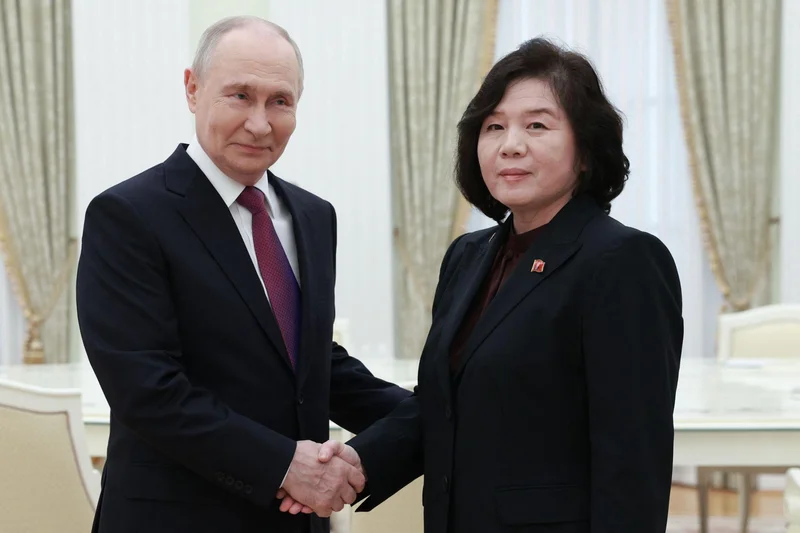
Overlooked amid global headlines, there are a few new developments in the relationship between North Korea and Russia that warrant renewed focus. Last week, North Korean Foreign Minister Choe Son-hui was seen shaking hands with Russian President Vladimir Putin during her visit to Moscow. In a meeting also attended by Russian Foreign Minister Sergey Lavrov, the Russian president expressed gratitude to North Korea for sending soldiers to the war in Ukraine. Media reports also suggested that the two sides had discussed dispatching more North Korean soldiers.
Ukrainian President Volodymyr Zelenskyy warned in a social media post Saturday that Russia was preparing to receive additional North Korean soldiers — this time around 30,000 — to support Russia's offensive in Ukraine this autumn. Pyongyang also intends to deliver additional launch pads for ballistic missiles to Russia, according to the Ukrainian president. An NHK report published Tuesday cited an anonymous Russian diplomatic official saying that the two countries discussed dispatching 20,000 more soldiers during her visit. Current estimates are that 10,000 to 15,000 North Korean soldiers have been sent to the war since 2024.
South Korea remains far from the war's fronts, yet the atrocities and the dangers from closer military ties between Pyongyang and Moscow remain a growing concern. Interviews with the two North Korean soldiers captured by Ukraine have been especially revealing of the human cost of this war.
The South Korean government has responded by saying that it is closely monitoring the situation. During their meeting in Seoul in June, South Korea's Foreign Minister Cho Hyun and Ukrainian Foreign Minister Andrii Sybiha discussed repatriation of the two North Koreans and measures needed for postwar reconstruction. The prospect of more North Korean soldiers on the frontlines in Ukraine raises new concerns for South Korea.
In a social media post, Zelenskyy warned, "Russia is helping North Korea learn how to wage war, improve its weapons, and gain real combat experience in using them. All of this is a threat to everyone in Asia who is within range of North Korean missiles."
Experts and North Korea watchers believe the North has already obtained modernized warfare capabilities, including drone tactics and electromagnetic weapon systems, through the Ukraine war. If this conflict continues, they project that more sophisticated weaponry gained from technical assistance from Russia may be deployed on the battlefield — enhancing not only their warfare capability but also potentially emboldening their overall posture.
Ties between Russia and North Korea have evolved to the point where they signed a "strategic partnership relations" agreement in 2024. North Korean soldiers participated in a World War II victory parade to celebrate Russia's victory over Germany, held at the Red Square in Moscow in May.
At the same time, North Korea's relations with China have also expanded. Chinese President Xi Jinping made a visit to Pyongyang in June, and senior officials exchanged visits in the first half of the year. This alignment among authoritarian states contrasts sharply with the currently lukewarm alliance between South Korea and the United States.
Seoul and Washington have been heavily engaged in dialogue over business and trade-related issues. The traditional security relationship has been impacted by several events, including Washington reportedly limited South Korea's access to satellite intelligence data following Unification Minister Chung Dong-young's March comments at the National Assembly about a suspected nuclear facility in North Korea. Good communication on these issues is crucial to maintaining a balance between diplomacy and defense readiness for South Korea. Calls are growing for South Korea to cooperate with NATO members to address North Korea's participation in the war in Ukraine. But Seoul must also revisit its alliance with the United States and evaluate its readiness posture.