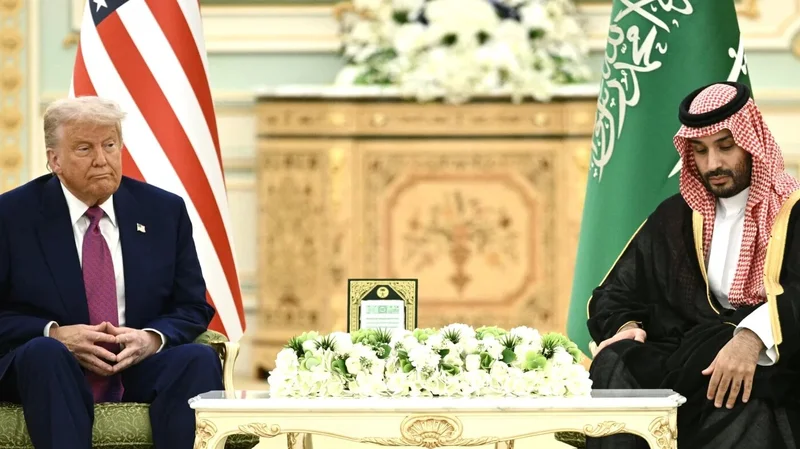
The US-Saudi nuclear deal signals a Middle East betting on deterrence
News of a US-Saudi civilian nuclear deal caused anger in Israel on Wednesday, with Israeli political leaders flocking to social media to say they feared the deal could put Saudi Arabia on the fast track to a nuclear weapon.
But a Thursday morning social media post by US President Donald Trump may have assuaged at least some Israeli anxieties.
Trump's Truth Social post stated that the nuclear deal would prohibit uranium enrichment and require Saudi Arabia to normalise relations with Israel.
Following Trump's post, the office of Israeli Prime Minister Benjamin Netanyahu celebrated the news as a victory for the Abraham Accords, the 2020 normalisation agreements brokered by Trump between Israel and several Arab states.
Whether or not Trump's characterisation of the agreement ultimately proves accurate, his post is significant because it points to some of the questions that will dictate the agreement's long-term strategic relevance.
Does the agreement permit domestic uranium enrichment? To what extent will the International Atomic Energy Agency (IAEA) be involved with monitoring?
Is Saudi normalisation with Israel part of the deal? What does the deal reveal about the Middle East's evolving strategic balance?
Normalisation doubts
The post was likely the product of Israeli pressure, but the veracity of Trump's enrichment and normalisation declarations is doubtful.
It is possible that, as the Trump post suggests, Saudi Crown Prince Mohammed bin Salman has already agreed to normalise relations with Israel as part of the agreement.
Political realities suggest that it is highly unlikely that the Saudis would agree to any deal that requires them to normalise relations with Israel
It is more likely, however, that Trump's post was an attempt to retroactively change the terms of a deal his administration had already negotiated, effectively trying to strong-arm the crown prince into accepting normalisation with Israel after the fact.
Importantly, the Saudi government has so far remained silent on Trump's post, and US officials told Middle East Eye that throughout months of nuclear negotiations, Saudi recognition of Israel was never mentioned.
Even more notably, perhaps, official announcements of the nuclear agreement made on Wednesday by the US Department of Energy and the Saudi Press Agency made no mention of normalisation with Israel.
Political realities suggest that it is highly unlikely that the Saudis would agree to any deal that requires them to normalise relations with Israel.
In September 2023, Mohammed bin Salman signalled tentative openness to the idea of normalisation, but that was before the start of Israel's genocide in Gaza and the dramatic acceleration of its illegal settlement expansion programme in the occupied West Bank.
In recent months, Saudi leaders have repeatedly condemned Israeli aggression against Palestinians and indicated that normalisation with Israel is no longer on the table.
Barring very significant progress on the Palestinian front - and in particular on the prospect of Palestinian statehood - Saudi-Israeli normalisation seems improbable, if not altogether impossible.
The crown prince has reportedly told American lawmakers that a normalisation deal with Israel would be so unpopular in Saudi Arabia that it could lead to his assassination.
If the Saudis are indeed opposed to normalisation, then Mohammed bin Salman is likely to have read Trump's Truth Social post disapprovingly. That alone could complicate the deal's completion.
The most likely outcome at this stage, however, is that the already-signed deal will proceed as negotiated and that Saudi normalisation with Israel is not, in fact, one of its conditions.
Strategic interests
In the end, Israeli objections notwithstanding, both Washington and Riyadh have compelling reasons to move forward with the nuclear deal.
For the United States, the strategic logic is straightforward. For years, first under former US President Joe Biden and now under Trump, Washington has feared that refusing to cooperate with Saudi Arabia's civilian nuclear ambitions would simply push Riyadh towards China or Russia. If the US doesn't build Saudi Arabia's nuclear programme, Beijing or Moscow almost certainly will.
By securing the agreement, Washington not only helps keep Saudi Arabia firmly within the American strategic orbit but also ensures business opportunities for American companies.
For Saudi Arabia, the agreement supports the kingdom's long-term effort to diversify its economy beyond oil while using civilian nuclear power to generate electricity and meet growing energy demand.
Importantly, however, the agreement will also put the Saudis in a better position to create a nuclear deterrent.
Mohammed bin Salman has said that Saudi Arabia would quickly pursue a nuclear weapon if Iran acquires one.
If anything, the ongoing US-Israel war against Iran may have heightened Saudi concerns about Iran's regional strength and long-term nuclear ambitions.
The Iranians may be in a stronger strategic position today than they were before the war began. Also, Tehran may have calculated that a nuclear weapon would be its best guarantee against possible future Israeli and American aggression.
At the same time, Iranian leaders appear to view themselves as negotiating from a position of greater strategic confidence than before the war.
The prospect of a Saudi nuclear deal, combined with Iran's strengthened bargaining position, could lead Tehran to demand more favourable enrichment and monitoring terms in any future nuclear negotiations with the Trump administration.
What's missing
It is in this context that what is missing from the US-Saudi agreement becomes significant.
According to reporting, the US-Saudi deal could eventually allow Saudi Arabia to pursue domestic uranium enrichment.
Moreover, and importantly, the agreement does not appear to include an IAEA monitoring requirement.
The absence of an IAEA monitoring role, combined with the possibility of future domestic uranium enrichment, would almost certainly increase concerns about nuclear proliferation - not only in Tel Aviv but also in Tehran.
It is precisely these details that could shape the substance of a future US-Iran nuclear deal.
If the US is prepared to offer Saudi Arabia greater flexibility on enrichment and monitoring, then the Iranian negotiating team is almost certain to insist on similar treatment.
This may ultimately prove to be the most consequential aspect of the entire episode.
The US-Israel war against Iran may be remembered as the principal catalyst for nuclearisation in the Middle East, with ongoing Saudi and Iranian nuclear posturing producing a domino effect in the region.
If Tehran and Riyadh ultimately acquire nuclear weapons, Egypt and Turkey - and perhaps others - would face pressure to follow suit.
Rather than discouraging proliferation, the US-Israel war against Iran, as well as Iran's aggressive military retaliation across the Gulf, may have convinced governments across the region that the only reliable protection against military aggression is a credible nuclear deterrent.
For Saudi Arabia, such a deterrent may be viewed primarily as protection against Iran. For many other regional actors, however, nuclear deterrence is likely seen as the single greatest measure of protection against Israel and its expansionist "Greater Israel" project.
Whether intentionally or not, then, Washington and Tel Aviv may have accelerated precisely the regional nuclearisation they say they are working against.
It is in this sense that the US-Saudi nuclear agreement may ultimately come to symbolise not the success of American diplomacy, but the beginning of a new strategic era in the Middle East, one in which nuclear capability is viewed as the ultimate guarantee of national survival.
The views expressed in this article belong to the author and do not necessarily reflect the editorial policy of Middle East Eye.