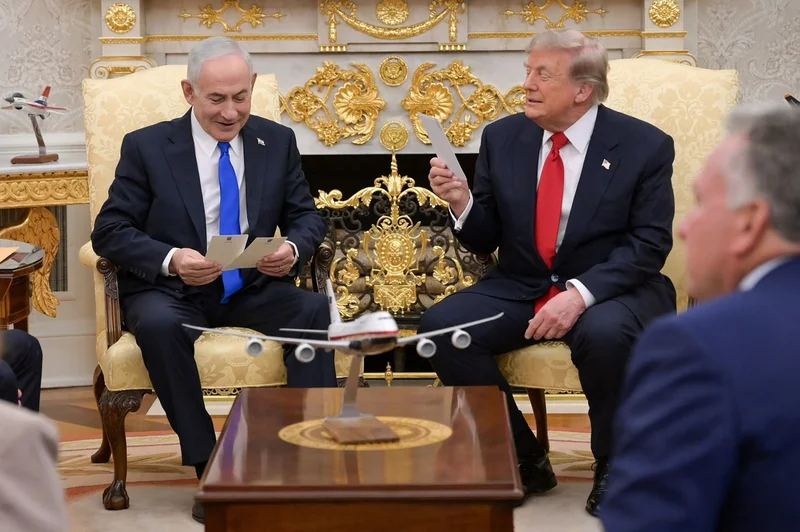
Israeli Prime Minister Benjamin Netanyahu's visit to Washington should not be viewed as just another routine diplomatic meeting between two close allies. There appears to be a striking pattern between his visits to Washington and Israel's subsequent military actions on the ground. For this reason, the meetings at the White House deserve attention not only for what they may mean for U.S.-Israeli relations, but also for their potential impact on a region stretching from Iran and Syria to Gaza and Lebanon.
Throughout his political career, Netanyahu has repeatedly demonstrated an ability to use security crises not merely as instruments of foreign policy but also as tools for strengthening his political position at home. In Israeli politics, periods of heightened external threats often reduce domestic polarization and generate greater public support for the government. Consequently, his visits to Washington should not be interpreted solely through their impact on the Middle East; they are equally important in understanding his domestic political calculations.
The 12-day war that engulfed the region last year offers one of the clearest examples of this pattern. Before the outbreak of hostilities, the Netanyahu government engaged in diplomatic consultations in Washington, arguing that Iran represented not only a threat to Israel but also a direct challenge to American interests in the Middle East. Backed by the influence of pro-Israel lobbying groups in Washington, significant pressure was placed on the U.S. administration to adopt a tougher military posture toward Tehran. Shortly afterward, the region descended into one of its most dangerous periods of military confrontation.
As the conflict unfolded, however, unexpected disagreements emerged between Washington and Tel Aviv. In particular, the U.S. administration reacted strongly after Qatar became a target. Qatar is not only home to one of America's largest military bases in the Middle East, but it also serves as a key hub for U.S. diplomacy, mediation efforts, and regional crisis management. Any action targeting Qatar therefore has implications that extend beyond Doha itself and directly affect American strategic interests.
During this period, international media widely reported that President Donald Trump summoned Netanyahu to Washington and that big differences had emerged between the two leaders. Reports also suggested that diplomatic efforts were undertaken to repair relations with Qatar and that Netanyahu was compelled to soften his position. Whether or not every detail of these reports proves accurate, the episode illustrated an important reality: despite their close alliance, the United States and Israel do not always share identical regional priorities, and Washington has at times been willing to intervene when its own strategic interests are at risk.
Nevertheless, Netanyahu's determination to keep military options on the table has never disappeared. Similar dynamics reportedly emerged before the wave of attacks that began on Feb. 28. Once again, the Israeli government launched an intensive diplomatic and political lobbying campaign in Washington. By emphasizing Iran's regional influence, its network of proxy groups, and its missile capabilities, Israeli officials sought to convince the U.S. administration that stronger military measures were necessary. Israel's security concerns were placed at the forefront of international discussions, while diplomatic solutions were increasingly portrayed as inadequate.
Today, however, the regional atmosphere appears to be evolving in a different direction. Türkiye, Qatar, Saudi Arabia, Egypt and Pakistan have all intensified diplomatic efforts aimed at preventing another major regional conflict. Recent initiatives to lower tensions across the Gulf have created renewed optimism that negotiations and dialogue could once again replace military confrontation. Although it remains too early to speak of lasting peace, there is growing hope that the current cycle of escalation can at least be contained.
It is precisely at such a moment that Netanyahu's visit to Washington becomes particularly significant. Ahead of these critical talks, recent developments have already begun to expose the widening cracks in the two leaders' relationship. U.S. President Donald Trump publicly dismissed Netanyahu’s expected pressure regarding Türkiye, bluntly stating that he does not need to ask Netanyahu's permission regarding the sale of F-35 jets to Türkiye. Meanwhile, as Netanyahu doubles down on his demands to launch fresh strikes against Iran, reports indicate that Trump has signaled deep frustration with these persistent calls, making it clear in no uncertain terms: "If I want to hit Iran, I'll hit Iran myself; I don't need you to push me into it."
This growing friction underscores a broader transformation in Washington's stance. Netanyahu is no longer viewed as a welcome or favored figure in the White House, but rather as an increasingly isolated Israeli prime minister whose political survival tactics risk entangling the U.S. in unwanted regional entanglements. Given these sharp disagreements, current indicators suggest a high probability that Netanyahu will return to Tel Aviv empty-handed, lacking the carte blanche or the explicit military backing he desperately seeks from Washington.
The Israeli prime minister faces an increasingly complicated political landscape at home. With elections expected in October, Netanyahu confronts one of the most consequential political challenges of his career. Given the uncertainties surrounding his political future, coalition dynamics and ongoing legal proceedings, securing a strong electoral victory has become not merely a political objective but a necessity.
Israel's political history over the past three decades demonstrates that periods of heightened security threats often reshape electoral dynamics. As external dangers dominate public discourse, voters tend to rally around leaders who present themselves as capable of protecting national security. Against this backdrop, arguments that Netanyahu may have a political interest in renewed regional tensions are rooted not only in political commentary but also in historical patterns within Israeli domestic politics.
His objective may extend beyond reviewing current regional developments or strengthening bilateral relations. It is entirely possible that the primary goal is to secure political backing from the Trump administration for future Israeli military initiatives. Such support would not necessarily require direct American military involvement. Even tacit approval, diplomatic protection, or strategic silence from Washington would significantly expand Israel's room for maneuver. Yet, with Washington increasingly pushing back against his unilateral demands, achieving even this diminished objective appears increasingly difficult.
Israel's security strategy in recent years suggests that it no longer views regional theaters as isolated conflicts. Iran, Syria, Lebanon, Gaza, Iraq and Yemen are increasingly treated as interconnected fronts within a broader regional security framework. Consequently, any political understanding reached in Washington could pave the way for military operations in multiple arenas, even if Washington's reluctance constrains the scope of such adventures.
For this reason, close attention should be paid not only to the official statements released after the meetings but also to changes in Israeli security rhetoric, shifts in American diplomatic messaging, and military developments on the ground in the weeks ahead. In the Middle East, wars often begin not with the launch of the first missile but with the political signals exchanged behind closed diplomatic doors.
If Netanyahu's discussions instead lay the political groundwork for another military campaign, today's fragile hopes for de-escalation could quickly give way to a new cycle of conflict. What the Middle East needs is not another battlefield but stronger political mechanisms capable of resolving existing disputes through diplomacy.
As Netanyahu continues to view regional security crises as a means of advancing his political future, decisions made in Washington and the growing rift between the two capitals will shape not only Israel's strategic trajectory but also the future of the entire Middle East. For that reason, this visit should be regarded not as an ordinary diplomatic engagement, but as one of the most consequential geopolitical moments facing the region today.