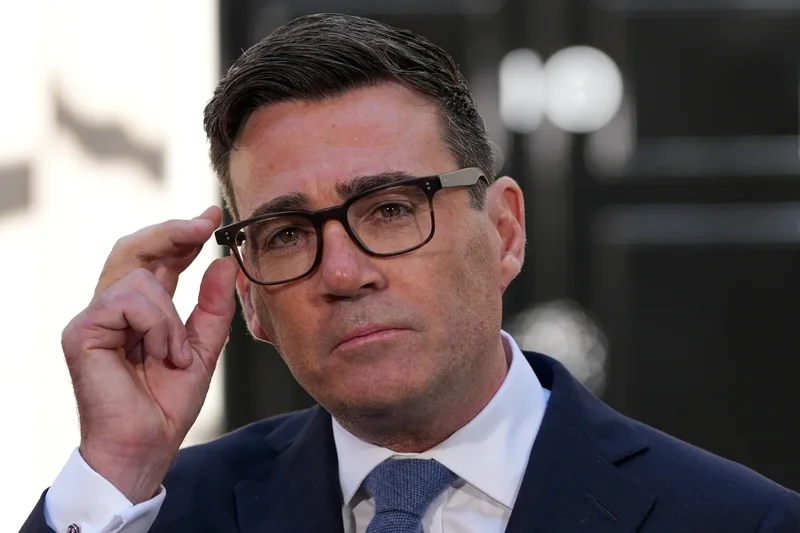
Less than a month into Andy Burnham’s premiership and Labour has already seen a major spike in popularity unlike any achieved by his predecessor.
Experts have termed it the ‘Burnham bounce’, as voters respond to his radical devolution plans, and his promise to “change politics”.
The former Manchester mayor is helped by having one of the highest levels of popularity for an incoming prime minister compared to any of his predecessors.
Before his move to Number 10, Mr Burnham regularly ranked as the UK’s most popular politician, credited for his work in the Manchester city region, especially during the Covid pandemic. And experts say that is already having an impact in his new role.
Polling guru, Sir John Curtice, told The Independent: “There is no doubt there is a Burnham bounce and it has happened quicker than most of us expected.
“Part of it is Andy Burnham himself – his policies and communication. And part of it is that Keir Starmer is no longer there.”
The new prime minister’s favourability has shot up to 19 per cent since taking power, following a dip during the Makerfield by-election that returned him to Westminster. By comparison, Sir Keir Starmer’s was at -41 per cent.
Sir John said: “The question for Andy Burnham is how long this will last and only time will tell on that.”
“Labour have definitely been given a second chance,” he added.
Could Labour win again under Burnham?
Labour under Sir Keir Starmer had struggled almost since they won the 2024 general election to contend with rising support for Reform UK, trailing behind as the Nigel Farage-led party stormed to victory making sweeping gains at two consecutive local elections.
But the two parties are now neck-and-neck, latest polling shows, at 22 per cent. Meanwhile, Kemi Badenoch’s Conservatives sit at 21 – virtually a three-way tie.
The challenge for Mr Burnham now will be maintaining or even extending this rise. The former mayor has launched his government with a flurry of policy pledges and a promises of a “new political model”. But questions remain over how he will fund any of it – a real test for his Autumn Budget.
Britons are clearly responding to the hopeful rhetoric of the new leader. But delivering on it will be the true test of how sustained the support for his government is.
Where is Andy Burnham most popular?
Perhaps surprisingly, the new prime minister records the highest favourability in London, at plus 2 per cent. In the North, the figure sits at -6.
This might seem low, but it is far higher than any other party leader. Mr Farage’s favourability in the North is -39 per cent, Zack Polanski’s, -26, and Kemi Badenoch’s, -19.
By comparison, Sir Keir’s sat at a dismal -49 at the time of his resignation.
Mr Burnham’s popularity in the capital likely reflects the higher proportion of young, left-leaning voters in the city – a demographic reflected in many major metropolitan areas.
As Labour has risen in the polls, the Green party has begun to drop, sitting at 13 per cent this month compared to a high of 21 per cent in March.
This may evidence that Mr Burnham’s stances on issues like Gaza, devolution and public control have cut through with left-leaning voters who turned away from Labour under Sir Keir.
What’s behind the ‘Burnham bounce’?
Several factors have worked in Mr Burnham’s favour to see him receive such a positive response upon taking power.
The first is the unpopularity of his predecessor, Sir Keir, who recorded an averaged -39 per cent approval rating upon leaving office.
Luke Tryl, director of pollsters More in Commons, said: “No doubt Burnham’s first week cut through and he was able to own the attention economy and look like he got it in a way Starmer struggled with that has brought some disillusioned progressives back to the fold.”
But the new prime minister was already very popular before the move to Number 10. His net approval rating in the month before coming into power was -7 per cent, compared to Sir Keir’s -20.
Mr Burnham later saw a considerable drop in popularity around the time of the Makerfield by-election, down from around 7 per cent, perhaps as some became wary of the obvious ambition on display.
But he has rebounded, with the new leader now back up to 19 per cent.
In just his first week in office, Mr Burnham announced a new cut to energy bills and a cap on bus fares, emphasising that the cost of living is a key priority for his government.
His focus clearly aligns with the concerns of the nation, as over half say that the economy is one of the most important issues facing the country, according to YouGov polling.
But the boost to Mr Burnham’s personal and party popularity will depend on making the change he has committed to in the months and years to come.