It’s an all-too familiar refrain on the nightly news, the shocked reaction to a violent crime in close proximity: “This is a quiet street, we never expected anything like this to happen here”. And it could easily be the mantra for the suburban and small-town horror stories that feature in Netflix’s true-crime series, Worst Neighbour Ever.
Australia’s most-watched show on the platform last week, and now fifth in the streamer’s top 10 shows globally with more than 3 million views since its release on July 1, the four-parter presents a selection of tales of greed and madness from the US. The big mystery about it, however, is why it’s proved so popular. A crass exploitation of tragedy that cynically plays on fear, it’s the kind of tawdry production that gives true crime a bad name.
The series focuses on a quartet of grim cases and offers interviews with those directly affected by them, as well as officials who became involved in the investigations. Two of the episodes, She Finally Snapped and Fear Thy Neighbour, involve assailants who appear – according to the testimonies on offer – to have been suffering from undiagnosed and untreated psychological ailments. Midwest Meltdown details the lead-up to a deadly explosion, and The Executor chronicles a missing-person investigation.
Irrespective of the events under examination in each episode, the approach by director and co-executive producer Cynthia Childs follows the same cookie-cutter pattern. First come the quotes culled from interviews with victims, witnesses and authorities, filled with foreboding and designed to grab attention. “We all got along, we were close-knit ... until Frances came along”; “I don’t know of anyone who would’ve thought that their neighbour would turn on them in such a depraved way”.
Then come the recordings of frantic calls to emergency help lines, followed by a history of what led to them. Often it will gradually become clear that a key figure is not among the interviewees because they didn’t survive.
We don’t need more of this unabashedly formulaic and sensationalist rubbish.
Also absent are the perpetrators and their families or friends. The series has absolutely no interest in hearing from anyone other than the victims, police and prosecutors, so viewers only get a superficial profile of these awful neighbours. There’s no indication of why they did what they did, beyond the most perfunctory, judgmental sketches. For the purposes of the series, it’s enough to cast them as a threat, The Other – the kind of danger that persistently lurks, ready to pounce on unsuspecting folk living in nice, family-friendly communities.
The settings, from a town in Kentucky to a tidy patch of Indianapolis and two suburbs in Los Angeles, suggest ordinary places where people go about everyday lives: having “cookouts”, watching their kids play in the streets, casually chatting. Then they collide with malign individuals who shatter the fragile facade.
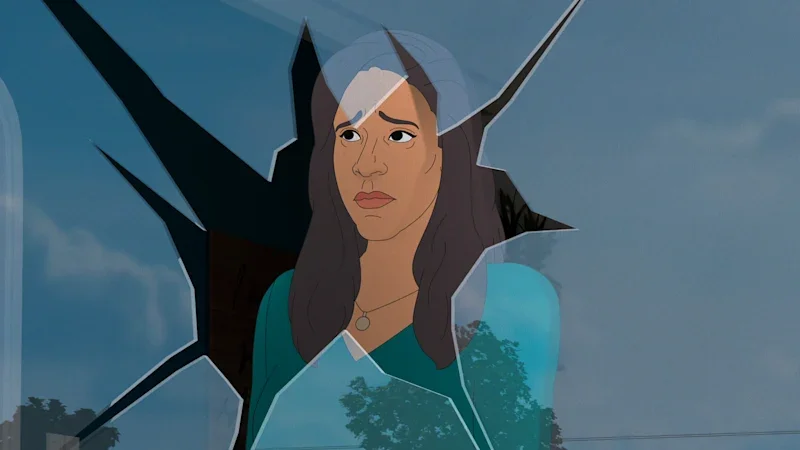
In telling these tales,Worst Neighbour also weirdly includes colourful 2D animated sequences depicting the events and interactions described by the interviewees. It’s a curious decision that appears to make light of what’s happened by turning those involved into cartoon characters, and it creates a distance from them too. Suddenly, instead of watching a crime story involving real people and lethal violence, it feels like you’re watching King of the Hill.
But it’s the narrowness of focus that really betrays the series’ limitations. And that’s where it differs noticeably from far more memorable and valuable true-crime series – many of them made earlier this century – whose intentions and interests were broader and more commendable.
Series such as The Jinx: The Life and Deaths of Robert Durst (2015), Making a Murderer (2015), I’ll Be Gone in the Dark and Jeffrey Epstein: Filthy Rich (both 2020), and films such as The Thin Blue Line (1988), Capturing the Friedmans (2003) and The Central Park Five (2012).
These works endeavour to understand how and why the crimes occurred and to investigate and illuminate the people and circumstances involved. They aren’t out to sensationalise, demonise and exploit. They tell us something about a community, a society or the world, beyond the fact that danger exists in it. They offer an insight into the nature of a place in which a crime occurred, or expose an injustice and reveal how it happened.
Yet, it seems that since the streamers discovered that true-crime constitutes a rich vein of material reliably appealing to subscribers, the area has mushroomed, and there are wildly varying degrees of accomplishment in what’s become a burgeoning section of their catalogues.
Neighbour is the latest addition to the Worst Ever franchise, which also includes Exes and Roommates. It’s produced by Blumhouse Atomic, the company created in 2024 when low-budget horror specialist Blumhouse merged with James Wan’s Atomic Monster. And given its success, perhaps we should stand by for variations on the theme focusing on, say, Cleaners, Nannies or even Pets. Then, of course, there’s the potential for contributions from other countries.
The apparent interest in this offering could easily be read as encouragement and endorsement to expand the Worst Ever footprint further. So, seriously, stop encouraging them. We don’t need more of this unabashedly formulaic and sensationalist rubbish.
The shallow intentions of those making Neighbour are evident in how it ends. After learning the gruesome truth about what went on in her supposedly quiet apartment block, perpetrated by someone that she once regarded as her friend, one resident again pushes viewers towards paranoia, remarking, “In hindsight, I realise that you never really know who your neighbours are.”
This show wants us to be afraid, be very afraid ... and Netflix wants us to stay tuned for the next ghoulish instalment.
Worst Neighbor Ever is now streaming on Netflix.
Want more TV? We’ve got you.
- Newsletter:Find out the next TV, streaming series and movies to add to your must-sees. Get The Watchlist delivered every Thursday.
- July streaming guide:All the exciting new shows to watch this month.
- Colin From Accounts:- Devil Wears Prada 2backlash.
- 120 movies to watch right now:Don’t miss our guides to all the best movies to watch on Netflix, HBO Max, Amazon Prime Video and Stan (which is owned by Nine, publisher of this masthead).
- This is the best show you have never heard of:Karl Quinn makes the case for ambitious sci-fi drama- Silo.
- New Zealand Spyreview- :This delightfully deadpan Kiwi comedy is a delicious spin on spy thrillers.
- Video:Deputy TV editor Meg Watson on the shows she recommends watching right now (below).