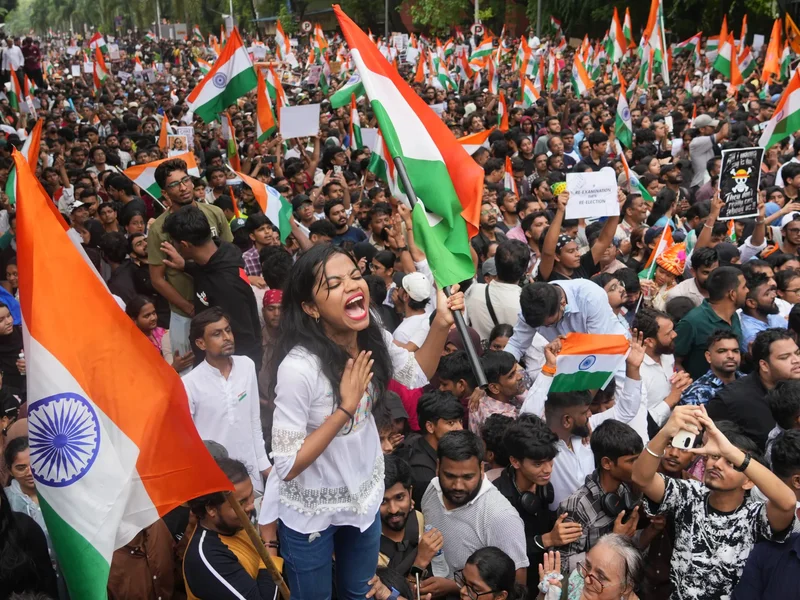
As the dust settles over New Delhi’s Jantar Mantar after weeks of some of the biggest protests against Prime Minister Narendra Modi’s 12-year rule, the government has so far responded with both a measured crackdown and an attempt to woo the youth.
In several states governed by Modi’s right-wing Bharatiya Janata Party (BJP), hundreds of young men and women – some less than 18 years old – were arrested and slapped with serious charges.
Recommended Stories
list of 4 items- list 1 of 4What next for India’s ‘Cockroach’ movement after education minister sacked
- list 2 of 4Who is India’s new education minister Pralhad Joshi?
- list 3 of 4India’s youth have broken Modi’s spell
- list 4 of 4‘Future at stake’: India moves to demolish university Muslim leader founded
India’s Supreme Court on Tuesday ordered the release of all under-18s arrested during the Cockroach Janta Party (CJP)-led protests over a series of examination paper leaks and calls for education reforms.
But even before the top court’s order, many of those arrested were released earlier this week after protest leaders and opposition politicians slammed the government’s crackdown.
Meanwhile, several students and Gen Z protesters say their social media accounts are now being targeted and cases filed against them for criticising the government.
The protests began in June at Jantar Mantar, a historic 18th‑century astronomical observatory close to the Indian Parliament, over the leak of key medical exam papers. The leak allowed some candidates advance access to questions, forcing students to retake their exams, stoking anger over years of preparation rendered meaningless and leading to several student suicides.
Here’s what we know:
What’s happening with the arrests?
The BJP governments in West Bengal and Maharashtra states on Tuesday stopped their actions against those who participated in the CJP-led protests following similar moves in Bihar, Assam and the national capital territory of Delhi.
The governments in these states said they will withdraw their cases against the protesters who demanded the resignation of Education Minister Dharmendra Pradhan, who quit on Saturday in a rare setback for Modi.
In several places including New Delhi, the protesters were attacked with batons, tear gas and even pellet guns. In Bihar’s Siwan district, a police officer was suspended on Tuesday for pointing an AK-47 at protesters and firing at least three rounds in the air.
Meanwhile, the government has been accused of using AI-powered surveillance to track and arrest the protesters.
Student activist Aishe Ghosh has asked the Delhi High Court to declare the mass surveillance of protesters unconstitutional and direct the destruction of all personal data collected during the CJP-led demonstration, the Reuters news agency reported.
Police in New Delhi also tried to arrest Ghosh on Tuesday by raiding the office of the Communist Party of India (Marxist) (CPM). But the CPM and CJP threatened more protests if she was arrested.
Why is the government targeting social media accounts?
Meanwhile, Delhi Police have filed a first information report (FIR) against allegedly abusive social media posts against Modi and have asked X to provide details of the account that published the content.
The FIR was filed over a complaint that “derogatory, malicious and defamatory content is being circulated on social media platform targeting constitutional heads”, India’s ANI news agency reported on Wednesday.
Police have asked X to delete the alleged posts and videos from the platform immediately. They have also sought the full names, addresses and other contact details of people holding those X accounts, including their login and logout details with time and date stamp, ANI reported.
During the protests, police were also seen noting Instagram handles of protesters arriving at the main protest site at Jantar Mantar.
Modi’s government has often been accused by opposition parties and digital rights advocates of expanding surveillance powers and tightly controlling online platforms.
The government has rejected the accusations, saying it only acts in the public interest.
What did the top court say?
The Supreme Court on Tuesday heard a bunch of petitions filed by the protesters and activists seeking action against police and paramilitary forces for their alleged use of excess force, including pellet guns, during the weeks-long demonstrations in New Delhi and other cities.
The court called for the preservation of all footage, including from drones, body cameras and CCTV footage, and directed the authorities to ensure protesters’ data was not made public, Reuters reported.
“Whoever has committed excess … atrocities on innocent people, the law will take care of them. For that, there needs to be a completely independent and fair investigation,” Chief Justice Surya Kant said, according to legal website Live Law.
“A probe is meaningless if no responsibility is fixed,” he said.
How have the protest leaders responded?
Hours later, CJP spokesman Saurav Das said the government has not provided any written assurance on its guarantee that all FIRs against students and protesters would be withdrawn, and no action would be taken against any protester in the future.
During his meeting with government officials, Das said they showed him the Supreme Court order, specifically Direction No 4, allowing investigations into the existing FIRs.
Das told ANI the government argued that since the Supreme Court’s directive is a written order, the matter is now “subjudice”.
In response to the Delhi Police FIRs against allegedly abusive social media posts, the CJP asked why ordinary citizens cannot question their government without fears of reprisals.
“[…] since when is an elected representative above questioning? In a functioning democracy, citizens have every right to demand answers and accountability from their PM,” it posed on X on Wednesday.
“By treating online criticism as a criminal offense and a threat to ‘public order’, the state machinery is sending a chilling message: the Prime Minister is beyond the reach of public scrutiny.”
How is the government wooing Gen Z?
Meanwhile, the government has also launched a campaign to win back Gen Z, many of whom are the children of the BJP’s core voters. People under the age of 29 (including Gen Z) account for about half of India’s population, according to Pew Research.
“The party has been posting a string of social media videos peppered with pop culture references, casual conversations and everyday settings, delivering political messaging in a format designed for India’s reel generation,” The Hindustan Times newspaper reported on Wednesday.
One of those videos is set inside a gymnasium, showing Gen Z-style banter between a group of youngsters interrupted by an older trainer, who argues that Pradhan’s resignation was “not a Jantar Mantar victory, but an example of democracy’s strength”.
He says the country now had “stronger foundations” after the government built metro networks, expressways, airports and expanded the network of state-run medical, engineering and management colleges.
The BJP has also been posting a series of X posts, using Gen Z language and aesthetics, days after Modi himself posted rare Instagram-style vertical selfie video messages to reach out to the protesters.