The total solar eclipse on Aug. 12, 2026, will attract millions of viewers across northern Spain, western Iceland and eastern Greenland, while a deep partial eclipse will be visible across much of Europe, and a smaller partial eclipse will reach parts of northeastern North America.
If you're planning to watch, one question matters more than almost any other: how are you going to observe it safely?
The answer depends on where you are, your budget and what kind of experience you're after. Some people want to simply look up and enjoy the spectacle. Others want to study sunspots, photograph the eclipse or capture loved ones gazing at the eclipsed sun. Many away from the path will stay at home and livestream it. There is no correct way to watch a solar eclipse, but it's important to stay safe. Here are eight ways to safely view the Aug. 12, 2026, solar eclipse.
1. Eclipse glasses for viewing from land
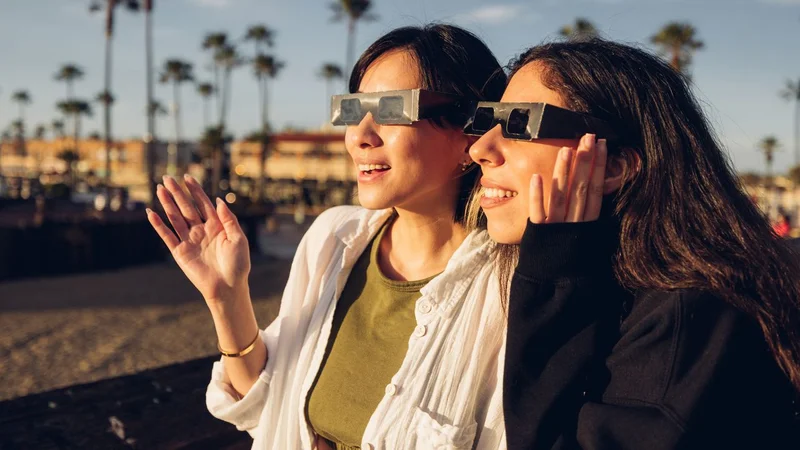
If you're planning to watch any part of the eclipse with your own eyes, eclipse glasses should be your first purchase. Certified eclipse glasses that comply with the ISO 12312-2 standard block more than 99.999% of sunlight, making it safe to look directly at the sun during the partial phases.
Without them, even a brief glance at the uneclipsed or partially eclipsed sun can cause permanent eye damage. Through them, the sun appears as either a bright orange or a whitish disk against a black background. As the moon gradually moves across it, the changing crescent shape becomes immediately obvious. During the final minutes before totality, the solar crescent shrinks to an impossibly thin sliver.
For observers in Britain, Europe and North America outside the path of totality, eclipse glasses are arguably all you need. The entire eclipse remains partial, so the glasses stay on from beginning to end. Even if you're traveling to Iceland, Greenland or Spain for totality, eclipse glasses remain essential throughout the partial phases before and after totality, when the sun is still dangerously bright.
However, you should buy them early. Before every major eclipse, supplies tighten and some retailers sell out entirely. For reputable sellers, check out the American Astronomical Society's list of safe products. Recommended manufacturers include American Paper Optics, Rainbow Symphony and Thousand Oaks in the U.S. and Baader in Europe.
Get the world’s most fascinating discoveries delivered straight to your inbox.
2. Handheld solar viewers for cruise ships
Many eclipse chasers prefer handheld solar viewers to eclipse glasses. These use the same safe solar-filter material and are made by the same manufacturers, but provide a larger viewing window. They typically hang around your neck on a lanyard, which makes them essential if you want to observe an eclipse from a cruise ship — it stops them from blowing into the sea. The actual view is almost identical to what you'll see through eclipse glasses.
3. Totality with the naked eye
If you're fortunate enough to observe from within the path of totality, there is one viewing method that rules all others during totality only — the naked eye. Although you must never look at the sun without eclipse glasses during the partial phases, during totality it's not only perfectly safe, but also the only sane thing to do.
During totality, you MUST take your eclipse glasses off to see the solar corona — one of nature's most extraordinary sights. The naked eye will also help you find bright planets around the eclipsed sun and the horizon glowing with twilight colors in every direction. If this is your first total solar eclipse, make a promise to yourself beforehand: spend at least some of totality doing nothing except looking up.
4. Solar binoculars
If observing the eclipsed sun through eclipse glasses and solar viewers leaves you unimpressed, you can upgrade your experience by opting for dedicated solar binoculars, which have permanently attached solar filters. They offer a significant jump in detail over eclipse glasses without introducing the complexity of a telescope. Sunspots become obvious, and you can more easily see them get covered by the advancing edge of the moon.
All kinds of magnifications are offered, but 10x42 is about the limit. Any more and they not only become hard to hold steady, but the eclipse then gets more difficult to find in the sky.
Since you can't use them during totality, solar binoculars are best seen as a good upgrade for observers outside the path of totality.
5. Regular binoculars
Normal binoculars are arguably a better choice if you plan to be within the path of totality. This is what experienced eclipse watchers do, and with good reason — they simply add solar filters for the partial phases, then remove them during totality for a close-up of the solar corona.
For the partial phases, solar filters must completely cover the front objective lenses. Never place filters over the eyepieces and never rely on improvised materials such as sunglasses, smoked glass or photographic filters — you must use dedicated solar eclipse filters.
However, since objective lenses come in all shapes and sizes, it's often easier to make your own solar filters using Baader AstroSolar Film. Typically, users will make a solar filter for one lens and cap the other, removing both during totality.
Image-stabilized binoculars deserve special mention. Models from Canon and other manufacturers can provide remarkably steady views of the eclipse without requiring a tripod, making them particularly attractive for travel.
6. Telescopes
The same applies to telescopes as applies to binoculars — you can buy a solar telescope with a permanently attached solar filter, or (a more popular method) put a solar filter on any telescope. However, there is another unusual option here — a dedicated hydrogen-alpha solar telescope, which reveals an entirely different side of the sun.
Rather than showing the photosphere, they isolate light emitted by hydrogen atoms in the chromosphere and show prominences arching above the solar limb as well as dark filaments across the disk. The downside is that hydrogen-alpha instruments are among the most specialized and expensive telescopes in amateur astronomy.
7. Smart telescopes
Few areas of amateur astronomy have changed as rapidly as smart telescopes. Devices such as the Unistellar Odyssey Pro, ZWO Seestar S30, DwarfLab Dwarf Mini and Celestron Origin have introduced a new generation of observers to astronomy by automating much of the traditional setup and operation.
For eclipse observing, the appeal is obvious. Once fitted with a solar filter, these systems can automatically track the sun, display images on a smartphone or tablet and save photographs with minimal fuss.
For eclipse travelers heading to Iceland, Greenland or Spain, smart telescopes can also reduce some of the stress associated with eclipse photography. Many users plan to have the telescope automatically capture the eclipse during the partial phases, then simply enjoy totality with their own eyes. Just don't spend the entire eclipse staring at a smartphone!
8. Livestreams
What if you can't travel? Or if it's cloudy? The Aug. 12, 2026, eclipse will be streamed by observatories, astronomy organizations and media outlets around the world. A livestream can never replace standing beneath the moon's shadow, but it guarantees you'll see totality even if clouds intervene.
Confirmed live streams so far include the total solar eclipse by TimeAndDate and the European Space Agency, while partial solar eclipse images will come from the Royal Observatory in Greenwich, London, U.K. When cell signal allows, some eclipse observers keep a livestream running on a nearby phone while observing the real eclipse overhead, and/or livestream views from their own telescope on social media.
What's the best way to look at the eclipse?
The best viewing method for a solar eclipse depends entirely on what you want to get from it. Just remember that the purpose of the technology is to support the experience, not replace it — no instrument can replace the experience of seeing the solar corona with your own eyes if you're within the path of totality. Choose the viewing method that helps you do that — and spend as much time as possible simply looking up.
Jamie Carter is a Cardiff, U.K.-based freelance science journalist and a regular contributor to Live Science. He is the author of A Stargazing Program For Beginners and co-author of The Eclipse Effect, and leads international stargazing and eclipse-chasing tours. His work appears regularly in Space.com, Forbes, New Scientist, BBC Sky at Night, Sky & Telescope, and other major science and astronomy publications. He is also the editor of WhenIsTheNextEclipse.com.