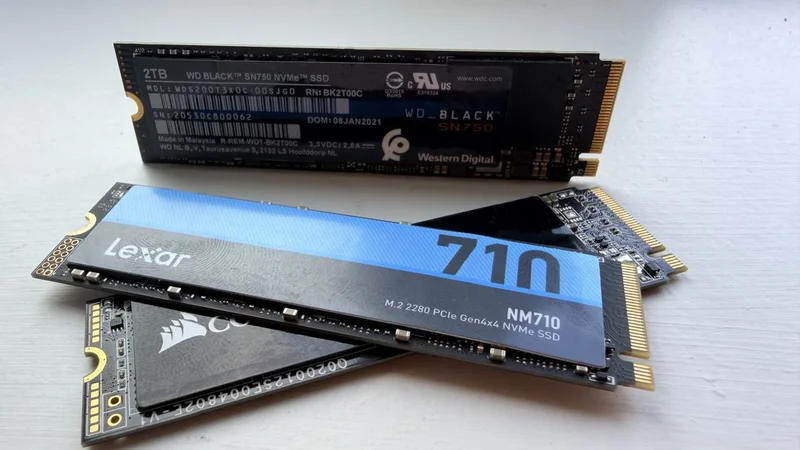
Following our brief tour around the state of RAM pricing in 2026, it seemed only fair to extend our ‘State of the Union’ look at PC component pricing to another market that has taken an absolute beating in the AI crunch: SSDs.
It’s a sadly familiar tale. Like RAM, SSDs were once an afterthought when it came to PC building — you always knew you could find a ton of capacity, decent speeds, and a reputable brand at a reasonable price. Like RAM, SSD shortages have driven absolutely insane price rises across the board, and like RAM, the death of Micron’s Crucial has seen a major player leave the scene.
As you can imagine, the SSD market is decidedly more complex and fragmented than the RAM market, for obvious reasons. Whereas your principal choice of RAM boils down to DDR4 vs DDR5, and then capacity, there are a plethora of SSD solutions for PC. There are M.2 drives for performance, or larger SATA SSDs for volume or even external storage. The former also sees vast performance differences between Gen 5 and Gen 4 options, adding another dimension.
Sadly, prices on SSDs generally have skyrocketed. This uncomplicates the picture slightly. But just how badly have SSD prices changed in the last year, and can you buy an affordable SSD these days?
12 months on
We’re fortunate to be carrying out this look 12 months removed from the 2025 Amazon Prime Day event, which means we have a plethora of pricing and sales data from exactly a year ago that we can use to pinpoint just how badly the SSD market has tanked. As we did with RAM, we’ll start with our fabled 2025 Amazon Prime Day build, in which we recommended users kit out our 1440p, 7800X3D gaming rig with a Samsung 990 EVO Plus 2TB SSD. The deal at the time was a hefty discount, bringing the price to $113, down from $176. That same drive is on sale right now, discounted by 36%, to an eye-watering $363, triple the price. The list price of that drive is $579.99, and the highest actual price we’ve seen on it is $465 in May this year, more than four times what it cost a year ago.
Famously, buying a 4TB SSD could net you M.2 storage for your PC for as little as $0.05 per GB just over a year ago, with devices like the WD Blue SN5000 and Silicon Power UD90 costing just $214 and $209, respectively. The SN5000 has doubled in price to $449.99, with the cost per GB at 11.2 cents.
|
|
|
|
|
| Samsung 990 Evo Plus 2TB | $113 | $363.49 | +221.5% |
SATA: No less painful
You’d be forgiven for thinking that toning down your storage for a less potent SATA III drive would be a great way to save some money over an M.2 drive, but you’d be wrong. Case in point is a drive we've been watching on Amazon for some time, the Samsung 870 Evo. This 2 TB drive was once just $80, and no more than $150 a year ago. Now, Amazon is selling it discounted by 62% at a cost of $399, with a list price of an eye-watering $1,039. That’s not a typo; that’s a 2021 hard drive with 2TB of storage now listed at a price of over $1,000. Of course, much like RAM, these numbers and prices aren’t really real, which makes it absolutely impossible to try and pin down the reasonable price of SSD storage in 2026.
Get Tom's Hardware's best news and in-depth reviews, straight to your inbox.
|
|
|
|
|
| Samsung 870 Evo 2TB | ~$150 | $399 | ~+160% |
A crucial factor
Micron announced in December that it was shuttering its consumer outfit Crucial in favor of enterprise. With so many SSD vendors and solutions, it’s arguable that Crucial’s absence in the SSD sector will be a little less keenly felt than it will in the RAM industry — after all, Micron is one of only three memory makers in the industry. Still, Crucial’s T-series and P-series drives are capable and performant offerings that will be missed once they disappear from the market completely. Of course, any reduction in competition is going to have an impact on pricing, but Crucial’s loss certainly seems like it will be more felt when it comes to RAM, rather than SSDs.
If you actually need to buy SSD storage
If we discount Gen 3 drives, which you shouldn’t be settling for in 2026, the cheapest you can grab an M.2 SSD these days is 11 cents per GB; specifically, this Silicon Power UD90 is one of the best value drives right now, at $439. SP’s UD90 is also one of the cheapest 1TB options on the market at around $150, and its 2TB option is $244. Of course, the larger the drive, generally, the less you’ll pay per GB when it comes to storage. Simply put, these are the baseline prices for 1TB, 2TB, and 4TB SSDs, respectively, in 2026.
If you want a snappier Gen 5 option, Crucial’s 1TB P510 is $180 dollars right now, while the 2TB version is $340.The popular Samsung 9100 Pro’s 1TB, 2TB, and 4TB drives will set you back $250, $400, and $900, respectively, a truly tragic state of affairs.
Pre-build your way out of the crisis
As with RAM, a pre-built PC is one of the best ways to secure a decent amount of SSD storage. However, unlike RAM, the vendors can more easily obfuscate SSD performance. I’ve been covering PC sales and deals for months since the crisis hit, and it’s clear that vendors find it much easier to hide poor SSD storage inside a pre-built than RAM. The reasons are obvious: it’s very difficult to sugarcoat a PC having 16GB of DDR5 RAM, as opposed to 32GB; however, you can quite easily bury a slower Gen 4 SSD or a less spacious drive inside a pre-built spec sheet.
Generally, I’d recommend pushing towards a build with 32GB of RAM, even if it means compromising on storage. You can always add more SSD space down the line, and while you’d obviously rather have a blistering Gen 5 drive with those 14,000MB/s speeds, Gen 4 will do you just fine for gaming, and likely will for years to come.
Stephen is Tom's Hardware's News Editor with almost a decade of industry experience covering technology, having worked at TechRadar, iMore, and even Apple over the years. He has covered the world of consumer tech from nearly every angle, including supply chain rumors, patents, and litigation, and more. When he's not at work, he loves reading about history and playing video games.