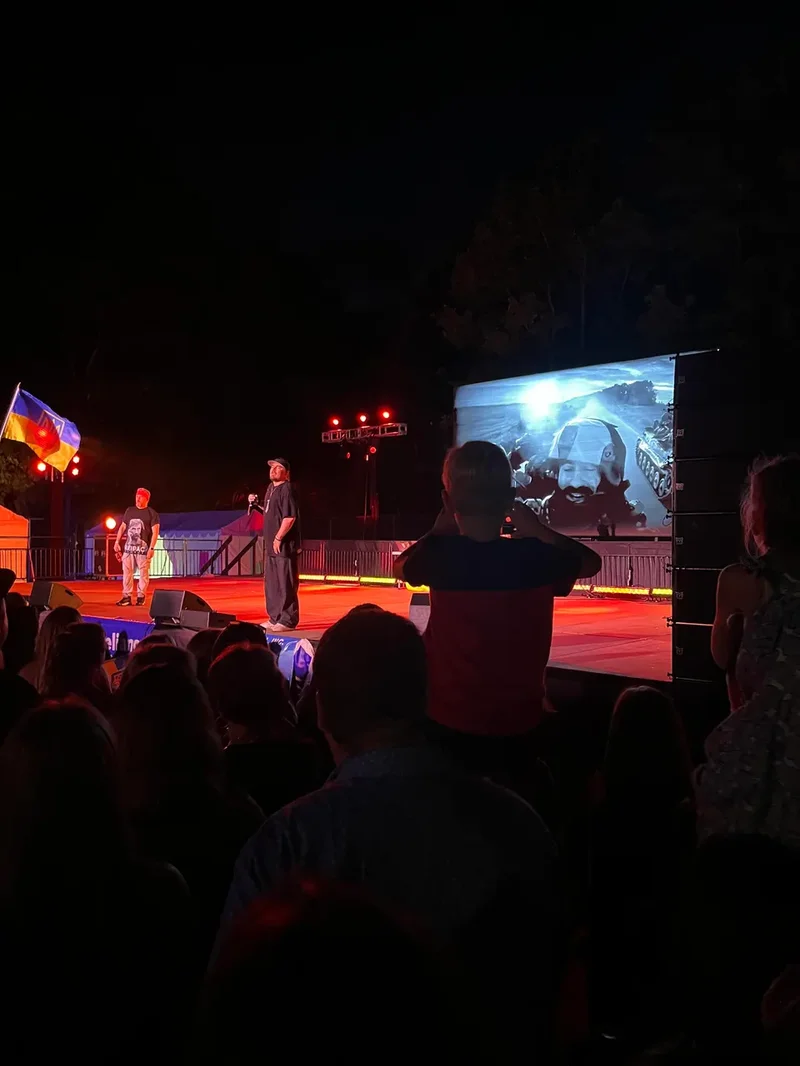
Ukrainian hip-hop band TNMK came to New York this month with music, witty lyrics, and a reminder for Americans: Don't forget Ukraine.
The United States, they said, should remember the security assurances it made when Ukraine gave up the world's third-largest nuclear arsenal in 1994 after the collapse of the Soviet Union.
The message came during concerts in New York City and at Soyuzivka Ukrainian Heritage Center in the Catskill Mountains.
Many New Yorkers know the region's historic Borscht Belt, a network of Jewish resorts that flourished during the 20th century. Far fewer know about what some Ukrainian Americans call "Little Ukraine" — a handful of resorts, children's camps and cultural centers founded by immigrants who fled World War II, Soviet occupation and postwar displacement in Europe.
The forests, waterfalls and rolling mountains reminded them of Ukraine's Carpathian Mountains. They built places where they could preserve their language, traditions and identity while creating new lives in America.
Today, every summer, Ukrainian festivals, concerts and youth camps draw visitors from across the United States to the Catskills. Contemporary musicians perform alongside folk ensembles. Children learn traditional dance, songs and crafts while also meeting artists helping shape modern Ukrainian culture.
The best-known of those places is Soyuzivka Ukrainian Heritage Center in Kerhonkson, founded nearly 75 years ago by the Ukrainian National Association. It is not the only one. Nearby are Oselya CYM in Ellenville, Saint John the Baptist Ukrainian Catholic Church and Parish Center in Jewett, NY, and dozens of private homes displaying blue-and-yellow Ukrainian flags along winding mountain roads.
For decades, these places helped preserve a culture separated from its homeland by the Iron Curtain. Since Russia's full-scale invasion of Ukraine in 2022, they have taken on a renewed role.
Thousands of Ukrainians who arrived in the United States after fleeing the war expected to be away from home only briefly. More than four years later, many are still here. For them, places like Soyuzivka have become gathering places where newcomers can maintain ties with the established Ukrainian diaspora and support the country they were forced to leave behind.
It was there, before TNMK's July 17 concert, that I sat down with founding members Oleh Mykhailyuta, known as Fahot, and Oleksandr Sydorenko, known as Fozzy.
When I introduced myself and mentioned I was also from Kharkiv, their hometown, they immediately asked the question every Kharkiv native eventually asks another: "So, what neighborhood are you from?"
Kharkiv, Ukraine's second-largest city, is known for its universities, research institutes and historic city center. With a prewar population of about 2 million, it is also a city of neighborhoods with distinct identities. Within seconds, we established that none of us came from the historic city center. I grew up in Novoselivka. Sydorenko is from Novi Doma. Mykhailyuta is from Saltivka.
Saltivka, especially its northern part, is no longer just a residential district of identical gray apartment blocks that once housed nearly half a million people. Since 2022, it has become one of the symbols of Ukraine's resistance after enduring relentless Russian shelling during the first year of the full-scale invasion.
I first saw TNMK perform in Kharkiv in 1996 during a regional qualifying round of the Chervona Ruta Festival, Ukraine's landmark contemporary youth music festival that helped launch many of the country's best-known artists.
The following year, after winning the 1997 Chervona Ruta Festival with "Zroby Meni Hip-Hop," TNMK embarked on a career that would make it one of Ukraine's defining hip-hop groups.
Three decades later, the group remains one of Ukraine’s most influential bands. Their music blends hip-hop with rock, funk and jazz, backed by live instruments and lyrics that shift between humor, social commentary and philosophy.
Since Russia's full-scale invasion, concerts have taken on another purpose. The band has toured internationally to raise money for Ukraine's military needs. According to Roman Panychevnyy, founder of MoLoKo Entertainment, which organizes tours by Ukrainian artists in North America, TNMK has raised more than $250,000 during three U.S. tours.
Not all TNMK members were able to travel this time. Three members of the band are currently serving in Ukraine's armed forces, leaving Mykhailyuta and Sydorenko to perform with a DJ.
"This is just the hip-hop version," Mykhailyuta said with a grin. “One DJ, two MCs. The economy version.” The stripped-down tour comes as TNMK marks its 30th anniversary. Later this year, the band plans to tour with a symphonic orchestra program.
Much of what the band does is connected to Russia's full-scale war on Ukraine, now in its fifth year.
"Every day something changes in Ukraine," Mykhailyuta said. "Everywhere in Ukraine is dangerous. You live every day as if it could be your last. It changes the way you think about tomorrow. It becomes philosophy, because tomorrow may never come."
After more than four years of full-scale war, international attention has inevitably shifted elsewhere.
"The media decides what people pay attention to," Mykhailyuta said. "If people stop talking about Ukraine, the world will forget Ukraine. We have to keep reminding people that we're still here, that we're still surviving."
"The United States persuaded us to give up our nuclear weapons," he said. "I'd like every American to remember that."
In 1994, under the Budapest Memorandum, Ukraine surrendered what was then the world’s third-largest nuclear arsenal. In return, the United States, the United Kingdom and Russia pledged to respect Ukraine’s independence, sovereignty and existing borders. "So where are those guarantors now?" Mykhailyuta asked.
The conversation turned to air defense, one of Ukraine's most urgent needs as Russia continues missile and drone attacks on cities across the country. Asked about the possibility of Ukraine eventually producing Patriot interceptor missiles under license, Mykhailyuta said it would still take at least three or four years.
"If we're given a license, it still takes time," he said. "Think about how many people will die in those three years."
With three band members serving in Ukraine's armed forces and the group continuing to raise money for the military, TNMK also continues to write and record new music. The group's latest release, "Bida za Bidov," was the final song produced by Oleksii Saranchin, who died after suffering a stroke.
"We don't stop," Mykhailyuta said. "There is a Tom Waits quote that I love so much that people in Ukraine probably think it's mine. 'You have to keep busy. After all, no dog's ever pissed on a moving car.'"
Sydorenko also raises money by selling his books. Known to readers by his stage name, Fozzy, he has published more than 10 books of fiction, short stories and essays, including a popular series of children's books about the adventures of Vasyl Hupalo, a Ukrainian superhero.
Like millions of Ukrainians, his family fled after Russia's full-scale invasion. Despite the uncertainty surrounding the war, they are now preparing to return home. For both musicians, Ukraine's future depends not only on those who remained in Ukraine but also on those forced to leave.
"We want Ukrainians everywhere, whether they're in America, Europe or somewhere else, to keep thinking about home," Sydorenko said. "Some people want to return but can't. We understand that."
"But wherever Ukrainians live, we want them to support what's happening back home. Without the diaspora, without everyone who had to leave, it would be much harder for Ukraine. We know that our strength is in our unity."
"The most important thing," he added, "is not to forget. Don't forget what gave us life and what raised us."
"Sooner or later," Mykhailyuta said, "you're going to give us the Tomahawks anyway. Let's make it sooner."
"Yes," Sydorenko added. "Sooner is better than later. It's in your own interest. A strong Ukraine is in the interests of both Europe and America."
"If people don't understand that yet," Mykhailyuta said, "they should think about it a little more carefully."