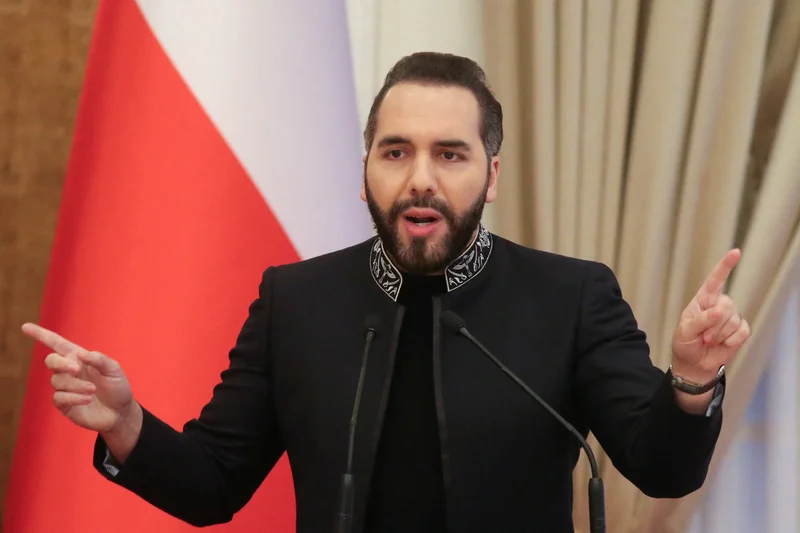
Nayib Bukele had a categorical stance on the rules of democratic play in El Salvador: “A person can be president 80 times, if they want, but not consecutively. That is to guarantee they do not use their power to stay in power,” he stated in 2013, when he governed the modest municipality of Nuevo Cuscatlán. Thirteen years later, that warning became prophecy: Bukele has just formalized his candidacy for a third consecutive term.
The paradox is not the result of a sudden ideological shift or an unexpected plot twist. The search for indefinite permanence in power is the outcome of a strategy developed from the Presidential House from the very day Bukele took office. Between the declarations of the popular, up-and-coming young Bukele and the consolidation of a hegemonic leader there is a systematic path: once in power, he used that power to decapitate the high courts, amend the Constitution outside due process, and co-opt oversight bodies. A patient, calculated route toward the absolute concentration of power in a single man: himself.
In just seven years Bukele has managed to establish as his model what took other regional leaders such as Daniel Ortega in Nicaragua or Hugo Chávez in Venezuela a much longer period: he turned the Legislative Assembly into a rubber stamp, reduced the political opposition to a minimum and carried out a coup against the Supreme Court of Justice by replacing magistrates with handpicked allies who then interpreted the Constitution so that where it once said immediate re-election was prohibited, it would now be understood as permitted.
He ran for re-election. Then, over the course of the past year, he completed his chess game with three final moves: he amended the Constitution to allow indefinite re-election, co-opted the Supreme Electoral Tribunal, and registered once again as a candidate.
Alongside institutional control, Bukele has pushed critical voices into exile and jailed others. Party opposition is almost nonexistent and, seven months before the elections to be held in February, no figure has yet emerged who could confront him. Bukele has paved the way to secure 14 years in power, more than the last of El Salvador’s dictators, General Maximiliano Hernández Martínez, who governed for 13 years, from 1931 to 1944.
Total control
The first turning point in Bukele’s democratic rhetoric came in 2021, when his party, Nuevas Ideas, won an absolute majority in the Legislative Assembly. For the first time since the signing of the Peace Accords, a president had enough power to pass laws and constitutional reforms without negotiating with the opposition.
On May 1, 2021, just after the new Assembly was seated, the ruling-party deputies removed — without following the prior process — the five magistrates of the Constitutional Chamber and the attorney general and replaced them with men aligned with Bukele. Four months later, the new Chamber issued a ruling that changed the country’s political course: it reinterpreted one of five constitutional articles that for decades had explicitly prohibited immediate presidential re-election and concluded that, from now on, a leader could compete for a second consecutive term.
After formalizing his candidacy, Bukele defended himself in a post on X: “Practically all countries have modified their constitutions. In many cases, those changes occurred through wars, coups or violent processes; not through a civic celebration at the polls, as we Salvadorans did.” He added that countries such as Canada, the United Kingdom, or Germany have re-election through a parliamentary democracy. “It is interesting that they present that system as superior,” he wrote.
Muchos argumentan que la mayoría de los países que permiten la reelección indefinida de su jefe de Gobierno son “democracias parlamentarias”, y resulta interesante que presenten ese sistema como superior.
— Nayib Bukele (@nayibbukele) July 14, 2026
El simple hecho de agregarle la palabra “democracia” como adjetivo no lo… https://t.co/WQGlremrYa
“In a presidential system (like El Salvador’s), the Legislature cannot force the Executive to bring forward elections so the term lasts less than it should, nor can it extend the office beyond what the Constitution allows,” explains Rodolfo González, constitutional lawyer and former magistrate of the Constitutional Chamber of El Salvador’s Supreme Court of Justice. “If the Constitution allows re-election as in the case of the United States, instead of being in office only four years you can be [there for] eight, but if the Constitution says there is no re-election, the president serves what the Constitution states and then must leave,” he clarifies.
With the judicial resolution issued by the new magistrates, Bukele ran in the 2024 elections and obtained a second term in a landslide. At the time, international bodies rejected the device. Bukele, for his part, said that would be his last term. He explained the decision had been discussed with his wife, Gabriela Rodríguez de Bukele, and that after that term he planned to devote himself to his family. But that promise also came to nothing.
Amending the Constitution
Once re-elected, Bukele continued with his strategy to remain in power indefinitely. The reinterpretation offered by his justices held that anyone who had served as president two terms prior to the upcoming one was ineligible to run for president; therefore, on this occasion, it was necessary to amend the Constitution. However, the Constitution itself prohibited amending the articles pertaining to the rotation of power. In fact, the text stated that to amend any article of the Constitution, a first legislature had to approve the amendment and the next one then had to ratify it.
Jonathan Sisco, head of the Anti-Corruption Unit at Cristosal, a human rights organization targeted by Bukele, explains that “in El Salvador the system of government is a classic example of hyper-presidentialism; it is characterized by the president exercising control over the other branches of the state. Even when a formal separation of powers exists, in practice it does not function.”
The ruling bloc approved on April 30, 2024 — overlooking all jurisprudence — an expedited mechanism to reform the Constitution. These deputies removed the safeguard of two separate legislatures in place since 1983 and decreed that to amend the Basic Law it would only be necessary for them to agree.
But no one buys a weapon if not to use it. On the night of July 31, 2025, the Bukele-controlled Assembly approved — again without much discussion — a series of reforms to allow indefinite re-election and also extended the presidential term from five to six years. Soon after, Bukele publicly reaffirmed his intention to remain in power. “I wouldn’t like to leave right now… if it were up to me, I’d stay 10 more years,” he said in an interview with Spanish content creator David Cánovas Martínez.
“Bukele exercises concentrated power; he is head of government and at the same time head of state, commander-in-chief of the Armed Forces and responsible for state intelligence. He has also reformed the electoral system to favor his party and has perpetuated himself in power illegitimately; the Constitution has been amended while violating the formal amendment process,” Sisco added.
Bukele’s final move had to do with timing. After defending indefinite re-election, the president argued that his decision had more to do with saving the state money than with a desire to perpetuate himself. He said extending the term to six years would synchronize general elections with midterm elections, held every three years, avoiding constant campaigning as occurred when elections were every three and five years.
Polls continue to show approval levels above 80% and a majority in favor of him remaining in power. However, a study by the Jesuit Central American University (UCA) shows a rise in citizens’ fear of expressing criticism of the government: six out of 10 Salvadorans are afraid of criticizing Bukele and believe doing so can have negative consequences.
Since March 2022, El Salvador has been under a state of emergency that suspended constitutional guarantees and empowered police and soldiers to be “judges on the street,” in the words of former police director Mauricio Arriaza Chicas (who died in August 2024). The measure, initially approved for 30 days to confront a spike in homicides caused by gangs, has become the norm for more than four years; that is, over half the time Bukele has been in office. The government argues that policy helped dismantle the gangs, while also saying it must continue “until the last gang member is captured.”
“Politicians should be judged by deeds and not by their promises. Recent history on the continent has several cases of leaders who promised not to seek re-election and, in the end, did; some even remained in power until their death,” warns analyst Sisco. Today, with his candidacy for a third term formalized, that 2013 statement Bukele made about the importance of preventing a president from staying in power has become one more of the contradictions that have marked his administration. “In the end, each people chooses its own path,” he concluded on X.