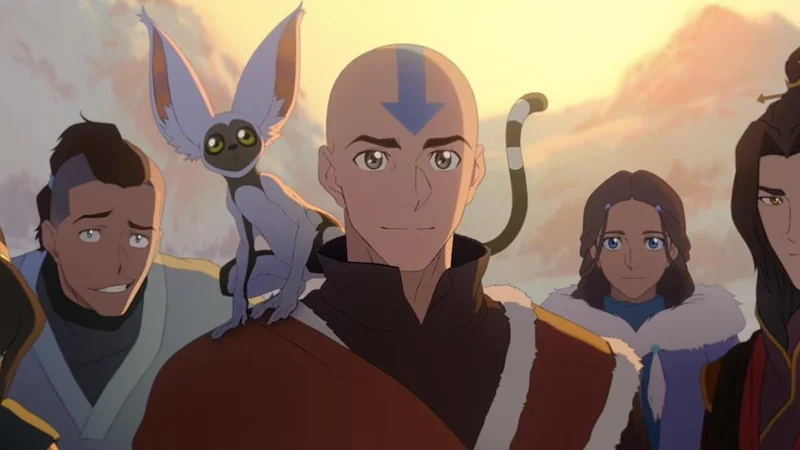
Through some combination of good fortune and a few persistent friends who refused to take no for an answer, I finally watched Avatar: The Last Airbender earlier this year. Even though my childhood had its Nickelodeon staples in SpongeBob SquarePants, Rugrats, Hey Arnold! and plenty of others, Aang and his adventures somehow slipped through the cracks (an anomaly that continues to bewilder almost everyone I know). Watching it almost twenty years after its premiere meant missing the nostalgia that has become inseparable from the show’s reputation. I don’t particularly mourn that. Without childhood memory smoothing over the rough edges, Avatar had to survive entirely on its own ideas, and I’m glad it came to me when it did, because few children’s shows have ever smuggled such a sophisticated understanding of empire and rebellion into an adventure this joyful.
Nearly twenty years after Avatar: The Last Airbender finished its original run, Avatar Aang: The Last Airbender is the first feature produced under Paramount’s Avatar Studios banner, although calling it a film almost obscures what it actually is. Hollywood has spent the better part of fifteen years treating Avatar as a fantasy property waiting to be scaled up, first through M. Night Shyamalan’s disastrous live-action adaptation and later through Netflix’s considerably more faithful, yet just as egregious live-action remake. Both approached the series as a world requiring translation, but here, Lauren Montgomery’s spinoff sequel approaches it as a relationship requiring continuation. That distinction explains why Avatar Aang succeeds whenever it allows these beloved characters to simply exist together again, and why it struggles whenever the demands of feature filmmaking insist on compressing a season’s worth of emotional and political development into ninety-nine minutes.
Avatar Aang: The Last Airbender (English)
Director:Lauren Montgomery
Cast:Eric Nam, Dave Bautista, Jessica Matten, Román Zaragoza, Dionne Quan, Taika Waititi, Geraldine Viswanathan, Ronny Chieng, Ken Jeong, Dee Bradley Baker, Steven Yeun, Freida Pinto, and Ke Huy Quan
Runtime:99 minutes
Storyline:Avatar Aang and his allies discover Tagah, a surviving airbender, and join him in searching for an airbending staff to bring back the Air Nomads
Set several years after Fire Lord Ozai’s defeat, and before The Legend of Korra, the film follows an adult Aang, now voiced by Eric Nam, who has begun constructing Republic City as a shared political project where citizens from the Water Tribes, Earth Kingdom, Fire Nation and Air Nomads might coexist after a century of imperial conquest. That project acquires ideological cracks through the arrival of The Denied — a militant movement composed of non-benders who reject a society where bending abilities continue to determine political influence and social status. Their search for an ancient staff capable of granting bending powers intersects with Aang’s own desperate hope that the relic might restore the extinct Air Nomad civilisation after the genocide committed by the Fire Nation. Dave Bautista’s new character Tagah, another Air Nomad preserved in ice across centuries, transforms that search into something considerably messier because he represents an impossible temptation. Aang suddenly discovers somebody who remembers the world he lost, which means every political responsibility he has accumulated since childhood collides with grief he has never actually processed.
The search for the staff reunites the ‘Gaang’, although adulthood has naturally scattered them into different corners of the post-war world. Katara remains Aang’s closest companion, balancing his idealism with the emotional clarity that repeatedly held Team Avatar together as children. Zuko has inherited the Fire Nation throne and now shoulders the considerably less cinematic task of governing the former imperial power whose century-long campaign of conquest devastated the world. Toph, the blind earthbending prodigy who permanently revolutionised her discipline by inventing metalbending, has lost none of the abrasive confidence that made her the group’s cheeky agent of chaos, while Sokka continues proving that strategic instinct and reckless enthusiasm can somehow coexist, despite possessing no bending abilities whatsoever. The film’s best moments are watching these relationships resume almost exactly where they left off, allowing years of shared history to surface through familiar banter and the kind of unspoken shorthand that only survives between people who have already lived through the impossible together.
The surrounding material unfortunately proves considerably shakier. The Denied’s resentment in particular rests on a perfectly credible premise, but they come fully radicalised before we witness the conditions that radicalised them. Republic City has been built around the coexistence of the four bending nations, while bending itself continues to shape policing and public authority. Yet the film spends little time examining whether that ambitious political experiment has produced new forms of exclusion for those born without bending, and the screenplay rarely excavates how ordinary non-benders actually experience those inequalities in everyday life, leaving their grievances frustratingly theoretical.
The compressed runtime continually exposes itself elsewhere. At ninety-nine minutes, the film attempts to contain material that feels engineered for an entire television season, leaving Katara, Zuko, Toph, and Sokka functioning primarily as repositories of audience affection almost entirely devoid of meaningful trajectories. Román Zaragoza successfully translates Sokka’s anxious theatricality into adulthood without flattening him into self-conscious Marvel quipping, while Dionne Quan’s return from retirement gives Toph a wonderfully impatient physical confidence that immediately recalls the original series. Steven Yeun and Jessica Matten receive considerably thinner material because the script repeatedly redirects attention toward Tagah and Aang’s ideological confrontation. Fans will still enjoy their presence because history already exists between these people, but the film itself contributes surprisingly little to their characters.
The film nevertheless discovers genuine urgency whenever it places Aang opposite Tagah because their conflict ultimately concerns competing responses to historical trauma. Having inherited the Air Nomad genocide as both personal grief and political responsibility, Aang continues believing that institutions can interrupt cycles of violence without reproducing them, a conviction that still carries traces of the liberal optimism defining the original series. Tagah, also preserved in ice while his civilisation was exterminated, reaches the opposite conclusion. History has convinced him that survival belongs exclusively to ethnic consolidation and territorial possession, a rhetoric that resembles the reactionary nationalism presently justifying ethnic cleansing across Gaza, where Zionist victimhood is being repurposed into a moral licence for collective punishment and permanent dispossession. The story never fully explores the political implications of that collision, yet the contrast remains striking because Tagah functions almost as an Eren Jeager-like figure stripped of tragic romanticism. He weaponises historical memory into an exclusionary future, while Aang continues searching for a politics capable of preserving his people without abandoning everyone else, and that tension gives the film its sharpest ideological edge, even if it ultimately doesn’t confront the full consequences of either worldview.
Fortunately, Flying Bark Productions and Studio Mir produce animation that justifies every complaint surrounding Paramount’s decision to abandon a wide theatrical release. The hybrid integration of hand-drawn character animation with expansive three-dimensional environments creates extraordinary depth without sacrificing the graphic clarity that defined the television series. Bending once again feels rooted in distinct philosophical and martial arts traditions, although several climactic confrontations eventually meander toward spectacle scaled for blockbuster expectations. Even then, Montgomery’s direction consistently privileges intention and personality instead of dissolving into digitally accelerated chaos.
Jeremy Zuckerman’s score remains as evergreen as the series itself, while Varijashree Venugopal’s luminous Indian classical vocal passages thread fresh textures through familiar motifs, letting the music honour Avatar‘s past without becoming imprisoned by nostalgia.
The streaming economy may ultimately file Avatar Aang away as another expandable franchise asset, but the film remembers why this universe endured in the first place. It trusts younger audiences with genocide and imperialism, treating them as citizens capable of wrestling with the historical violence instead of brain-rotted consumers awaiting the next continuity update. That faith feels especially poignant given Paramount’s own tactless decision to abandon a theatrical release, which reduced the film to streaming inventory, creating the conditions for a contentious leak whose fallout was far easier to blame on piracy than on the studio’s own short-sighted, money-grubbing strategy.
That craft ultimately rescues whatever is caught between artistic conviction and franchise logistics. Avatar Aang: The Last Airbender never entirely escapes its status as connective tissue positioned between completed television chapters, which limits how radically it can reshape either its protagonist or the world surrounding him. Yet its strongest passages recover the moral seriousness that separated Avatar from countless descendants chasing identical demographics.
Avatar Aang: The Last Airbender is currently streaming on Prime Video
Published - July 29, 2026 05:30 pm IST