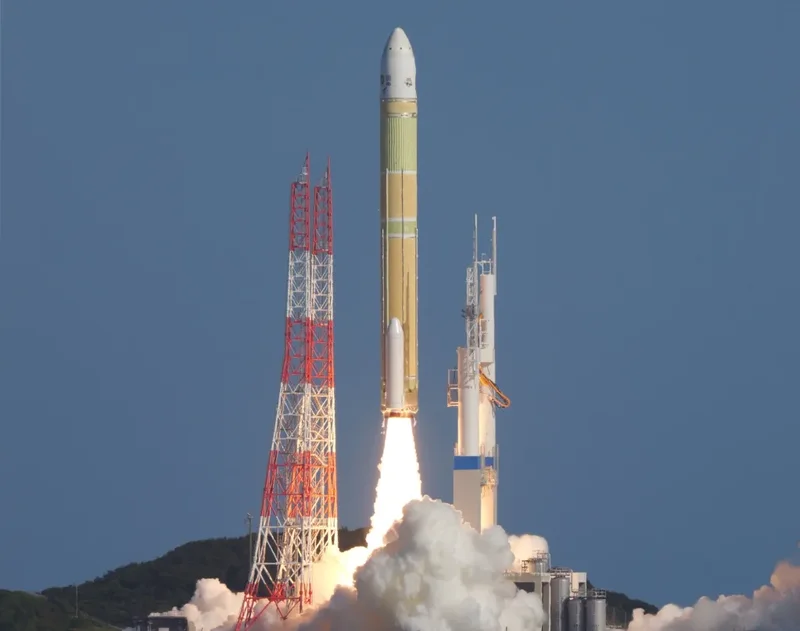
WASHINGTON — Japanese lunar lander developer ispace has selected the H3 rocket to launch its next mission in 2028, creating what the companies called Japan’s first private lunar transportation system.
At a July 28 (U.S. time) briefing, executives with ispace and Mitsubishi Heavy Industries, or MHI, signed an agreement for the launch of ispace’s Mission 3 in 2028 on an H3 rocket provided by MHI. Mission 3 will be the first flight of ispace’s new Ultra lander design announced earlier this year.
This will be the first time an H3 has launched an ispace lunar lander or any payload from a Japanese startup. ispace’s first two lunar landers flew on SpaceX Falcon 9 launches in December 2022 and January 2025.
Takeshi Hakamada, chief executive of ispace, said the agreement with MHI was more than a launch contract. “What begins today is a new challenge, a joint effort between Mitsubishi Heavy Industries and ispace to build Japan’s first privately led lunar transportation system.”
“Together with ispace, we have decided to create a new infrastructure scheme,” said Iwao Igarashi, vice president and senior general manager of the space systems division at MHI. “This infrastructure will serve as the foundation for a new ecosystem within Japan’s space industry.”
Ryo Ujiie, ispace’s chief technology officer, said that his company selected H3 for reasons beyond just creating a fully Japanese transportation system. He cited the vehicle’s capacity, launch environment and “loading flexibility” among the reasons for choosing the rocket.
He said ispace and MHI have already worked well together to confirm the rocket’s compatibility with the lander, including addressing issues such as how to accommodate the spacecraft and its landing legs within the payload fairing.
The companies declined to discuss the cost of the launch contract or how it compared with SpaceX. Hakamada hinted one factor was the depreciation of the yen, which makes launches whose prices are denominated in U.S. dollars, like the Falcon 9, more expensive for Japanese companies. “That is giving us a very huge impact,” he said.
One issue he acknowledged with the H3 is the vehicle’s reliability. The H3 has suffered two failures in its eight launches to date, including one on a December 2025 flight. The H3 returned to flight last month on what was primarily a test flight of a new configuration of the rocket.
“You did the investigation and you were able to succeed in the next flight,” he said to Igarashi. “We thought that it is reliable enough.”
While ispace is launching Mission 3 on H3, the company is not ending its relationship with SpaceX. It announced July 8 a new Mobile Cargo System rover that will be able to deploy several hundred kilograms of payloads on the lunar surface. That system will go to the moon on a SpaceX Starship mission no earlier than 2030.
Hakamada said the company will consider other launch vehicles beyond H3 for future missions. “Our landers are getting bigger, so we may have the need to select a bigger rocket in the future,” he said.
ESA rover funding
The launch contract for Mission 3 came days after ispace won a contract for a rover it will fly on the following lander mission.
The company’s European subsidiary, ispace-Europe, announced July 24 it was awarded Phase 2 of a European Space Agency contract for the Mission for Advanced Geophysics and Polar Ice Exploration, or MAGPIE, rover. The contract, valued at 65 million euros ($74 million), covers the remaining development of the small robotic rover and delivery to the moon.
MAGPIE will fly on ispace’s Mission 4 lander in 2029 to the south polar region of the moon. The rover will carry instruments to study lunar regolith and any water ice deposits there.
“MAGPIE represents a major step forward for European lunar exploration,” said Julien-Alexandre Lamamy, chief executive of ispace-Europe, in a statement. “This contract award demonstrates ESA’s commitment to a new model for small, agile exploration missions — one that combines commercial delivery, scientific ambition and international collaboration.”