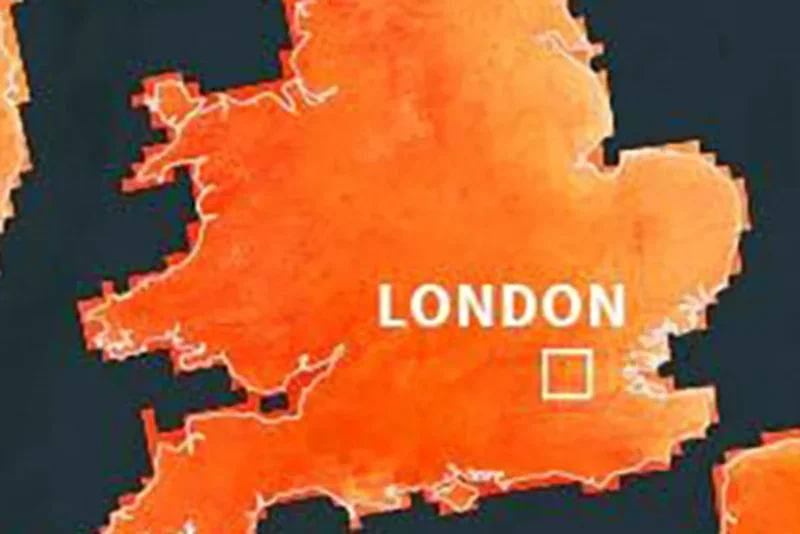
Half of England is officially in drought after record low rain and high temperatures, the Environment Agency has said.
Seven areas across central, eastern and southern England have been declared as in drought, including East Anglia, Hertfordshire, London, Thames Valley, Hampshire & the Isle of Wight, Devon & Cornwall, the West Midlands and Wessex – the latter of which covers Dorset, Somerset, Wiltshire, and south Gloucestershire.
July is set to be the driest month on record, with England having just 7 per cent of expected rainfall, and southern England seeing just 1 per cent.
As such, swathes of the country are now experiencing a flash drought – one which has come on swiftly despite a wet winter.
Drought map:
It comes as health alerts issued by the the UK Health Security Agency (UKHSA) have come into effect for large parts of the country.
An amber heat health alert is in place for the East Midlands, east of England, London and south east until Thursday, 30 July at 9am.
Meanwhile, a yellow heat health alert is in force for the West Midlands, south west and Yorkshire and the Humber during the same period.
There have been three droughts in the past five years: 2022, 2025 and 2026.
Helen Wakeham, director of water at the Environment Agency and chairwoman of the National Drought Group, said: “The hot and dry weather means we are currently using water faster than nature can replenish it.
“A second consecutive summer drought is an exceptionally serious situation and one that will have long-lasting impacts on our environment, wildlife and the economy.
“We want everyone to stay safe and hydrated during the hot weather but every drop we can save is a drop more for nature and agriculture.”
Water minister Emma Hardy said “droughts are becoming increasingly common”, adding that “we need to be prepared for this new normal”.
She continued: “We’re delivering long-term change in the water industry and driving record investments in infrastructure, including nine new reservoirs.
“We expect water companies to follow their drought plans, to go further and faster to reduce leaks, and to ensure supplies are not disrupted even in the driest of weather.”
Why has a drought been declared now?
According to the Environment Agency, “droughts are natural events that cannot be defined, as every drought is different.”
It adds: “Whilst they are all caused by a shortage of rainfall, the characteristics (including timing, duration, impacts on people, the environment, agriculture and business) can vary.”
The agency lists three different main types of drought, including agricultural drought – “when there isn’t enough rainfall and moisture in soils to support crop production or farming practices” – environmental drought and water supply drought “when a lack of rainfall leads to concerns from water companies about supplies for their customers”.
Temperatures soar in Europe amid raging wildfires
In Europe, the world's fastest-warming continent, temperatures were climbing again in both France and Spain on Wednesday amid the fourth heatwave of the summer.
In Spain, weather agency AEMET said temperatures were expected to reach 40C in at least six regions, which have been placed on orange alert, the second-highest level.
Meanwhile, temperatures in the southwest of France, hit by devastating fires, were expected to rise from around 33 C on Tuesday to peak at 42 C, according to Meteo France, while dry winds from the southwest in the morning and from the west in the afternoon could stoke flames.
French firefighters kept a major blaze west of Bordeaux stable overnight. And near Bordeaux's airport, which has remained open, tramway services resumed and hotels reopened. But officials warned the wildfires were far from over.
"As we speak, the situation is stable but the fire is still not under control," firefighter commander Matthieu Jomain told reporters. "We remain vigilant of course today, considering the forecast weather conditions, with a new rise in temperatures and higher wind speeds in the afternoon."
In Spain, Prime Minister Pedro Sanchez said that 10 wildfires remained active across the country, though he expressed optimism that things were going in the right direction.
"Right now, efforts are focused on containing the fire and cooling down affected areas, among other things, in order to prevent any possible re-ignition," he said.
Officials said the situation had improved in the central provinces of Avila and Madrid, but the blaze in eastern Castellon remained out of control after burning more than 10,000 hectares as weather conditions triggered several flare-ups.
Meanwhile, the EU's emergency response centre warned that Greece, Italy and Central Europe were set to face heightened wildfire risk in the coming weeks.
Europe has endured record-breaking heatwaves this year, as human-driven climate change is intensifying the heat and drought that allow wildfires to spread faster.
More frequent and intense heatwaves are causing thousands of excess deaths and increasingly disrupting everyday life, from snarling road and rail travel to hindering river shipping.