Leron Borsten and Shanti Pise report back from a week-long event at the University of Hertfordshire in the UK that sought to teach quantum physics to teenagers
Quantum theory is one of humanity’s great intellectual achievements, radically transforming our understanding of nature at the deepest level while delivering unprecedented technological advances. I have thus always felt it a great pity that most young people never get the opportunity to engage with the theory at a substantive level.
The theorist David Mermin, who has studied the fundamentals of quantum mechanics, once memorably wrote of quantum theory that “We now know that the Moon is demonstrably not there when nobody looks”. It was a comment that certainly captures the imagination, but it is difficult to appreciate what he meant meant without engaging with the mathematics that lies behind it.
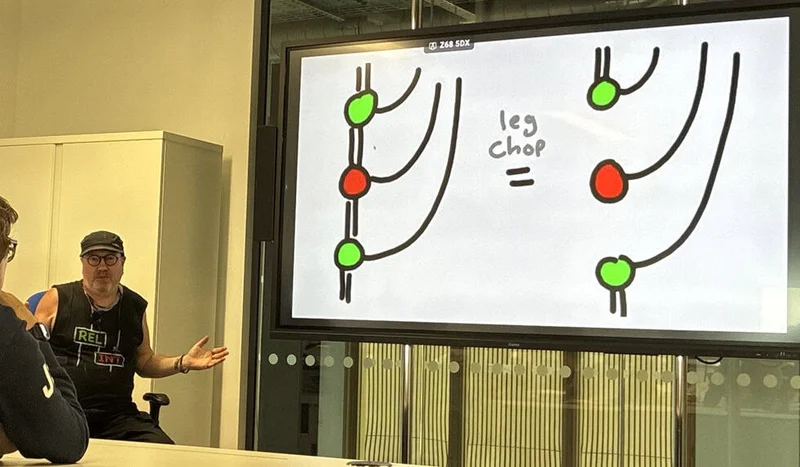
In an attempt to see if we could change that, we ran our first Quantum in Pictures programme at the University of Hertfordshire earlier this month. A five-day, in-person course, it was attended by about 45 students aged 16-18 and was built around Quantum Pictorialism – a diagrammatic approach to quantum theory pioneered by Bob Coecke from the University of Oxford and collaborators.
The crucial point is that the pictures aren’t illustrations of some more fundamental mathematics hidden underneath. The pictures are the mathematics. A rigorous graphical calculus built from spider diagrams enables students to reason directly about quantum processes. Since this diagrammatic formulation is fully equivalent to the usual Hilbert space formalism, the students were doing quantum mechanics for real.
Teaching quantum physics to everyone: pictures offer a new way of understanding
I felt truly privileged to share the mysteries of quantum mechanics with a fantastically friendly, interested and diverse cohort from schools across south-east England. What struck me was how readily they engaged with the material: asking excellent (and sometimes rather challenging) questions, debating ideas and working collaboratively through the problem-solving sessions.
The graphical problems proved particularly popular, with repeated cries for “more spider diagrams!”. The course was deliberately ambitious, but by the end, they were able to work through the complete quantum teleportation protocol. Indeed, one student was confident enough to get up and reason through it for the whole class (something I certainly would not have dared to do at their age).
Muhammad Hamza Waseem, who helped develop the programme and joined us on the final day, captured the atmosphere perfectly. “I found the enthusiasm, curiosity, and irreverence of the students very inspiring,” he said, “and I hope that they take the same spirit into their university education and beyond.”
Feedback from students was positive, even for Andrew, a non-science student from Sir John Lawes School in Harpenden. “The programme was captivating,” he said. “The concept of using diagrams was innovative and explained things in a logical manner to help me understand topics such as quantum teleportation. The programme showed the stark differences between classical and quantum physics through real-world examples, enriched by talks from industry experts and pioneers with different backgrounds.”
That sense of joy and excitement was, for me, the lesson of the week. I’ve been thoroughly convinced that quantum theory isn’t intrinsically beyond the reach of curious 16-year-olds. We just need to give them the right mathematical language. The next step is an optional graduate-level exam, which will put that claim to the test. Watch this space.