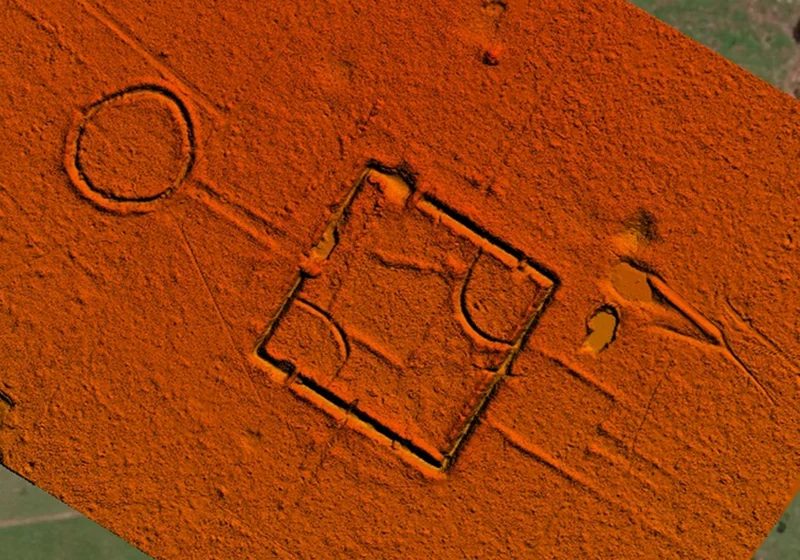
Tens of thousands of undiscovered ancient structures known as “earthworks” are likely hidden in the Amazon near the border between Brazil, Bolivia and Peru.
That’s what researchers concluded after flying a plane equipped with remote sensing instruments over an approximately 4,497-square-kilometer (1,736-square-mile) region in Brazil. They detected 396 new earthworks, suggesting that the Southwest Amazon could contain more of these structures than researchers ever expected—somewhere between 24,000 and 30,000 in total.
A particular kind of earthwork kept showing up in the images: mysterious, geometric designs in the ground called geoglyphs. The structures can extend several football fields in size, and they are a signature of the so-called Aquiry civilization that inhabited the Amazon between 600 B.C.E. and C.E. 850. Researchers think geoglyphs may have served ceremonial or cultural purposes, such as a hosting site for festivities, but their exact function is still up for debate.
On supporting science journalism
If you're enjoying this article, consider supporting our award-winning journalism by subscribing. By purchasing a subscription you are helping to ensure the future of impactful stories about the discoveries and ideas shaping our world today.
Archaeologists had identified geoglyphs in this Amazon region before but never on this scale. “We were surprised that we found about 10 times more of the geoglyphs than we ever thought,” says Martti Pärssinen, lead author of the study and an emeritus professor at the University of Helsinki. The results published on Wednesday in the journal Nature.
What’s more, based on the number and distribution of the recently found geoglyphs, Pärssinen and his team estimate that the Aquiry population may have reached up to three million people at its apparent peak, around C.E. 100–300. The finding also suggests the civilization would have spanned 183,000 square kilometers (70,657 square miles), an area about the size of North Dakota.
The results, if confirmed, could force archaeologists to reevaluate the total population of the Amazon before Spanish and Portuguese colonization, the authors write in the study.
“What we have studied represents less than 3 percent of the whole Amazonia,” Pärssinen says, adding that it is “probable” that there are other sites where the population density may be similarly high, indicating a precolonial population in the Amazon of possibly tens of millions of people. “That’s something amazing and something new,” he says.
The study is “really fascinating,” says Heiko Prümers, a researcher at the German Archaeological Institute, who has studied ancient settlements in the Amazon but was not involved with the new research. That discovery helps to correct the perception “that the Amazon region is a region of ‘untouched nature.’”
But, he adds, it does have some limitations: It’s unclear to Prümers, for instance, whether structures found in the same vicinity were counted as individual “sites” or combined—which could have possibly affected the authors’ total estimates, he says. And, Prümers says, the high number of sites could be the result of “frequent relocations” by the Aquiry rather than a high population density.
To Pärssinen, the findings force a deeper reckoning with humanity’s stewardship of the Amazon today. An estimated one third of the iconic forest has been damaged by modern human activity, and about 17 percent has been completely deforested. But 2,000 years ago, archaeological evidence suggests ancient humans lived in balance with the environment, even while shaping the land with possibly tens of thousands of geoglyphs, Pärssinen says.
“We could learn something about how they managed the forest in the past,” he says.