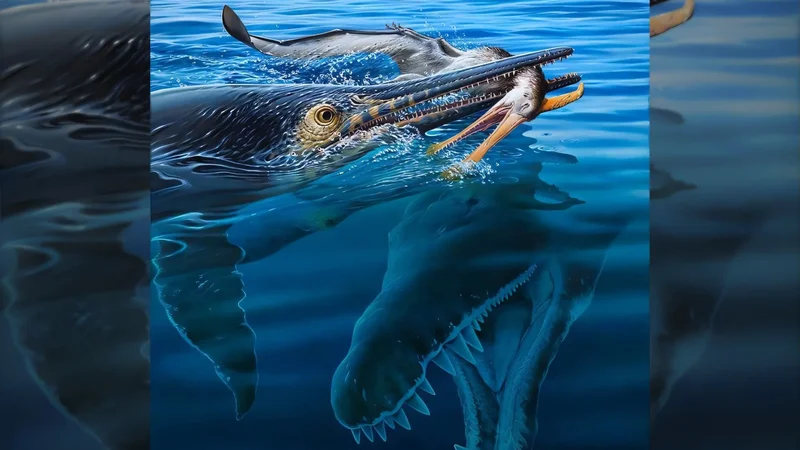
For the first time, paleontologists digging in the Australian Outback have discovered a fossilized food chain. The remains found inside of an ancient marine reptile chowing down on a flying dinosaur vividly illustrates this prehistoric predator-prey relationship in action. . But what goes around, comes around. As paleontologists explain in a study published in the journal Gondwana Research, the massive ichthyosaur who made a meal of the pterosaur soon became a snack for a gigantic apex predator that swam the inland Eromanga Sea over 100 million years ago.
“It’s one of the clearest examples ever discovered of a three-tier predator interaction and offers an unprecedented snapshot of behaviour in Australia’s Cretaceous seas,” Dean Lomax, a paleontologist and reviewer of the new study, said in a statement.
Forensics signs of the fossils were first discovered in 2019 by four fossil hunter hobbyists near the town of Richmond in Queensland. The group amassed and stored multiple large specimens that they later nicknamed their “Bag of Bones,” which lKronosaurus Korner fossil museum curator Kevin Petersen decided to investigate further. A team of museum staff and volunteers spent over 600 hours uncovering and preparing what eventually revealed itself to be a massive, partially articulated ichthyosaur specimen measuring nearly 23 feet long.
There was even more to find, however. Excavators also identified multiple oddly shaped rock nodules near the ichthyosaur’s skull. Instead of breaking them apart, they opted to avoid any potential damage by sending the mysteries to the Australian Nuclear Science and Technology Organization to perform advanced synchrotron CT scans. They soon learned that the rocks contained a prehistoric menu of squid-like cephalopods, fish, and most surprisingly, the jaw of a flying dinosaur.
While remarkably preserved, the ichthyosaur did not make it out of the Eromanga Sea in one piece. Portions of its skeleton featured pulverizing bite marks and missing chunks that all bore the hallmark signs of another predatory attack. But what could take down a trailer-sized ichthyosaur? Based on the injury details, only one culprit could be responsible: Kronosaurus queenslandicus.
Named Greek mythology’s fearsome Titan, Kronosaurus ruled the Early Cretaceous waters near present-day Australia. The short-necked pliosaur grew upwards of 40-feet-long while weighing 11 to 13 tons. Kronosaurus could clamp down on its prey with a bite estimated at 3,370—6,070 pounds of force, meaning even a large animal like an ichthyosaur rarely stood a chance against the apex predator.
“I was amazed by the size of the ichthyosaur, and shocked to see it littered with bite marks,” said University of New England paleontologist and study co-author Matt White. “This discovery enriches our understanding of these ancient marine reptiles and illustrates the complex interactions that shaped their prehistoric aquatic environment.”