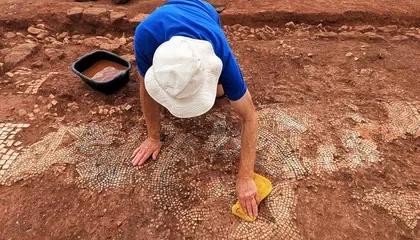
John Hill was surveying a farmer’s field in southwestern England when his metal detector identified a Roman-era coin hidden beneath the soil. Now, about two decades later, archaeologists have returned to the site and excavated the ruins of an ancient villa—complete with a lavish mosaic floor.
Stretching across roughly 130 square feet, the mosaic is located near Halberton, Devon. Experts think it dates to the fourth century C.E. The thousands of colorful tiles, each measuring less than half an inch, form a flower with eight petals. This design is bordered by a guilloche pattern, featuring two bands woven together.
The site is the farthest west that a polychrome mosaic has been found in Roman-era Britain. “This, and the other trappings of Roman civilization and evidence of affluence that have been found, show how much even this far-flung part of the province had been integrated into the Roman Empire,” Bill Horner, county archaeologist and historic environment manager at Devon County Council, says in a statement.
Quick facts: A legendary Roman mosaic
- One of antiquity’s most famous mosaics is a 16-foot-long artwork showing Alexander the Great racing into battle on horseback.
- Known as the Alexander Mosaic, the piece was created in the second century B.C.E. and excavated from the House of the Faun in Pompeii.
After discovering ancient coins at the site, Hill decided to investigate further. He realized that the field was full of small tiles known as tesserae. The landowner, whose family purchased the property in the 1950s, had never noticed any artifacts hidden beneath it. Farmers have been plowing the land for many years.
Today, however, archaeologists can tell that the villa’s ruins are “badly damaged” and “under threat from further plowing,” according to the University of Exeter’s website. “There is a narrow window of opportunity to conduct rescue excavations on this site.”
Archaeology students and volunteers are now digging at the property. The project, known as Saving Halberton’s Ancient Roman Environment, is a partnership between the University of Exeter, Devon County Council, Cotswold Archaeology, Tiverton Archaeological Group and Sampford Peverell Society.
Hill has been metal detecting for four decades, and he’s excited to see a team carefully investigating the site he discovered. “It’s taken 16 years to get everyone here to do the dig,” he tells BBC News’ Emma Ruminski. “I’m nearly 80 now, so I thought I wouldn’t possibly see it in my lifetime.”
Several years ago, researchers collected artifacts that were visible on the surface, including tesserae and pottery fragments, according to the University of Exeter. They then conducted a geophysical survey, which suggested that the farmland was once home to a large villa complex. In 2019, volunteers excavated two trenches, revealing parts of the mosaic floor. Additional excavations in 2021 uncovered more of the site.
The project will run for five years. Organizers hope to preserve the ancient villa before more damage can occur, while also creating opportunities for the community to participate in the excavation process.
The villa was originally “a modest rectangular structure,” Susan Greaney, an archaeologist at the University of Exeter, writes in a blog post. Over time, however, workers expanded the structure, “adding additional rooms to both the north and south ends, filling in the front portion and building an entrance porch.”
“A picture has emerged over time of a villa sitting within a wider complex, with two further possible buildings, an enclosure to the south and possibly an earlier enclosure to the northwest,” Horner said in a January statement.
The mosaic decorated a small space, perhaps a dining room, in the villa. The artifacts recovered from the site, including the mosaic, will go to the Tiverton Museum of Mid-Devon Life, where some will go on display.
The excavations have also revealed the remains of a building that may have been a bathhouse. This structure, which is separate from the main villa, appears to have featured at least two plunge pools, where bathers would submerge themselves in cold water.
The ruins of Roman villas can be found in other parts of England. But such lavish examples were rare in this region, suggesting that this villa’s owners were quite wealthy. Thousands of Roman mosaics survive throughout the Mediterranean region and northern Africa, and hundreds have been found in Britain. Craftsmen in different locations divided themselves into schools, which favored particular styles and motifs.
“In Devon, we are very much on the edge of the Roman Empire, and Roman villas here are really rare,” Greaney tells BBC News. “It’s even rarer to have one with a mosaic. This would have been a really high-status family home.”