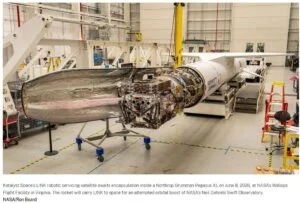
Katalyst Space’s efforts to reboost NASA’s Swift observatory has encountered a setback. The LINK on-orbit servicing spacecraft is in a multi-axis spin. LINK must attach itself to Swift and raise the orbit to avoid reentering later this year. Other systems are working properly and Katalyst remains hopeful they can regain control of LINK and complete the mission.
Katalyst said yesterday LINK had been in a multi-axis spin for 72 hours, with “two of three reaction wheels non-functional and partial RCS functionality.” The spin caused a “temporary loss of communications and subsequent bus reset,” but other systems currently are performing properly including S-band and L-band communications.
NASA contracted with Katalyst less than a year ago to develop a method to reboost the Neil Gehrels Swift Observatory, which has been studying gamma-ray bursts since 2004. Swift’s orbit is decaying more rapidly than expected due to increased solar activity.
Katalyst said it was already working on an in-space demonstration of its rendezvous, proximity operations, and docking technology for June 2026 prior to a planned 2027 launch of its NEXUS robotic spacecraft, but after NASA “raised the alarm” about Swift, they “seized the opportunity to pivot to a live rescue operation which would demonstrate similar capabilities.”
LINK was launched by a Pegasus-XL rocket that was taken aloft by Northrop Grumman’s Stargazer L-1011 aircraft on July 3.
Swift was not designed to be reboosted and doesn’t have grappling fixtures, but NASA viewed this as a way to demonstrate on-orbit servicing for a modest price, $30 million, and get more years of data from this unique space telescope. Swift looks at the universe in the visible, ultraviolet, X-ray, and gamma-ray bands. The name refers to its ability to swiftly repoint itself when a gamma ray burst is detected so the other instruments can study it in more detail in the other spectral bands.
Katalyst’s Keiran Wilson calls Swift “an unprepared but cooperative partner.” The plan is for LINK to maneuver close to Swift and grapple it with one of three “grippers,” then use its propulsion system to boost Swift back up to its original orbit at 600 kilometers. Otherwise the orbit will reach 300 km in October, after which a reboost likely won’t be possible.
The company outlined the steps it will take over the next few weeks to regain control of LINK, starting with using the electric propulsion thrusters to stabilize the spacecraft. “The mission remains active and we continue to believe that with these changes, LINK has a viable path to rendezvous with Swift.”