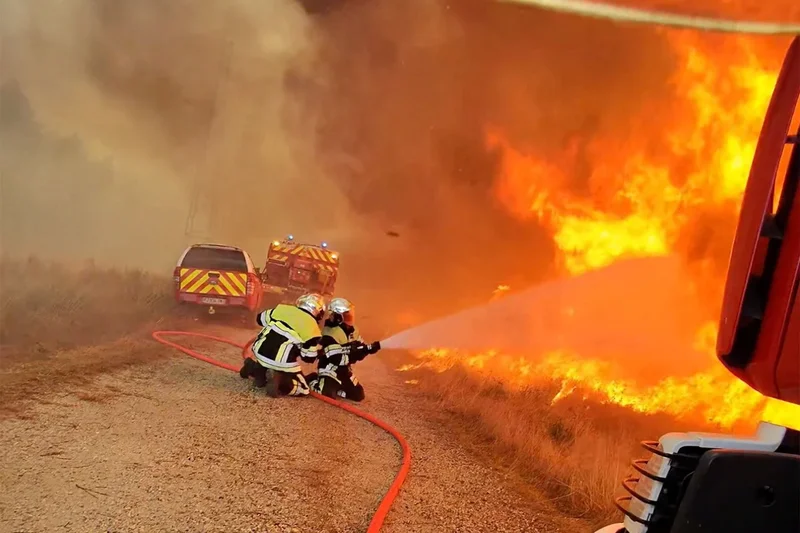
A student has told how he rescued his young cousins from their home as smoke closed in from toxic wildfires sweeping through south west France, forcing hundreds of thousands to flee.
Yanis Sharif, a 21-year-old engineering student, described how he was woken in the middle of the night by an alert on his phone and urged to leave his home in Saint-Jean d’Illac, west of Bordeaux, with his aunt and her young children, aged two and seven, as the fires closed in.
“It was really scary,” he said, speaking to The Independent. “We didn’t have much information. We thought that the fire was close. With the babies, we took our stuff. We didn’t really have any time, so we had to act very fast.”
Mr Sharif is one of 500 people now living in rows of camp beds at the Parc des Expositions in the north of Bordeaux, having brought just the possessions they managed to grab in a hurried late-night departure from their homes.
“I didn’t realise anything. I woke up and found myself driving here. The babies were crying because we had to wake them. But we settled here. The first night was a little tough; we spent it in the car. There was no bed.”
Mr Sharif, who said he was only able to grab his laptop, some paperwork and a few T-shirts in the rush, said the four of them had been living in a hall ever since, and moved around several times as others came in.
He praised the volunteers and helpers on site who ensured they had food, shelter, somewhere to sleep and showers. They provided strollers for the children, he said.
Other refugees displaced by the devastating wildfires said they were grateful to be alive as they waited for news of their homes.
Patrice Gaucher, also displaced from his home in Saint-Jean d’Illac, stressed how grateful he was for the response that he believes may have saved his life.
He said he arrived late on Friday evening after receiving a knock on the door from the gendarmerie, telling him he had two minutes to pack a bag and head east to the city.
“We have to say ‘thank you’,” he said. “We arrived at 10pm and I was given a bed. I was given something for the heat, to drink, to clean ... Every five minutes, a doctor comes for us. They take a lot of care of all of the people.”
“Some people arrived with nothing. There is a lot of solidarity from the population. They give a lot. And I’m very surprised by the French people. And maybe we did not die because we saw that solidarity. Because now in France there are many individuals... But after no, no.
“Some people have a different mentality but me, I say, ‘no, I’m okay. I am lucky to be here. I am alive’ ... So if I come back and my home is no more, it’s okay, I’m not happy, but that’s life.
“And after we are not happy because it’s paperwork with the insurance. But the more important thing is I’m alive ... I can make a new house, I can buy a new motorbike, but I cannot buy a new life. So I have to say thank you.”
The sheer volume of people seeking support has put immense strain on the region, with some 6,000 people spread across three halls in Bordeaux at the height of the displacement.
Residents of the municipalities of Eysines, Mérignac (areas outside the ring road), and Le Haillan have now been returned to their homes, and last night there were 850 at the displacement centre.
Many have also been moved, or are being moved, to vacant student accommodation or available housing in the city, officials said.
On Wednesday, the Bordeaux Métropole confirmed that due to the “massive influx” of food, clothing and essentials, they were suspending their call for donations.
Thomas Cazenave, President of Bordeaux Métropole and Mayor of Bordeaux, said: “I would like to thank all the citizens, associations, business leaders, mayors, and heads of local authorities who have shown such exceptional support.
“We are receiving donations from all over France; the volume of donations has now exceeded our expectations. This outpouring of solidarity has made it possible to provide an immediate, tangible response to the families affected by the fires.”
Gabin Bourdin Marchand, a 20-year-old nurse and student from Eysines, said he had come back to volunteer after four days spent living in the camp, but had found the authorities more reluctant to let volunteers back in as they had so many helpers.
Firefighters and volunteers continue to battle an unprecedented wildfire season in the communes to the west and south, with some 220,000 people already forced to flee their homes.
Esteban De Riberolles, a physiotherapist still living in Lacanau, to the west, said his clinic in Le Porge was forced to close when the town became one of the first to be evacuated.
“We heard many accounts from friends and local residents who had to flee their homes in the middle of the night under very distressing circumstances,” he recalled.
“In the days that followed, I called all of my patients to check on them and reorganise their treatment. Several told me they had lost their homes. My best friend is one of them and is currently staying with me while he finds a new place to live.
“Lacanau itself was mostly spared, with only some areas on the outskirts affected, while the town centre remained safe.”
Mr De Riberolles, who has been volunteering to offer massage relief to the firefighters working tirelessly to contain the blaze, said the fires have mobilised the local community to help.
“Together with friends, we obtained a 1,000-litre water tank mounted on a trailer to transport water to those working on the ground and, whenever appropriate, help deal with small fire spots,” he said.
“It has been an unforgettable experience. I've seen how an entire community can come together in the face of a disaster like this.”