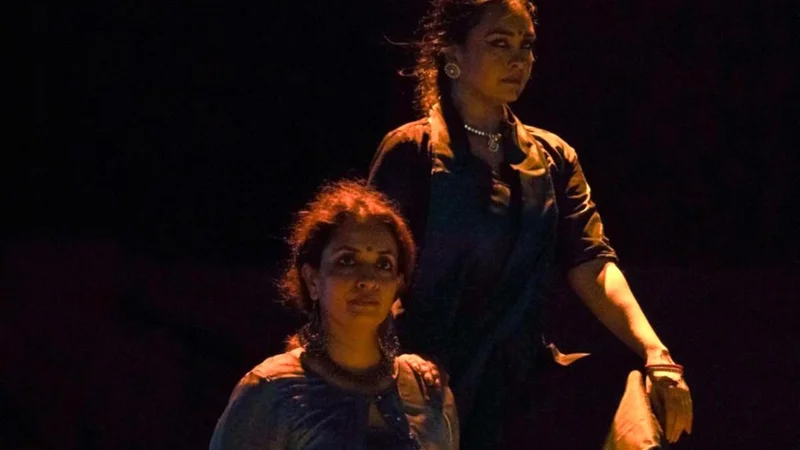
Can the navarasa or nine emotions in Bharatamuni’s Natyashastra be interpreted differently? Ten years ago, writer Anupama Raju presented these rasas in a new light, in her book, *Nine, * as a series of triolets (eight-line poems using a strict rhyme and repetition structure). Years later when she thought of giving an interpretation to these poems through dance, she found a collaborator in the multifaceted Bharatanatyam exponent Rajashree Warrier. The result was the production, NINE – Our Circle of Lines, which blends ‘poetry, movement, music and space to explore these powerful emotions’. It premiered at the annual Kerala Literary Festival (KLF) at Kozhikode in January 2025, with a second staging in Kolkata in December. This weekend, they will take the stage at Bengaluru Poetry Festival.
Anupama and Rajashree, both celebrated names in their respective fields, took three out of the nine rasas for the production – shringaram, bhibatsam (disgust/aversion) and bhayanakam (fear). The collaboration works with Anupama reciting a verse about a rasa, while Rajashree interprets it through movements to which Anupama responds with a new poem. “It is like a dialogue between us, with me using words and Rajashree, movements,” says Anupama.
Rajashree does not conform to conventional Bharatanatyam in the production. “When you talk about Bharatanatyam, the structure is treated as the form. For me, it is about the language; structure constitutes the language, which in turn becomes the form. I have used the language but placed it in a different mould. Basically, I have broken the existing form – classical art forms dictate specific movements of the limbs. I have recycled it,” says Rajashree who has also scored music for the production, incorporating violin, mridangam, harp, mizhavu and vocals.
Anupama and Rajashree connected during the pandemic. During the initial chats, Anupama wondered if her Navarasa series would work as a dance production. “We are both based in Thiruvananthapuram and used to run into each other at literary festivals. I felt it would be nice to work together someday,” says Anupama.
Rajashree adds, “I liked the poems. But usually when I take up a poem I go off on my own tangent and the poet may not approve of it. However, once we started interacting, I realised that there won’t be any such problem. We both connected over the emotions that ran through the poems. But it took over a year to start working on it since I was held up with other productions. It was when we heard that KLF is back after a break due to the pandemic, we decided to find a stage there,” Rajashree says.
The duo says that they wanted an audience which could relate to what they were presenting. “We wanted those viewers who could look into the layers in the work and that’s why we chose a literary festival,” she adds. The 45-minute production was staged at Kozhikode beach, whereas the one in Kolkata was for an intimate audience.
Ruminating upon her take on the emotions, Anupama says that they might come across as “a little dark”. Shringara, in her perspective, is the stage when one gets tamed by the other, as one of the line goes ‘…when each day ends up as chore’. Rajashree adds, “In her view, the woman becomes so dependent that her every emotion is controlled by the other. I elaborated upon that observation. She has a realisation about her subjugation when she stands in front of a mirror and scratches its surface. From being restrained, she reaches a stage where she feels that shringara is about loving herself. Anupama understood my interpretation and responded with a beautiful set of verses.”
Bhayanakam explores the situation where the emotions of two persons, man and woman, are swapped. “When the swap happens, it becomes a tussle between the characters, you and me. It is a frightening situation when one becomes other, as you have to swallow what you once said or believed,” says Rajashree.
Although they will have to skip the portion on bhibatsa at the Poetry Festival for want of time, Rajashree says that the section is special for her. “I built different contexts with Anupama’s words. I based the whole thing around a dream, that disgusting dream we all might have had at some point of time, which gets stuck in the head and makes you uncomfortable.”
Regarding the title, Anupama explains, “A circle is an ongoing thing. At the same time there are lines within that circle, which could be lines of poetry or movement. There is a constant symbiosis happening there.“
Both artists are appreciative of the distinctive way in which the other responded. “Collaboration is a lovely space. You get to communicate with another individual, get a peek into that person’s universe. There is mutual respect and we don’t interfere in each other’s spaces. That boundary is also important, along with the chemistry,” says Anupama, who had collaborated with French photographer Pascal Bernard on two Indo-French poetry and photography projects a few years ago. Ranked among the best Anglophone poets, her other literary works are another poetry collection, Bitter Gourd, and a novel,C. A well-known translator and literary journalist, she is working on her next poetry collection and novel, even as she balances a full-time corporate career with UST.
“The collaboration has made me immensely happy. It is extremely gratifying when the other person understands you exactly the way you wanted to be understood,” says Rajashree, who has conceptualised several literary works and compositions for the stage, winning accolades for her choreography. A top grade artist with Doordarshan and empanelled artist with ICCR, she has won acclaim for adapting compositions of social reformer Sree Narayana Guru to Bharatanatyam repertoire.
The production will be staged at Indira Nagar Sangeetha Sabha, Indira Nagar, Bengaluru, on August 1 at 12 noon.
Published - July 29, 2026 11:13 pm IST