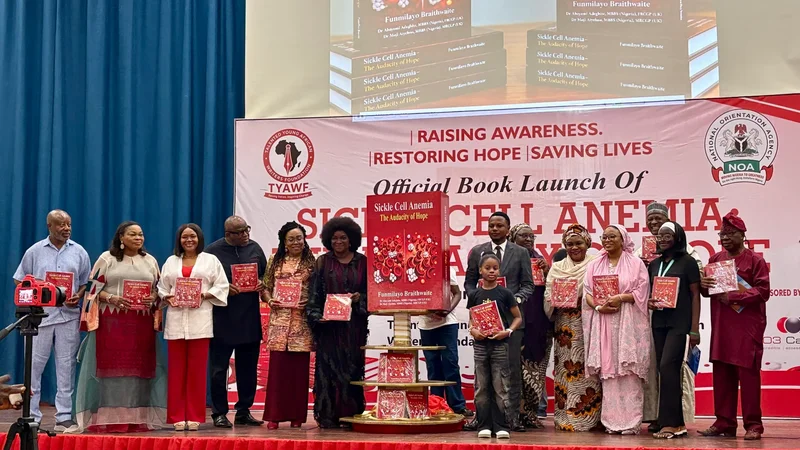
Stakeholders have called for stronger public education, compulsory genotype awareness and better support for people living with sickle cell disease, warning that Nigeria will continue to record thousands of preventable cases unless more people make informed decisions before marriage.
The call was made on Wednesday in Abuja at the launch of ‘Sickle Cell Anaemia: The Audacity of Hope’, a new book by Funmilayo Braithwaite, with medical contributions from Abayomi Adegbite and Moji Aiyemo.
The publication, Mrs Braithwaite’s 11th book, combines storytelling, medical explanations and advocacy to raise awareness about sickle cell disease, combat stigma and encourage informed reproductive decisions.
The event brought together health professionals, librarians, writers, faith leaders and advocates, who said poor understanding of genotype compatibility continues to drive Nigeria’s high burden of sickle cell disease despite improvements in treatment.
| | |
|---|
Nigeria’s burden
Sickle cell disease is an inherited blood disorder that occurs when a child inherits an abnormal haemoglobin gene from both parents. It causes red blood cells to become rigid and sickle-shaped, leading to severe pain, anaemia, infections, stroke and organ damage.
According to the World Health Organisation (WHO), Nigeria has the world’s highest burden of sickle cell disease, with about 150,000 babies born with the condition every year.
Earlier this month, PT Health Watch reported that misconceptions about genotype compatibility, inadequate public education and persistent stigma continue to undermine efforts to reduce new cases. Experts also called for expanded newborn screening, improved access to treatment and sustained awareness campaigns.
‘Knowledge is the missing link’
Delivering the keynote address, the National Librarian and Chief Executive Officer of the National Library of Nigeria, Chinwe Anunobi, described Nigeria’s sickle cell burden as “not only a medical problem but also a knowledge problem.”
Mrs Anunobi said awareness alone is insufficient unless people understand genotype compatibility and apply that knowledge when making life decisions.
“Information becomes knowledge only when it is understood, evaluated, accepted and translated into action,” she said.
She explained that many people are aware of sickle cell disease but lack adequate health literacy to understand genotype compatibility and its implications before marriage.
“Somewhere before a child was conceived, knowledge was either absent, misunderstood, unavailable or ignored,” she said.
She stressed that health literacy means more than knowing about sickle cell disease; it requires understanding one’s genotype and making informed reproductive decisions.
Beyond healthcare
Mrs Anunobi said sickle cell disease affects education, employment, household income and national productivity, noting that many children miss school because of repeated painful crises, while parents face emotional and financial strain from frequent hospital visits.
She added that adults living with the condition often experience discrimination in schools and workplaces because of misconceptions about their productivity.
She urged Nigerians to replace prejudice with understanding and called for health literacy to be integrated into school curricula while encouraging libraries to play a greater role in community health education.
Highlighting persistent misconceptions, she cited a PREMIUM TIMES vox pop in which a respondent said that love mattered more than genotype compatibility.
According to her, the responses demonstrated that access to information does not always translate into informed behaviour because cultural beliefs, emotions and social expectations often outweigh scientific evidence.
She urged governments, healthcare providers, schools, faith-based organisations, traditional rulers, civil society groups and the media to work together to promote evidence-based health information and combat misinformation.
Book humanises the disease
In reviewing the book, Nigerian poet Kabura Zakama described the publication as one that moves readers beyond understanding sickle cell disease as merely a medical diagnosis.
He said the book introduces readers to the human realities behind the disease through the story of a young woman living with sickle cell disease.
According to him, the publication is organised into three broad sections.
The first focuses on the lived experiences of patients and families; the second provides accessible medical explanations of diagnosis, treatment, and emerging therapies; while the third explores public policy, advocacy, and institutional responsibility.
Mr Zakama said the book also examines issues such as discrimination, workplace inclusion, health insurance, emergency care and legal protections for people living with sickle cell disease.
He said one of the publication’s greatest strengths is that it presents complex medical information in language that ordinary readers can easily understand.
He urged intending couples to know their genotype before marriage and encouraged governments, employers, schools and healthcare institutions to provide greater support for people living with the condition.
Hope beyond diagnosis
The Lead Pastor of Light Nation Church, Apostle Femi Lazarus, said the launch was more than the unveiling of a book.
Represented by the church’s Regional Pastor, Lekan Popoola, he described the publication as a launch of awareness, understanding, courage and hope
He said it reminds society that a medical condition should never define a person’s future or limit their potential.
Speaking after the launch, Mrs Braithwaite said the publication was the fulfilment of a long-held dream and expressed hope it would reach homes, schools, hospitals and communities across Nigeria.
She said increasing awareness and promoting informed decisions remain central to the book’s message.