A new Human Rights Watch (HWR) report says that the Indonesian government is silencing environmental activists in Papua region, known internationally as West Papua.
The report, titled Grabbed Land, Silenced Justice, examines how parts of Papua, in particular South Papua, are seeing a greater military presence in service of massive national development projects.
Indonesian govt silencing Papuan activists - report
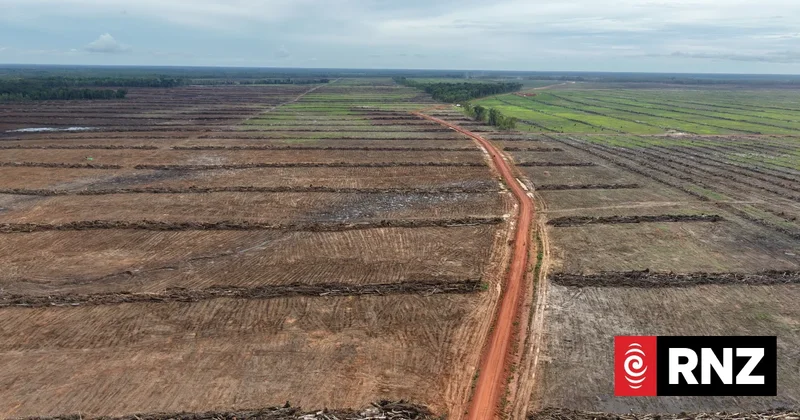
These projects, its argues, are causing mass deforestation and displacement throughout the province, directly threatening local livelihoods. All the while, journalists and activists who speak out tend to be arrested and mistreated.
HRW's Andrea Harsono, a lawyer and one of the report authors, told RNZ Pacific it is business as usual.
"More than a dozen laws in Indonesia are used to silence protests over environmental harms", he said.
"Authorities used provisions of the Plantation Law, the Mineral and Mining Law, the Job Creation Law, or the Prevention of Forest Destruction Law to prosecute all these indigenous leaders and environmentalists."
Harsono noted that while higher courts would typically throw these cases out, activists would be mistreated during their arrests and tied up fighting their case for months.
"Individual can spend months, even years, appearing before various law enforcement agencies to contest groundless claims against them."
It comes as forest fires continue to ravage South Papua, which activists say are exacerbated by the dead wood and dry land left by deforestation across million of hectares.
Every bulldozer has a soldier
South Papua has increasingly become the target of major Indonesian agricultural projects, most notably the Merauke Food and Energy Estate project, slated to cover roughly three million hectares.
The project would convert forests, wetlands, and savannas into rice fields, and sugarcane and palm oil plantations.
Harsono said that his sources on the ground in South Papua were reporting that land clearing had become increasingly militarised.
"Every bulldozer is accompanied by soldiers with semi-automatic weapons ... this is the only province of the six (Papuan provinces) that exists without armed (West Papuan pro-independence) movement against them," he said.
"It is easier to clear the swamps and the forests in South Papua compared with the other five provinces, where resistance is higher."
All the while, severe fire warnings are in place province-wide. According to spatial analysis from Indonesian NGO WALHI, most fire hotspots are concentrated in areas designated for the Food Estate program, and other projects such as palm oil.
The report also posited that the Indonesian government tends to under-report forest clearing, and by extension, Papua's vulnerability.
"West Papua has thick peatland, meaning that underneath the surface, if there is fire, the fire will keep on burning," Harsono explained.
"There are studies after studies showing unnatural death because of respiratory problems in Sumatra and Lakimantan, there is still no study about that in West Papua."
But Harsono said there was evidence of the impact of the large-scale environmental destruction in declining animal populations, loss of biodiversity, and downstream from that, community livelihoods.
"They used to hunt for deer, for cuscus who eat Saku trees - Saku trees are missing, sweet potatoes are missing."
Food estate protesters targeted
The report claims that protesters of the food estate project are being actively targeted and silenced.
It points to an incident in January where police detained 11 Papuans who had protested about "risks to the customary land rights and livelihood of over 40,000 people from the Indigenous Malind, Maklew, Yei, and Khimaima communities."
It also reported a resident in the Ngguti District saying that the military compelled his family to leave their home for protesting, while the fear of appearing against the state drove them out of their village entirely.
Recently, RNZ Pacific reported the disappearance of Yasinta Moiwend, a Merauke resident who participated in the documentary Pesta Babi (or Pig Feast) that criticised the Merauke Food and Energy Estate project.
She had also filed two lawsuits against the government over its actions in relation to the project.
However, soon after the film's release, Moiwend's family said she was taken suddenly to Jakarta, where HRW reports they continue to believe she had been abducted, with an attempt to coerce her silence.
Harsono said that authorities attempt to silence activists, through intimidation, all the way up to physical abuse.
"If you are outspoken, if you are prominent, your family members or your children are put under pressure, or your livelihood, your job is disrupted, if not you losing your job."
Nevertheless, Harsono said he has seen no indication that activism within Papua will die down, especially among younger residents, who have no memory of life without Indonesian rule.
"If you take a look at the number of soldiers stationed in all the six provinces in West Papua, you will know that statistically, the ratio of a soldier to the population is getting lower," he said.
"It means that the security measurement is getting higher and higher... that the resistance against this kind of rule by Indonesia is not decreasing; it is increasing."