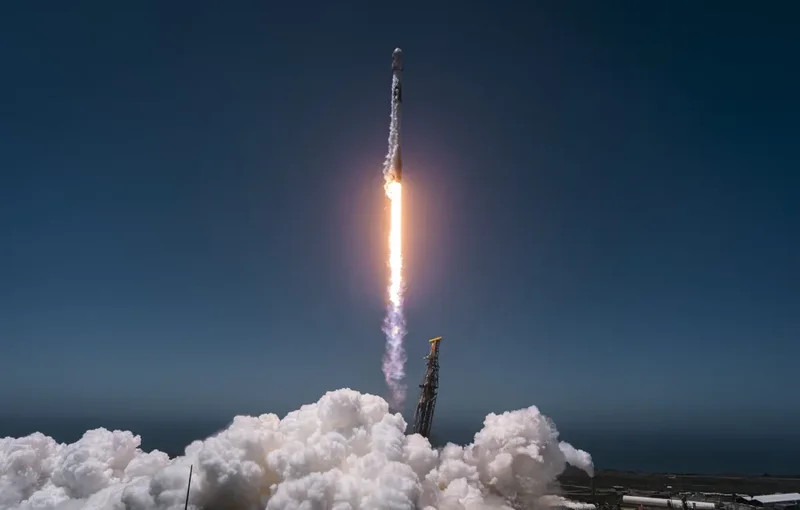
WASHINGTON — The U.S. Space Force awarded SpaceX two launch task orders worth $1.6 billion to deploy military satellite constellations, marking the largest publicly announced batch of missions yet under the National Security Space Launch Phase 3 program.
The award covers 18 Falcon 9 launches from Vandenberg Space Force Base in California through the end of 2027 in support of the Space Based Sensing and Targeting portfolio, a collection of satellite programs intended to improve how the military detects, tracks and communicates information about threats in near real time.
The task orders reinforce SpaceX’s central role in the military’s next-generation satellite networks. Beyond providing the launches, the company is building two of the portfolio’s largest satellite systems under separate multibillion-dollar contracts, giving it responsibility for both placing the constellations in orbit and supplying key elements of the architecture itself.
Space Based Sensing and Targeting is one of the Space Force’s newly established acquisition portfolios. It oversees the Space Development Agency’s Tracking Layer, a constellation of infrared satellites designed to detect and track advanced missile threats; the Space Data Network Backbone, an optically linked communications network being built by SpaceX to move large volumes of military data across the Joint Force; and the Space-Based Airborne Moving Target Indicator program, another SpaceX-led constellation intended to track aircraft and other airborne targets from orbit.
SpaceX previously received contracts worth $2.29 billion for the Space Data Network Backbone and $4.16 billion for the Airborne Moving Target Indicator system.
The launch award is the largest publicly disclosed order under National Security Space Launch Phase 3 Lane 1, the Space Force’s commercial-style procurement program for lower-risk national security missions that allows pre-qualified providers to compete for individual launch orders without completing the military’s most demanding certification process.
The contract also follows the Space Force’s decision earlier this month to raise the Phase 3 Lane 1 contract ceiling to $17 billion from $5.6 billion, reflecting expectations that military launch demand will grow substantially faster than originally anticipated.
The schedule itself is notable. Completing 18 launches by the end of 2027 will require a sustained campaign averaging roughly one mission a month from Vandenberg, depending on the timing of satellite deliveries.
That cadence also highlights the gap between the number of companies eligible to compete for national security launches and those capable of executing them today.
Seven companies currently hold positions on the Lane 1 contract vehicle. For now, SpaceX remains the only company with the combination of launch frequency, operational Falcon 9 rockets and West Coast infrastructure needed to support a campaign of this scale.
Col. Eric Zarybnisky, the Space Force’s acting portfolio acquisition executive for space access, said the awards also demonstrate how quickly the Lane 1 contracting approach can move. He said the service completed the procurement in roughly two months from identifying the requirement to making the award, including a month for industry to prepare proposals.