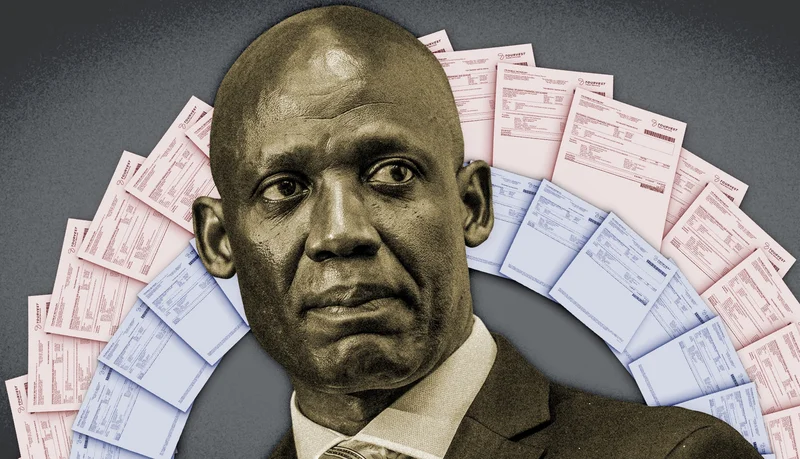
Daily Maverick has obtained a trail of invoices revealing how NSFAS splashed public funds on hotel stays for Administrator Hlengani Mathebula. The most damning evidence of blatant financial negligence lies in an outright âdouble-bookingâ of two hotels during the final week of May 2026, and a stay at an estate.
Double-booking hotels and fruitless expenditure
According to official tax invoices, taxpayers paid R9,200 for Mathebula to stay at the Pepperclub Hotel & Spa for four nights from 25 to 29 May. On the same dates, a separate invoice reveals that NSFAS simultaneously paid R14,850 for Mathebula to occupy a luxury suite at The Westin Cape Town from 25-28 May. For three consecutive nights, public funds were burnt to secure two separate five-star hotel rooms in the same city under a single individualâs name.
Responding to Daily Maverick questions on the reasons behind the double booking, NSFAS technical adviser Khulani Qoma told Daily Maverick to attribute the response to spokesperson Ishmael Mnisi, who said that all travel and accommodation were carefully considered and reasonably priced.
âOn the Tourvest tax matter, Professor Hlengani Mathebula stayed at The Westin Cape Town for the duration of his stay, but a prior booking had been made with the Pepperclub Hotel. However, an unsuccessful attempt to cancel the booking was made due to health reasons. What further compounded the matter was the fact that this coincided with the budget vote debates when hotels were oversubscribed, leaving NSFAS with limited booking options,â Mnisi attempted to explain.
Mnisi could not elaborate on whose health condition led to the cancellation of the Pepperclub Hotel. Treasuryâs National Travel Policy Framework establishes minimum norms and standards for public sector officials travelling on official business in SA.
Section 15.2 â no-shows and cancellations of the policy â says that if a traveller fails to cancel a booking in time, it is officially classified as Fruitless and Wasteful Expenditure. Section 15.2.4 says: âThe Traveller will be responsible for any fruitless expenditure incurred due to a no-show or late cancellation where it was in his/her ability to cancel... The Institution must recover the amount from the Traveller.â
NSFASâ provision of travel management services also states: âCancellation of accommodation bookings must be done promptly to guard against no-show and late cancellation fees.â
When asked whether Mathebula would be held personally liable, Mnisi said responsibility lay elsewhere.
âThis double-booking error is therefore not personally attributable to him. It came as a shock to him when this was raised by Daily Maverick, which contradicted the assurance he received when the matter came to his attention previously,â said Mnisi.
Following the stay at Westin, a new reservation was again made at the same Hotel between 7 and 12 June.
Estate booking
In mid-June, from 13 June until 1 August, NSFAS forked out R86,811.67 to book Mathebula into the Advertentia Real Estate Holiday Apartments to stay in Cape Town for a 49-night stay. Mnisi said: âFollowing our internal verifications, NSFAS can state that Mathebula didnât incur additional hotel accommodation costs in the immediate days following the Advertentia booking in Cape Town.â
NSFAS did not respond to the question of why it booked the estate. Instead it said Mathebula was being unfairly painted as spending state resources irrationally.
âHis administration is the leanest by people and spend,â said Mnisi.
R10-million spent on advisers
Mathebula has also raised eyebrow by appointing four advisers at a salary of nearly R10-million. Daily Maverick asked for justification of the appointment of advisers Nonkululeko Manyika, Khulani Qoma, Dudu Hlatshwayo and Madala Mthembu, who cumulatively make up an annual salary of close to R10-million.
Mnisi said: âMathebula didnât walk in with his advisers from day one. He spent a month alone, making dispassionate assessments of the needs. He later appointed his advisers incrementally across the period, ending up with a total of four advisers, who possess skills ranging from financial management, strategy, legal, governance to corporate affairs and stakeholder relations.â
Students struggling
The spending comes as NSFAS-funded students continue to argue that current allowances no longer meet the cost of living.
University of Johannesburg second-year student Simamkele Qoyi says the money is insufficient.
âI divide the allowance, with the R1,550 being for food and the rest for toiletries. Sometimes I sacrifice from my savings in order to buy all my toiletries as the money was finished by food â for example, meat. Sometimes with the money I help at home and also buy large quantities of food to last the whole month⦠I do wish for an increase, because an increase could benefit us as students as then we would be able to buy enough groceries to sustain us for the whole month,â said Qoyi.
He said learning of the administratorâs spending was deeply frustrating.
âTheir selfishness is what causes the students receiving allowances which arenât enough to buy groceries to sustain us for the whole month,â said Qoyi.
Another student, from the University of the Western Cape who asked to remain anonymous, said it was enough for her.
âIt is enough to cover essential items because I mainly use it for groceries and toiletries, which is what the allowance is intended for; however, some students rely entirely on this allowance to cover everything, including personal care, clothes and sometimes even helping their families; for those students, R1,716 is often not enough,â she said.
On hearing of the administratorâs spending, she said: âHearing that such a large amount was spent on luxury travel raises concerns about priorities. Those funds could have been used to improve student support or other important services.â
The spokesperson of the South African Union of Students (Saus), Dr Thato Masekoa, said the students were living under harsh conditions.
âSaus believes that the current living allowance of R1,716 per month is grossly inadequate and no longer reflects the economic realities faced by students⦠Many students skip meals, experience chronic food insecurity, walk long distances because they cannot afford transport, borrow money to meet basic needs, or sacrifice essential academic materials simply to eat,â said Masekoa.
On the travel expenditure, he added: âIf confirmed, such expenditure represents a deeply troubling contradiction between the hardships experienced by students and the stewardship of public resources intended to support them.â
Daily Maverick questioned NSFAS on plans to increase student allowances. Mnisi said: âNSFAS is disinclined to answer your latter questions presently.â
Economic development and transformation adviser Duma Gqubule told Daily Maverick that the âchaosâ at NSFAS needed to be probed, and that the allowance needed to keep up with inflation.
âIt has to keep up with inflation⦠We must set the allowances higher. Weâve been seeing in the media the stories of children without accommodation, sleeping in libraries, people in desperate situations. When I talk to people who are lecturers, they tell me about these situations, that the students are in a desperate situation,â said Gqubule.
EFF demands accountability
The Economic Freedom Fighters (EFF) have since called for an investigation into Mathebulaâs actions. Speaking to Daily Maverick, the EFFâs Sihle Lonzi said the administrator was living lavishly, and also noted that the National Treasury had yet to approve the remuneration of the NSFAS administrator.
âItâs a vote of no confidence in what (Minister of Higher Education) Buti Manamela is trying to do at NSFAS, because the finance minister would have long approved. They are just employing each other, spending money of the government that is meant to serve the student,â said Lonzi.
He added that they would aim to bring Mathebula and Manamela before the Portfolio Committee on Higher Education to explain NSFASâ issues and clarify whether accommodation middlemen had been eliminated. Lonzi heavily criticised the appointments of the four advisers, writing to committee chairperson Tebogo Letsie to demand an investigation into the administrator and his advisersâ remuneration.
On Tuesday, News24 reported that Minister of Finance, Enoch Godongwana, had rejected the annual salary package of R5.5-million for Mathebula. This comes after the National Treasury told Daily Maverick that it has received a request seeking the concurrence of Godongwana regarding the remuneration of the administrator in terms of section 17C of the NSFAS Act.
âIt is currently being considered, and when a response has been finalised the minister will inform the minister of higher education of his decision. It is worth noting that although the letter is dated 17 June, the minister of finance only received it on 4 July,â said the National Treasury.
It added: âSpending by NSFAS on this and all other matters is governed by the Public Finance Management Act and the entityâs policies and prescripts on spending. In this regard, the Department of Higher Education and NSFAS will have their own travel policies governing accommodation, travel costs, etc. Any expenditure on this must be aligned to their policy. If it isnât, it may then be considered irregular expenditure.â
Daily Maverick also sent questions to Department of Higher Education and Training spokesperson Matshepo Seedat, who referred the publication to a statement dated 14 July 2026, in which Manamela defended the spending by Mathebula on the advisers, saying that Mathebula had adopted a lean technical support model comprising four specialist advisers appointed to support him.
âThe technical support structure utilised during a previous NSFAS administration amounted to approximately R16.5-million per annum; an earlier administration incurred technical support costs of approximately R19.6-million per annum; and the remuneration associated with the former NSFAS board and its committee structures during the 2025/26 period amounted to approximately R31-million,â said Seedat. DM