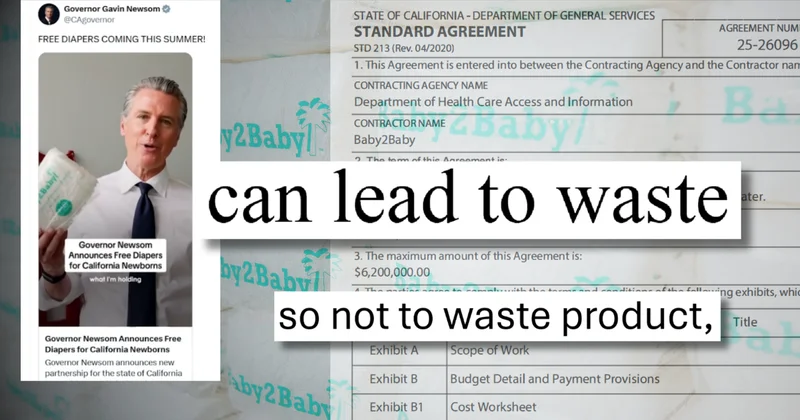
California waited 66 days to release the records behind Gov. Gavin Newsom's taxpayer-funded diaper program, including a $6.2 million contract awarded to the nonprofit Baby2Baby without a formal competitive bid.
The 356 pages the state released include the executed contract, internal analyses, vendor proposals and email threads between the California Department of Health Care Access and Information (HCAI) and the organizations that responded to the state's request for information.
CBS California Investigates reviewed every page.
Nothing in the released records reveals illegal conduct. The made it legal for the administration to bypass ordinarily required competitive bidding and state contract review.
Instead, the records raise questions about why the state designed a program its own agency warned could waste taxpayer-funded diapers. They also show the state selected Baby2Baby even though the state's recommendation identified the other finalist as ready to provide the planned direct-to-consumer component.
These are the key findings.
- Records that Baby2Baby's plan to send every baby home with 400 diapers in limited sizes could lead to waste. The other finalist offered more diapers, more sizes and a direct-to-consumer option.
- The contract locks in the same design that prompted those waste concerns raised by applicants and state staff. Families receive 400 diapers at hospital discharge, limited to Newborn and Size 1, with no right to return or exchange them if the baby outgrows the supply.
- The state designed the program around Baby2Baby's existing hospital-distribution model before officially seeking information from other potential vendors, then signed a contract that adopted Baby2Baby's specific plan.
- The 356-page record release contains no bid scoring sheets, evaluation criteria or rankings showing how proposals were assessed against one another. The state's comparison spreadsheet contains numerous "Not answered" cells, and the closest thing to an evaluation in the released records is the agency's final recommendation.
- That recommendation identifies two finalists and documents significant advantages offered by the other finalist. SupplyBank.org offered more diapers, in more sizes, along with direct-to-consumer distribution.
- Other proposals offered families more flexibility but are absent from the state's final comparison documents. Amazon proposed vouchers that would allow families to select diaper sizes, receive them at home and make returns, but Amazon does not appear in the comparison or finalist records.
- The state's own records do not agree on how many organizations responded. Different documents identify 11, 14 and 15 respondents. At least one applicant says it submitted a response but never received a meeting.
- The contract requires taxpayers to cover California branding. The records say a simpler design "could reduce" costs and warn that diaper quality could affect "the State's reputation."
- Confidentiality and coordinated messaging are written into the agreement. The program's oversight committee meetings are "not open or public," and the state and Baby2Baby must mutually approve the communications strategy and talking points.
- Baby2Baby declined to identify its diaper manufacturer during the selection process. The manufacturer is in Mexico.
- The executed contract originally cited a prescription-drug law as authority to bypass contract oversight. In the released copy, that citation is crossed out and replaced with the budget exemption beside a notation dated eight days after CBS California Investigates requested the records.
- Despite concerns about transparency, oversight and the optics of the Baby2Baby deal, lawmakers renewed both the diaper program and its contracting exemption for a second year.
CBS California Investigates sent the state several follow-up questions July 20 and is still waiting for answers.
(Document links in this story open the individual state records on DocumentCloud, redacted to remove personal contact information and confidential pricing information.)