Every large enterprise runs on a paradox. The most consequential financial machinery in the company, the system that decides which invoices get paid, which contracts get enforced, and which suppliers get renegotiated, is also its least modernized.
American companies spend more than $20 trillion a year on the raw materials, logistics, data centers and services that power the US economy, according to the Bureau of Economic Analysis. And for decades, that spend has been managed the same way: legacy software on top, armies of outsourced labor underneath.
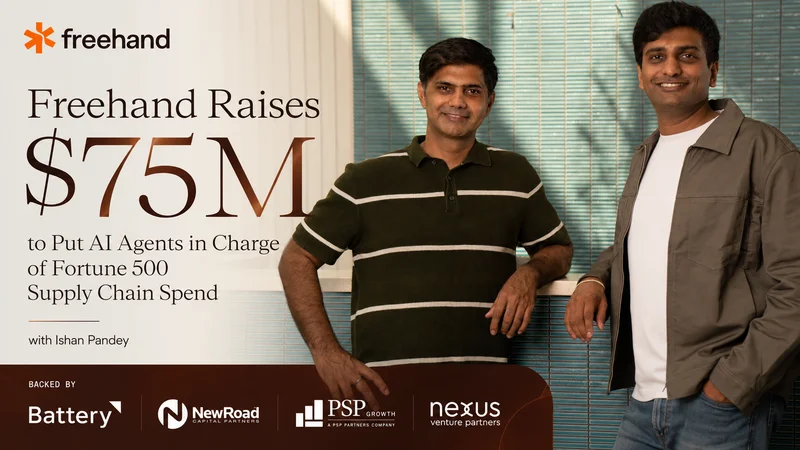
Freehand, which announced a $75 million round today, exists because of the asymmetry inside that stack. As co-founder and CEO Nitin Jayakrishnan frames it, enterprises spend $16 billion a year on supply chain software and another $348 billion hiring people to do what that software cannot.
The "why" behind every supply chain decision, the negotiated exception, the tolerance clause, the verbal agreement confirmed by email, lives in contracts, inboxes and chat threads, not in the ERP. Software that only reads structured data can assist, but it cannot decide.
So enterprises hired people, then outsourced those people, and called it efficiency. Freehand's proposition is that agentic AI finally collapses the distinction: software that reads the unstructured context, makes the decision, executes it inside the enterprise system, and signs its name to the outcome.
Why Now: The Outsourcing Model Is Cracking
The timing of this round is not a coincidence of the funding cycle. It maps directly onto a policy environment that is actively dismantling the economics of the old model. Tariffs, taxes and immigration policies are straining the outsourcing arrangements that have historically run global supply chains, and the survey data shows how fast the pressure has built. In the 2026 Thomson Reuters Global Trade Report, 72% of trade professionals named US tariff volatility the most impactful regulatory change, up from 41% a year earlier, and 39% of firms are now absorbing or considering absorbing tariff costs rather than passing them on, triple the prior year's share.
A McKinsey survey found 82% of supply chain leaders had their chains affected by new tariffs, and the Manufacturers Alliance reported 57% of manufacturers saying tariff policy was negatively affecting sourcing, pricing and investment decisions. Every tariff revision, every rerouted supplier, every renegotiated contract multiplies the volume of exceptions, reconciliations and audits that human teams must process. When margin compression and workflow volume rise simultaneously, an offshore BPO contract stops being a cost saving and becomes a bottleneck. That is the wedge Freehand is driving into.
What the Agents Actually Do
Freehand's focus is deliberately narrow: replacing the outsourced labor and legacy software used to audit and pay invoices across the supply chain. Its agents run the entire workflow, reading contracts, negotiating with suppliers, identifying leakage, processing payments and closing the loop with procurement, across complex categories such as logistics, direct materials and MRO. The results the company reports from early deployments are the strongest numbers in the release: customers recovered 5 to 10% of spend in complex categories, completed workflows 5 to 7x faster, and cut procure-to-pay cycles by more than 70%. In practice, Jayakrishnan told Forbes, the agents are making 99% of decisions without referring to a human, with difficult cases escalated to the finance team.
The engine underneath is Freehand's central IP, the Category Context Graph. It captures every decision, transaction and exception across a spend category, unifying the unstructured data buried in documents and communication channels with the structured data in enterprise systems. The company describes the effect as giving agents the situational knowledge of a tenured supply chain expert, along with an audit trail explaining every decision. That last clause matters more than it appears: auditability is the difference between an agent a Fortune 500 CFO will tolerate and one they will actually deploy against payments. Every agent Freehand ships enriches the graph, creating a compounding intelligence effect where each decision improves the accuracy and autonomy of the next. That is a data moat argument, and in enterprise AI, data moats built inside customer workflows are the ones that hold.
A Second Act on a Compressed Clock
Freehand is not a first experiment. Jayakrishnan and co-founder Abhijeet Manohar previously built Pando, an enterprise SaaS transportation management and procure-to-pay platform for large-scale logistics. In early 2024, as the AI transition accelerated, they moved to board roles at Pando and founded Freehand as an independent, agent-native entity; Pando was subsequently sold to a strategic buyer in early 2026, completing the founders' exit. Freehand itself emerged from stealth in February 2026 at Manifest with Fortune 500 customers already live, and closed today's $75 million round barely five months later.
The sequencing is the tell. Most enterprise AI startups raise on a demo and spend two years chasing their first logo. Freehand inverted the order: it spent its stealth period deploying inside Meta, Unilever, Johnson & Johnson, Pfizer, Dunkin' and Cardinal Health, then surfaced with the reference customers most vendors never land. That is what let Battery Ventures' Dharmesh Thakker, who joins the board, describe it as an applied-AI company with a vertical wedge, proven at some of the world's largest companies. It is also what drew Penny Pritzker, whose PSP Growth participation carries a specific signal: a former US Commerce Secretary underwriting the thesis that American industrial competitiveness now runs through enterprise AI productivity.
The Market Is Repricing Around Agents
The institutional forecasts have moved decisively in Freehand's direction this year. Gartner's first agentic SCM forecast projects supply chain management software with agentic AI growing from under $2 billion in 2025 to $53 billion in spend by 2030, a 26x expansion. The mirror image is just as important: SCM software without generative AI is forecast to contract from $28.3 billion in 2025 to $17.4 billion in 2030. The budget is not growing around the incumbents. It is migrating away from them.
The broader enterprise agentic AI market tells the same story at a different altitude: Grand View Research projects growth from $2.6 billion in 2024 to $24.5 billion by 2030, while MarketsandMarkets reaches $46 billion on a 47% CAGR, citing procurement operational expense reductions of up to 90% in supply chain operations. Whichever ruler you use, spend management is emerging as one of agentic AI's highest-conviction verticals, because it is one of the few where the ROI is denominated in recovered dollars rather than saved minutes.
Adoption Curves and the Accountability Question
Gartner predicts that 60% of enterprises using SCM software will have adopted agentic AI features by 2030, up from 5% in 2025, while 70% of SCM vendors will ship agentic products by the end of 2027, up from 1% in 2024. Availability is sprinting ahead of deployment, which means the differentiator over the next four years will not be whether a vendor has agents, but whether those agents can be trusted with money.
This is where Freehand's positioning is most precise. Co-founder Abhijeet Manohar's formulation, shifting from building software for the user to building software that is the user, sounds like a slogan until you notice what it requires: agents with enough context to act, and enough auditability to be held accountable. The Category Context Graph is the answer to both. The distinction between an agent that acts and a chatbot that suggests, as Manohar puts it, is context, and context is exactly what the graph compounds with every transaction. Organizations, meanwhile, are redeploying employees to higher-value work while winding down traditional outsourcing and BPO contracts, which reframes the technology not as headcount replacement but as the exit ramp from a labor model that policy has already made untenable.
Final Thoughts
The most important number in this announcement is not the $75 million. It is the 99%, the share of decisions Freehand's agents are making without asking a human first, inside companies like Meta and Pfizer, against real invoices and real payments. Enterprise AI has spent two years demonstrating that agents can draft, summarize and suggest. Freehand is part of a much smaller cohort demonstrating that agents can be given fiduciary-grade responsibility and an audit trail to match.
The macro forces are aligned in a way that is rare for a seed-stage thesis. A $20 trillion spend base. A 21x gap between what enterprises pay for software and what they pay people to compensate for it. Trade policy actively raising the cost and complexity of the manual model. And a Gartner forecast showing budgets migrating from non-AI software to agentic systems at 26x scale within four years. Freehand's bet, backed now by Battery, NewRoad, Nexus and a former Commerce Secretary, is that the winner in supply chain spend will not be the vendor with the best copilot but the one whose agents can decide, act and take accountability for outcomes. The Fortune 500 logos on its customer list suggest the world's largest companies are ready to test that proposition with their own money. The next proof point is expansion: whether the compounding graph carries Freehand from invoices into the rest of the procure-to-pay universe before the incumbents retrofit their way there.
Don’t forget to like and share the story!
Vested Interest Disclosure: HackerNoon has reviewed the report for quality, but the claims herein belong to the author. All market data is independently sourced and hyperlinked. Do your own research. #DYOR.