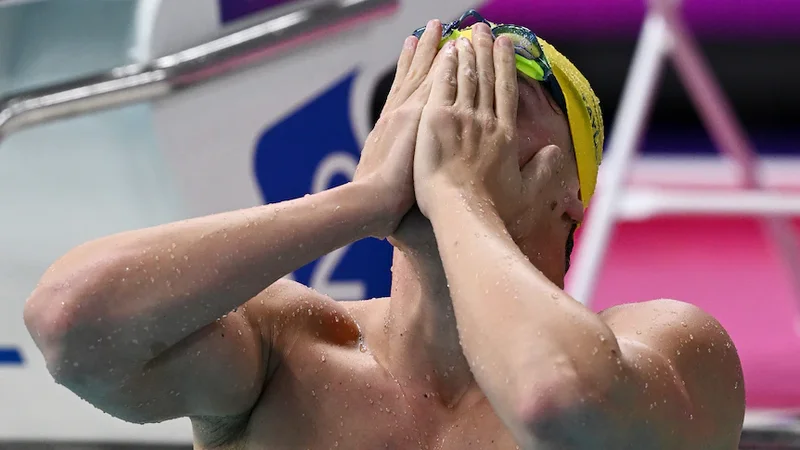
There's a ritual for Australians before every night of swimming at the Commonwealth Games: we run a rule down the schedule and count how many gold medals are locked in and how many others might be possible.
We did it on Tuesday, when the Dolphins' all-time gold medal record was in peril, ultimately equalled in the mixed 4x100m medley relay. And again on Wednesday, we knew the record would be broken, but by who?
The women's 50m freestyle was the first lock of the night, followed quickly by the men's 50m butterfly.
Trust this team to get greedy and nab three golds for the price of two races, with Kyle Chalmers and Ben Armbruster winning matching golds, trailed by Cameron McEvoy, just after Meg Harris led Alex Perkins and Shayna Jack in the first podium sweep of the night.
But neither were the first gold of the evening and the record-breaking 29th of the meet.
That honour went to young Kai Taylor, who won his first international individual gold medal with a wire-to-wire victory in the men's 200m freestyle.
Despite Taylor entering these Games as an elite 200m practitioner, he fell into the "possibly if not likely" category during that pre-night perusal.
More fool us, as his last 200m swim three days prior was one of the moments of the campaign for Australia.
After being a lead-off heat swimmer in the 4x200m freestyle relay at the Paris Olympics two years ago, the 22-year-old was chosen to anchor the final swim in Glasgow.
He entered the water about a body length and 0.24 seconds behind England's Max Litchfield and not only caught and put a gap on him within a lap, but powered ahead to a victory by 3.51 seconds.
But on Wednesday he swam a 1:47.23, two seconds slower than his personal best at June's trials, to qualify in seventh place.
He was placed in lane one for the final, and it seemed he simply wasn't feeling it on the day.
Taylor wasn't alive when Kieren Perkins famously won 1,500m gold from lane eight at the 1996 Atlanta Olympics. But many of us were.
Taylor's mum, Hayley Lewis, certainly was as a member of many of the same teams as Perkins.
All that to say, we should have known better. And Kai did.
"If you've got a lane, you've got a chance," he said.
"I managed to get myself into the final tonight after a bit of a slow swim this morning, but you've always got a chance when you're in the race, and I just went out there with no fear."
Unlike his stunning relay swim, he led the entire way, first staying clear of Jack McMillan and then the rest of the field that swallowed up the Northern Irishman but couldn't catch the Commonwealth Games debutant on his desperate charge for history.
Taylor's victory was followed by the aforementioned podium sweeps and victories in five of the final six races of the night.
That started with a swimmer at the other end of the spectrum as Lakeisha Patterson, one of only two swimmers returning to Glasgow after competing in 2014, flew home in the 100m freestyle S9 for her third Commonwealth crown.
Still somehow 27, it feels like "Lucky" has been around and will be around forever.
Australia has come to expect gold rushes from the Dolphins for decades, so much so that the epic victories and unrivalled dominance are frequently met by little more than a thumbs-up, while minor medals elsewhere at the Games are welcomed as historic events.
But Chalmers urged Australians not to take this moment for granted.
"We are in a golden era of swimming and it's not normal for swimmers to stand up and win gold medals and break world records, break Commonwealth Games records night in and night out," he said.
"But we draw so much inspiration from each other … we've got some generational talents on the team right now and I think we as a country really need to enjoy that while we can because it's not going to last forever."
Chalmers would know, having made his debut as a 17-year-old at the 2016 Olympics and winning one of Australia's three gold medals in the pool in Rio.
Ten years on, he is a seasoned veteran of the team with one eye on retirement.
Nothing is permanent in this game, so as the swimming ends and attention turns away from Tollcross, take a moment to recognise the brilliance we just witnessed.
Thirty-seven gold medals, 16 silver and 23 bronze. New names unearthed, old crowns getting a spit-shine and another reminder of this team's perpetual performances of the least appreciated but most anticipated feats of brilliance.