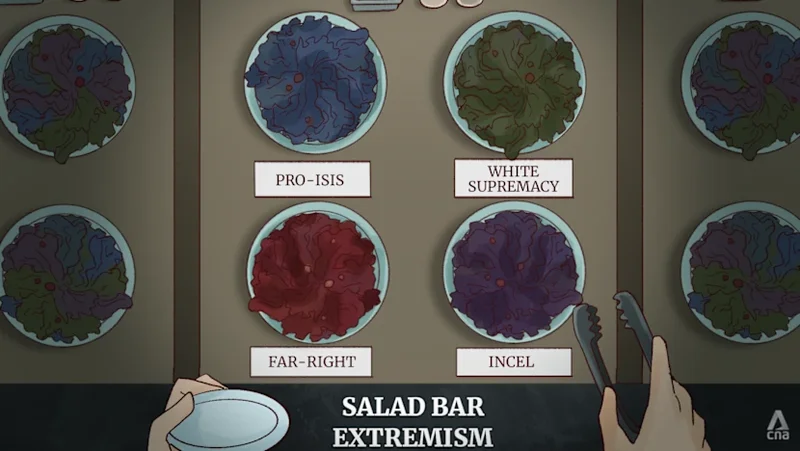
What is ‘salad bar’ extremism, and is a new rehab playbook needed to tackle this form of radicalisation?
In the last 10 months, the Internal Security Department (ISD) has handled at least three instances of “salad bar” extremism under the Internal Security Act.
SINGAPORE: As extremist threats shift beyond traditional ideological lines with the rise of “salad bar” extremism, detecting and rehabilitating radicalised individuals has become more difficult than before, said experts.
Also known as Composite Violent Extremism (CoVE), it has seen individuals assemble their own patchwork of ideologies, including conflicting ones such as pro-ISIS and far-right narratives, upon which they pursue violence.
This development has implications for rehabilitation, which has to address a more complex mix of ideological, psychological and behavioural influences in radicalised individuals. This means rehabilitation cannot rely on past playbooks, experts told CNA.
The term "salad bar" was made popular by former Federal Bureau of Investigation director Christopher Wray to describe individuals who pick and choose different beliefs and narratives, rather than subscribing to one ideology.
Researchers recently started referring to it as CoVE to better capture the complexity of these evolving pathways. Authorities in the United Kingdom have also used the term Mixed, Unstable and Unclear (MUU) extremism to describe it.
In Singapore, the Internal Security Department (ISD) faced the first case of salad bar extremism last September, when a 14-year-old boy was dealt with under the Internal Security Act (ISA). Since then, there have been similar cases.
In June this year, a 19-year-old youth was revealed to have been arrested for the same reason, while earlier this week, the ISD announced that it has detained a 14-year-old boy who was plotting a school attack.
WHY IS IT MORE DANGEROUS?
“For the individuals driven by CoVE, it is violence first, and ideology second. They will make their ideology fit their actions,” said S Rajaratnam School of International Studies (RSIS) professor of security studies Rohan Gunaratna.
The rise of salad bar extremism reflects an important shift in the threat landscape, noted Associate Professor Razwana Begum, head of global security and strategy at the Singapore University of Social Sciences.
“Traditionally, we tended to associate radicalisation with a single ideological movement,” she said.
However, individuals today are drawing from multiple sources, including conspiracy theories, anti-government sentiments, racial or religious hatred, geopolitical events, online communities and a fascination with previous attackers, she added.
This becomes dangerous as it is much harder to identify radicalised individuals, as they may not fit the traditional profile that security agencies, educators or even family members are familiar with, said Assoc Prof Razwana.
The 14-year-old in the recent case was radicalised by pro-ISIS thought, far-right extremism, including anti-Semitic and neo-Nazi narratives, white supremacy beliefs, and also violent gore and mass shooting content through the online True Crime Community.
RSIS associate research fellow Kenneth Yeo added that the “pick-and-choose nature” of such ideologies adds to the danger.
“Traditionally, there is an authoritative source of extremist ideology and counternarrative efforts could be directed towards it,” he said, noting that this does not really apply to salad bar ideologies where there is no need for coherence.
CoVE cannot be dealt with from a counter-ideological approach only, as it does not have a specific and relatively clear structure that can be deconstructed, analysed and countered, said RSIS dean Kumar Ramakrishna.
GLOBAL PHENOMENON
The rise of CoVE is not a new trend globally, but it is relatively new to Singapore, and the evolution of the social media landscape has played a big part in the rising number of cases, said experts.
“It does appear to be a global phenomenon, not just something that appears in certain societies,” said Prof Ramakrishna.
He said that any ideological strain accessible on social media can be pulled together to produce a composite mix of ideological tropes, such as antisemitism, anti-LGBTQ, pro-ISIS and white supremacy views.
United States authorities are also observing the emergence of Nihilistic Violent Extremism (NVE), in which the radicalised individual just engages in violence for no clear ideological reason.
“NVE extremists essentially engage in violence for violence's sake. NVE is particularly influenced by the online True Crime Community, which valorises mass shooters,” said Prof Ramakrishna.
The True Crime Community is a broad, decentralised online subculture where individuals glorify, celebrate and exhibit fan-like behaviour towards perpetrators of extreme violence.
While some narratives are more influential drivers of CoVE since they clearly define an enemy to the cause, fringe conspiracy theories and fantasy role play have also been featured in some cases abroad, said Mr Yeo.
Experts said that the fast-changing social media landscape and online algorithms only make the CoVE challenge tougher to tackle.
“Increasingly, we also need to recognise the role of recommendation algorithms, social media and generative AI in exposing individuals to a wide variety of narratives that reinforce one another,” said Assoc Prof Razwana.
People are no longer radicalised in “neat, predictable ways”, and may move rapidly across different online communities, adopting fragments of different narratives, she said.
“That is why I think we need to shift our focus from simply asking, ‘what ideology does this person follow?’ to ‘what behaviours are emerging’,” she said.
This means that apart from looking out for traditional indicators, like slogans, flags or symbols, there is a need to pay attention to how people act, such as individuals becoming more withdrawn and spending more time online.
However, Assoc Prof Razwana noted that this does not mean becoming suspicious of every young person who becomes quieter or spends more time online.
“Many of these behaviours are common and, on their own, do not indicate radicalisation. What matters is the overall pattern and whether there are multiple concerning changes occurring together," she said.
SHALLOW, BUT A THREAT
On Monday, the ISD said that individuals radicalised by CoVE may have “a shallow understanding of various extremist ideologies, and their support for such ideologies may be fluid”.
Experts told CNA that just because there is a shallower and more superficial level of understanding, it does not mean the threat is any less.
In fact, the simplified narratives can sometimes be even more persuasive, as they reduce complex issues into emotionally compelling messages, and provide a clear enemy and sense of purpose or belonging for radicalised individuals.
“It does not take one with sophisticated comprehension of any ideologies to adopt a violent extremist position on issues. Extremism is driven by anger and grievance instead of comprehension,” said Mr Yeo.
Superficial knowledge should not be mistaken for a lower level of risk, as research has shown, said Assoc Prof Razwana.
“Research on lone-actor terrorism has long shown that individuals do not need sophisticated ideological understanding to commit acts of violence. Sometimes ideology functions more as a justification than the primary motivation,” she said.
People radicalised by CoVE are likely to have more potential triggers for violence, given the multiple extremist ideologies they subscribe to, which can escalate from radicalised beliefs to violent actions.
        Listen:


  ## A NEW REHAB PLAYBOOK
Experts said that given that the number of CoVE cases in Singapore is quite small so far, there is insufficient evidence to conclude that rehabilitating such individuals necessarily takes longer or is inherently more difficult than single-ideology cases.
However, it is certainly a more complex issue and a new approach may be needed beyond the traditional playbook, said experts.
When someone has been influenced by multiple narratives, rehabilitation is no longer just about addressing ideology, but also factors like identity issues, unresolved trauma, emotional wellbeing and family relationships, said Assoc Prof Razwana.
“This naturally requires a multidisciplinary approach. Psychologists, counsellors, social workers, educators, family members and, where appropriate, religious or ideological mentors all have an important role to play. No single profession can address all the different factors that contribute to radicalisation,” she said.
Dr Joachim Lee, a volunteer religious counsellor and mentor for youths, said that while CoVE extremists are “not necessarily harder to rehabilitate”, they are often more complex because the individual has drawn from multiple, sometimes contradictory, extremist narratives.
When it comes to youths, early intervention is especially important, said the founder of Neuro-Therapy clinic.
“Adolescence is a period of significant brain development, making young people more vulnerable to online manipulation but also more responsive to timely rehabilitation,” said Dr Lee.
Prof Ramakrishna also agreed that tackling CoVE radicalisation is “less straightforward”, comparing it to the authorities’ experience of dealing with the Jemaah Islamiyah back in the early 2000s.
Back then, the Religious Rehabilitation Group could deconstruct extremist views and debunk them using mainstream understandings of the faith. The approach became the key plank of its rehabilitation effort, he said.
However, that approach is “insufficient” in addressing the “often haphazard ideological mix of ideas” under CoVE, which also requires building up the intellectual, emotional and social resilience of impressionable youth to violent extremism, said Prof Ramakrishna.
While religious counsellors may have taken the lead in the past, today digital and media literacy and balanced understandings of hot-button geopolitical issues, such as the Middle East conflicts, are equally crucial, he said.
Community support for stable families with pro-social, approachable and available older family members to guide youth is also vital in tackling CoVE, said Prof Ramakrishna.
Ultimately, the success of rehabilitation efforts is not measured by whether someone can recite the ‘right’ ideology,” said Assoc Prof Razwana.
“It is measured by whether they reject violence, reintegrate safely into society and develop the resilience to navigate future challenges without turning to extremism,” she said.
Given the complexity of this threat, a new rehabilitation playbook and programme may have to be designed, said Prof Gunaratna.
“It is a persistent global and regional threat with over 100 cases in Indonesia, Philippines and Malaysia,” he said. “Singapore can learn from other case studies.”
However, the government and community partners will have to develop their responses, as Singapore’s environment is unique, he said.
Experts said that Singapore is well-positioned to build on its established rehabilitation regime in developing its approach to the rise of CoVE.
“Rehabilitation programmes in Singapore have traditionally adopted a holistic approach to deal not only with ideology, but also psychology and social support. I believe this approach should continue,” said Mr Yeo.