New party Wawasan wants to offer ‘something fresh’ in Malaysian politics, but Bersatu shadow looms
The new party’s secretary-general Saifuddin Abdullah tells CNA it wants to offer a more moderate and inclusive brand of politics, but analysts argue it must first prove its relevance, starting with the upcoming Negeri Sembilan state polls.
KUALA LUMPUR: Barely two months after its launch, Parti Wawasan Negara (Wawasan) will make its electoral debut in the Negeri Sembilan state election this Saturday (Aug 1), testing whether the party led by opposition leader Hamzah Zainudin can carve out a place in the Perikatan Nasional (PN) coalition.
Wawasan is contesting four seats under the PN banner.
The new party’s secretary-general Saifuddin Abdullah told CNA in an interview that he is hopeful that given PN’s partnership with the Barisan Nasional (BN) pact, they can win enough seats to wrestle the state from Prime Minister Anwar Ibrahim’s Pakatan Harapan (PH).
PN is the federal opposition bloc while BN and PH are part of Anwar’s unity government though the latter two are rivals in the Negeri Sembilan state polls as well as the recent Johor election.
Saifuddin added that Wawasan aims to appeal across racial lines and should not be viewed as a direct replacement for the Malay-centric Parti Pribumi Bersatu Malaysia (Bersatu).
Both Hamzah and Saifuddin were sacked by Bersatu earlier this year before they formed Wawasan.
“We would like to fashion ourselves as a party that represents the 'Malaysian face'; not (just) a Malay-Bumiputera party but (one that) is open to all in accordance with the Malaysian demography,” Saifuddin, a former foreign minister, said in the interview on Jul 24.
“We want to serve all. Hence we need the support of all.”
However, analysts told CNA that it would not be easy for the young party to do so given its past links to Bersatu. They added that its performance in the Negeri Sembilan polls will shape its fortunes moving forward and its place within PN.
A “FRESH” START
Wawasan is a rebranding of Parti Cinta Malaysia, a minor political entity that has never won any seats since its establishment in 2009.
Saifuddin said that Wawasan is open to members of all races and religions, pointing to its leadership lineup that includes deputy president Tan Lek Khang, two non-Malay vice-presidents as well as six non-Malay supreme council members.
Wawasan would mirror Anwar’s Parti Keadilan Rakyat in its make-up more than any other party in Malaysia, Saifuddin conceded.
But he would not label Wawasan as a full-fledged multiracial party, saying that many parties claim the label while remaining single-race dominant.
“You see, there's another term about multiracialism that is a ‘multiracial mask’. So we want to be a true, genuine Malaysian face and not wear a multiracial mask.”
On what it brings to the table, Saifuddin told CNA that Wawasan aims to act as a bridge between parties both within PN and beyond the coalition.
He said that its leader Hamzah, for instance, was “instrumental” in bridging the gap between the United Malays National Organisation (UMNO) and Parti Islam Se-Malaysia (PAS) that eventually led to the formation of an electoral pact in the Negeri Sembilan election.
UMNO and PAS are the lynchpin parties of the BN and PN coalitions respectively. The two are also Malaysia’s two largest Malay-Muslim parties and have had their fair share of run-ins previously.
Malay-centric Bersatu is also part of PN, but its ties with PAS have been strained of late and it is contesting the Negeri Sembilan polls on its own and will face off against its coalition partners.
“(Hamzah’s) only interest is to build a bridge between all the bigger parties and it so happened that the bigger parties are the Malay parties,” said Saifuddin.
“The (Wawasan) party was formed out of necessity. It was never the intention to leave Bersatu. But I think when we formed Wawasan, the idea was not to replace Bersatu. The idea is to come up with something new, something fresh,” said Saifuddin.
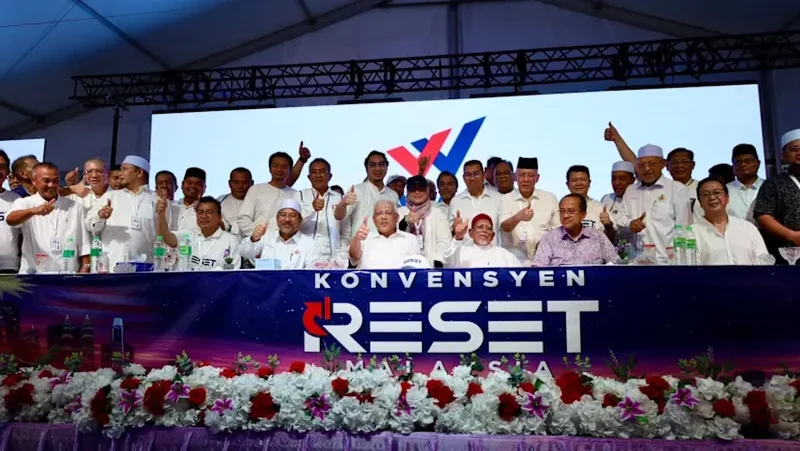
After his sacking by Bersatu in February, Hamzah had launched the “Reset” movement, a political platform geared towards national reform, before unveiling Wawasan on Jun 13.
This came days after PAS unilaterally decided to sever ties with Bersatu, claiming that the latter had become “power-hungry” and failed to prioritise Malay-Muslim unity in the country.
At least 19 parliamentarians are reportedly backing Hamzah, some of whom are still with Bersatu.
Besides Hamzah and Saifuddin, those who are aligned with the party include Tasek Gelugor MP Wan Saiful Wan Jan, Machang MP Wan Ahmad Fayhsal Wan Ahmad Kamal, Gerik MP Fathul Huzir Ayob and Padang Rengas MP Azahari Hasan.
A national PAS leader who did not want to be identified told CNA that Wawasan is expected to take over Bersatu’s role within PN, serving as a bridge to soften the Islamist party’s hardline image.
“Bersatu's role was, in a way, to soften the perception of PAS, which is sometimes labelled as radical, overly Islamic, or carrying a hardliner image. Wawasan would do the same,” he said.
DOING THINGS THE “MODERATE WAY”: SAIFUDDIN
Saifuddin said that Wawasan wants to move PN away from its conservative "green wave" image linked to rising Malay-Muslim conservatism, towards what he described as more moderate, consultative politics.
“I know it's very difficult, but if you cannot become centrist, then at least try to become a centre-right politician rather than a real rightist politician. Because practically speaking, Malaysians are by definition very, very centrist and very, very moderate,” he said.
To build toward these grassroots ambitions, Wawasan’s plans include setting up divisions nationwide and launching a membership drive across Malaysia.
Saifuddin said that when Hamzah initially launched the “Reset” movement, about 120 out of 160 Bersatu division chiefs joined, leaving Bersatu with around 40.
He said that they were targeting to form about 150 divisions all around the country.
When it comes to leadership at the divisional level, Saifuddin said there was a need for a practical and pragmatic approach.
"For places which are Chinese-dominated, it is very clear that it should be a Chinese head," he said.
At the same time, Saifuddin argued that non-Malays should not fear political discussions surrounding Malay unity, claiming instead that greater unity among Malays and Muslims actually creates a “safer” environment for non-Malays.
He claimed that when there is no unity among Malay-Muslims, they would “suffer from psychological effects” and instead look at non Malay-Muslims as if they were out to grab their land and livelihoods.
“The psychology is very straightforward, very simple.”
Saifuddin also claimed that the current unity government led by Anwar has the support of a very small percentage of Malay-Muslims, but about 70 per cent or 80 per cent of the minorities. Inversely, he claimed that the opposition has almost 90 per cent support of the majority Malay-Muslims, but less than 10 per cent support of the minorities.
“That is not stable Malaysian politics … I'm just laying down the cards on the table, this is exactly what is happening,” he said, adding that the collapse of the then-PH government in 2020 led by Mahathir Mohamed was caused by the lack of Malay support for the government.
Saifuddin said that the Negeri Sembilan polls would be the first “experiment” to test the viability of any pact between BN and PN in the future.
PN is contesting 11 seats while BN is contesting the other 25, as they join forces against Anwar’s PH in the 36 seats up for grabs. Before the dissolution of the state assembly, PH held 17 seats, BN 14, and PN held five.
In the 2023 state election, PH collaborated with BN after both coalitions formed the unity government following the hung parliament resulting from the 2022 general election.
Saifuddin said that he was cautiously optimistic that PN and BN would be able to get at least a simple majority in the state. A party or coalition needs to win at least 19 seats to form the government in the 36-seat Negeri Sembilan state legislative assembly.
“As far as the campaign is concerned. I think it is very clear that BN leaders are openly saying to vote for PN candidates and vice-versa. So I'm very hopeful that there will be a transfer of votes between the two blocs,” he said.
“If we can be very successful in Negeri Sembilan, then perhaps part of the problem is already solved,” he said when asked about how tough seat negotiations would be in the future if PN and BN were to continue its partnership in future elections, including the general election.
CHALLENGES AHEAD FOR WAWASAN
Analysts whom CNA spoke to said that for now, Wawasan would not be able to shake off the label of being a Bersatu replacement.
This is especially so given that its ranks are heavily populated by former Bersatu figures and its survival within PN relies closely on political alignment with PAS.
They also said that Wawasan would have to settle into the role of a junior partner in PN for now and prove itself in the upcoming Negeri Sembilan polls in order to give itself a fighting chance in the long term.
Azmi Hassan, a senior fellow at the Nusantara Academy for Strategic Research, said that the party must, for a start, establish its viability by outperforming Bersatu in vote share.
"If Wawasan can do that, it would show that they are much more accepted than Bersatu and can be accepted at a national level. That is their biggest challenge in the short term,” he said.
He also cast doubt on the fresh politics they espoused, questioning the appointment of certain figures into Wawasan, such as former minister Rais Yatim, 84, who is the party’s chairman.
“Unlike MUDA for example, you can see that their candidates and leadership structure is made up of those from the younger generation, but I don’t see this in Wawasan. It seems like the same old same old,” he said, referring to the youth-centric Malaysian United Democratic Alliance party.
Similarly, political scientist Syaza Shukri of the International Islamic University Malaysia (IIUM) told CNA that Wawasan's formation felt like an attempt by certain leaders to carve out a new political space for themselves.
“It claims to lead the ‘Reset’ movement but like most people have said, it feels more like a reset for Hamzah and his supporters than a reset for the country,” she said.
Syaza added that while Wawasan may attempt to project a “Malaysian” image, it still fundamentally felt like another Malay-based party due to the political history of its leaders.
“Maybe they can change and the current leadership is ethnically mixed but I feel they need to prove themselves, walk the talk basically,” she said, adding that the party’s best chance of success was if it could stay relevant within PN.
Socio-political analyst Awang Azman Awang Pawi of Universiti Malaya noted that Wawasan is currently viewed as latching onto PAS, which acts as the dominant coalition partner in PN.
Awang Azman also believes it remains uncertain whether PAS will allow another party, as Bersatu did previously, to lead and control the coalition's narrative.
“PAS is also growing in strength and confidence, meaning Wawasan would not be seen as a leader, but rather as a means to complement PN,” he said.
“They can try to build a new narrative, but they will have to prove themselves,” he added.