Singapore’s Como Group is taking its understated luxury hotels to the world
CEO Olivier Jolivet is steering the homegrown hospitality group into its next chapter, with new properties in France, refreshed hotels in Asia and Como Metropolitan Singapore as a test bed for wellness innovation.
There is a perpetual hum on Orchard Road, a steady thrum of traffic, footsteps and city noise that rarely seems to fully switch off, even late at night. But up in my corner room at Como Metropolitan Singapore, as I sink deeper into the pillows, all I hear is the gentle, rhythmic sound of waves lapping around me.
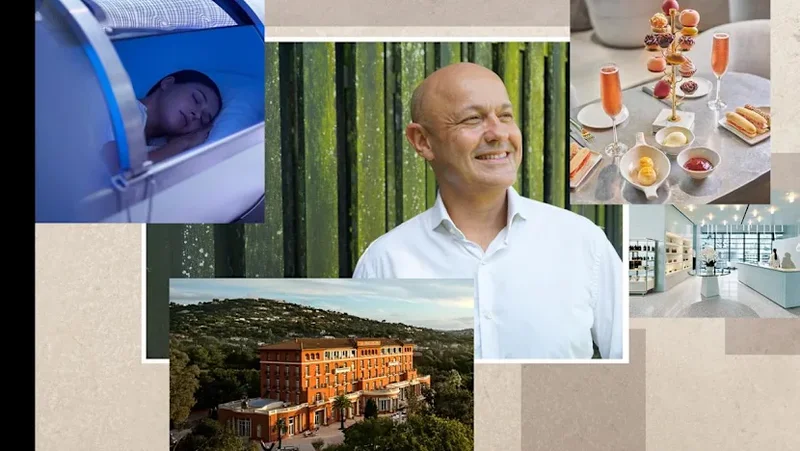
Credit goes to the in-room SleepHub, a device that plays low-frequency sounds designed to support natural sleep cycles – a new addition the hotel has introduced to help guests wind down.
Maybe it really did its job. Or could it have been the food coma from an excellent carnivorous feast at Korean Steakhouse, Cote, on the third floor? Perhaps I was simply exhausted from accidentally blowing my budget at the Club21 boutique downstairs, which, dangerously, happened to be holding its mid-year sale.
Whatever the case, I fall into a deep, dreamless sleep and awaken refreshed the next morning to birdsong in a forest. Courtesy of SleepHub, of course, which can also function as an alarm clock, gently bringing its soundscape back as the sleep programme ends.
After a workout at the state-of-the-art gym at the 9,000 sq ft flagship Como Shambhala, followed by a 60-minute hyperbaric oxygen therapy session, which is offered as a recovery treatment, I decide that virtue deserves a reward and treat myself to tea at French patisserie Cedric Grolet, complete with the trompe-l’oeil pastries for which he is known.
It has been 24 hours and I have yet to step outside Como Orchard, which is very much by design, according to Olivier Jolivet, chief executive officer of Como Group. When the development launched in 2023, the idea was to bring as many facets of the group as possible under one roof.
After all, while the Singapore-headquartered group has an international hotel portfolio spanning destinations including Bhutan, Thailand and the Maldives, as well as luxury fashion retailer Club21, Como Metropolitan Singapore is its first hotel in its home city.
“The idea of Como Metropolitan Singapore was to bring everything into one. Singapore is our headquarters, our home base, and we wanted to have a place where we could bring all that experience together,” the Singapore-based Jolivet said.
In some ways, the hotel is also a laboratory. Singapore, with its appetite for novelty, has become a testing ground for some of the brand’s wellness-meets-technology ideas before they are considered for the wider portfolio.
This particular hotel is also in some ways, a laboratory. Singapore, with its appetite for novelty, has become the place for the brand to test some of its wellness-meets-technology ideas before considering them for the wider portfolio.
Besides sleep technology, the hotel’s lobby is also home to Bruno, a two-armed robot barista that can pull espresso and froth milk for a cappuccino. Other wellness formats such as different Pilates techniques and breathwork coaching have also been introduced first at Como Shambhala Singapore.
“Wellness is definitely the big game changer in luxury hospitality today. Increasingly, this is not something guests visit for an hour at the spa; it is woven into the entire destination experience,” he said.
While buzzwords like wellbeing and longevity are now de rigueur at just about any five-star hotel, it is not a recent pivot for the group. Founder and luxury lifestyle doyenne Christina Ong created Como Shambhala around three decades ago and has consistently insisted that wellness remains a touchpoint throughout the group’s businesses.Jolivet, who joined Como in 2017 after holding senior roles at Aman Resorts, has long been drawn to the meticulous, detail-oriented nature of Asian luxury brands. “I think the best hotels and the best service in the world are still in Asia because here, it is an honour and privilege to serve,” he said.
The group remains privately held and founder-led, which Jolivet sees as increasingly rare in a hotel landscape dominated by large groups and shifting ownership structures. “It is a bit like the Patek Philippe of the hospitality industry. Como is one of the only brands in the world of luxury that is still owned by the owner-founder and will never be for sale. And she makes sure every detail of the brand is looked after,” he observed.
Taking this long view also explains why Como is comfortable with selective rather than aggressive growth. The group’s recent expansion in France – including Como Le Beauvallon on the French Riviera and Como Cordeillan-Bages in Bordeaux – is “a little bit of a stretch” by its standards, Jolivet said, given its preferred pace of opening a new hotel every year or two.
The point, he said, is that Como is not simply planting flags in marquee destinations. Growth only makes sense when a property can offer a more meaningful stay. Travel, in this view, is no longer necessarily about checking into a grand hotel and visiting famous landmarks, but finding experiences that feel more personal and rooted in a destination.
For Asian travellers in particular, Jolivet, whose wife is Singaporean, believes this desire for deeper travel has become increasingly pronounced. “When Singaporeans travel, they like to live the local life, have the local food, visit the market and meet people. It is really about enrichment,” he said.
Correspondingly, the brand’s differentiating factor goes beyond the “brick and mortar hotel” to curating immersive experiences that showcase the soul of a destination. In Burgundy and Bordeaux, part of the strategy was to create hotels offering a standard of hospitality familiar to Asian travellers, in regions where high-end options have traditionally been more limited. But the additional X factor lies in what happens beyond the hotel walls.
Recognising that many Asian guests travel with extended family, Como has incorporated experiences designed to appeal across generations, from wine tastings and vineyard cycling to market visits, cooking with chefs and, in Bordeaux, the chance to create a personalised wine label with a winemaker.
“Our edge is creating amazing experiences that cannot be replicated, whether it is an Arctic experience, playing with a tennis star in Wimbledon or truffle hunting in Tuscany,” he said.
At the same time, Jolivet is focused on renewing some of the brand’s best-known properties closer to home. Como Metropolitan Bangkok fully reopened in late 2025 after being reimagined by Italian designer Paola Navone, while Como Shambhala Estate in Bali is undergoing an extensive renovation around its 20th anniversary.
The point, he said, is to ensure that Como’s flagship properties continue to reflect the evolving needs of its guests, many of whom he describes as “second summit seekers”: travellers who have already scaled the first peak of success – the career, the income and the passport full of Four Seasons and Mandarin Oriental stamps – and are now searching for something less immediately visible.
“They are now looking for something more internal, that goes deeper into emotional and personal fulfilment.”
And perhaps, in a world that just keeps accelerating, this is what the second summit is really about: the opportunity to rest better.