Branded Content
For Gen Z drivers in Singapore, EVs are as much about tech as transport
Survey suggests that Gen Z car owners are the most receptive to electric vehicles, citing reliability and practicality
Jan Lee, Brand Newsroom
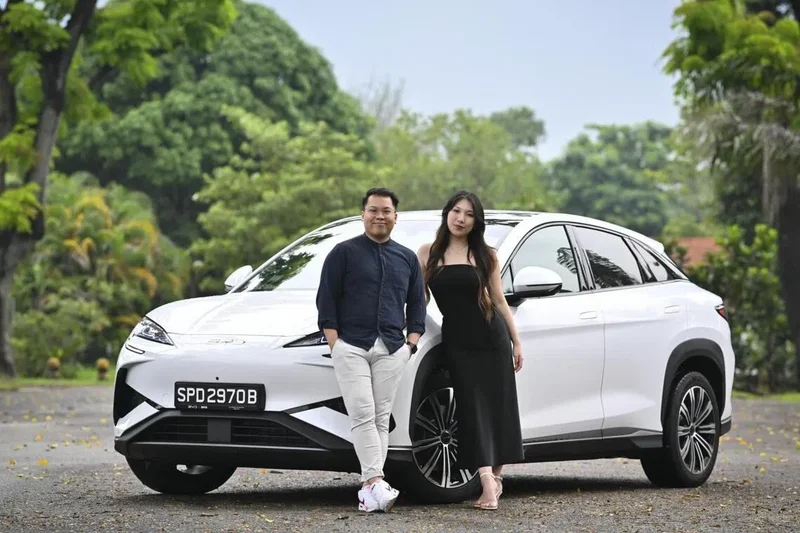
Kennedy Yong appreciates never having to return to an unbearably hot car anymore – not even after it has been parked under the sun for hours.
Whenever he is ready to leave, the 28-year-old real estate agent simply switches on the pre-cooling function through his phone. By the time he reaches the car park, his electric vehicle (EV) is already cool.
It is one of the features that persuaded Yong, who drives a BYD Sealion 7, to switch to an EV six months ago. He had previously driven a second-hand petrol car for three years.
Yong was enticed by the technological features of an EV – functions that the petrol cars he was considering do not have, he says.
His experience reflects a broader shift among younger drivers who emerged as the most enthusiastic supporters of EVs – drawn to a combination of convenience, technology and sustainability.
In a February 2026 survey of 1,055 petrol, hybrid and electric car owners, 77 per cent of Gen Z drivers (aged between 18 and 29) feel that EV technology is reliable while 76 per cent of them said EVs are practical for everyday use – the highest among all age groups.
Eighty-five per cent of them believe that EVs will help to reduce carbon emissions.
The survey was commissioned by SPH Media and BYD. Respondents were sourced from the Kantar Profiles Audience Network. Kantar is an independent market research company.
More convenience
The shift is felt most in how the technology fits into Yong’s daily routine. Beyond pre-cooling the car, the BYD app also allows him to remotely control most of its internal accessory functions, and monitor the battery level and charging status in real time.
He regularly ferries his wife and parents around in his EV, clocks around 2,000km a month and charges his car every three to four days using shared public chargers.
The app lets him monitor how long it takes to charge his car, aspects of his vehicle’s health such as tire pressure or steering system. He can also check whether his doors are securely locked.
The tech-enabled experience took some adjustment. “In my first week with the EV, I brought the keys out with me,” Yong says. “Then I slowly realised it was just an extra thing I had to carry in my pocket, and once I got used to (using my phone), it was very convenient.”
With Singapore’s high upfront taxes on cars, affordability remains a major consideration for Gen Z car owners, says general manager of automotive platform Sgcarmart Julian Kho. But he has seen a clear increase in EV adoption since around 2022 among younger buyers, especially as EVs moved from “niche to normal”.
EVs accounted for 62.4 per cent of the 27,144 new cars registered in the first half of 2026, according to data from the Land Transport Authority. 2026 marks the first year of EVs overtaking petrol and hybrid vehicles in new car registrations in Singapore.
Registration of new petrol-only vehicles will cease in 2030, to align with Singapore’s goal of cleaner vehicles-only by 2040.
Kho says: “Younger drivers often judge vehicles like consumer electronics: User interface, connectivity, app functions, driver assists, over-the-air updates, digital keys, remote pre‑cooling – these features can outweigh traditional ‘badge value’.”
It is a pattern that Chinese EV maker BYD has observed in the Singapore market as well.
“We do see growing interest from younger consumers, particularly millennials and younger professionals, as they tend to be more open to new technology and more familiar with electrification,” says James Ng, BYD Singapore’s managing director.
BYD is the top-selling car brand in Singapore, accounting for about one in four of the 27,144 new cars registered in the first six months of 2026.
Drivers below 35 make up about 10 per cent of BYD Singapore’s customer base, though Ng notes that the Certificate of Entitlement (COE) prices remain a key barrier to car ownership for many younger Singaporeans.
Content creator Silvy Wang, who switched to driving EVs in 2023, was also drawn to the tech-enabled features. For Wang and her husband, both 27, using apps to manage their car feels natural.
“I like being able to monitor things like battery range and charging through the app,” she says. “It just makes everything feel more seamless and convenient.”
“It’s very straightforward to locate chargers, track your charging, and make payment all in one place,” she adds.
Less emissions a bonus
Beyond technology, the survey findings suggest that sustainability is also part of the equation – though it may not be the starting point.
Wang, who gave birth to a daughter in March, says she chooses cleaner and more energy efficient options where she can.
“I think becoming a mother has definitely made me more aware of the kind of environment my child will grow up in, so sustainability matters to me more now than it used to,” she says.
But practicality is still key. An EV is more convenient than a petrol car for Wang, since she lives in a landed home and has a private charger.
Price, convenience and time consistently rank the highest when it comes to Gen Zs choosing transport options, says environmental economist Alberto Salvo, who ran a project in 2024 that surveyed National University of Singapore (NUS) undergraduates on modes of travel.
“I don’t think people enjoy creating pollution or emissions,” says Salvo, who is also associate professor and dean’s chair at the department of economics at NUS. “They prefer a cleaner environment,” he adds, but sustainability is rarely the main driver.
Kho agrees: “Younger buyers do care (about sustainability), but in the Singapore market, sustainability tends to be a reinforcer rather than the sole purchase trigger.”
“When the cost and tech case are already strong, sustainability becomes the ‘feel-good’ factor that seals it,” he adds.
A stronger focus on practicality is what BYD is seeing not just among Gen Zs, but more broadly across age groups, says Ng. It is partly why the EV maker introduced its plug-in hybrid models in Singapore last year, as an alternative for drivers who want lower fuel consumption and emissions than conventional petrol cars.
Unlike conventional hybrid cars, its plug-in hybrid models use a “dual mode intelligent” (DM-i) system which prioritises electric driving instead of the petrol engine, Ng shares.
BYD’s plug-in hybrid cars offer up to 80km of EV range, which Ng says is generally sufficient for everyday use in Singapore. When the battery level is low, the internal combustion engine then steps in to help recharge the car so it can go longer distances.
For Wang, sustainability and practicality are not in conflict, but they have a clear order. And EVs fit both, for a growing number of younger drivers like her.
“It’s less about making a ‘perfectly sustainable’ choice, and more about choosing options that make sense for my lifestyle while being better where I can,” she says.
- In Perspective is a research-led content programme by SPH Media that combines insight-driven storytelling with expert perspectives on key issues shaping society.
In partnership with BYD