Your people get AI. Get out of their way.
We are all using the same tools. Companies that win will be the ones willing to trust the people who already understand them.
Here’s a number more people should be talking about: Ninety-five percent of corporate AI projects go nowhere. MIT looked into why, and the answer had nothing to do with the tools being used. It was the companies using them.
I recently had two conversations that explain almost everything about why so many companies are finding it challenging to find success using AI. These two conversations were with people in different industries trying to use the same tools, with wildly polarized outcomes.
The thing that separated them was the size of the companies and everything that comes along with that: layers of bureaucracy, the amount of process for approvals, and the hundred years of history about who gets to make a decision.
The first was a friend who runs UX at a hundred-year-old manufacturer, the kind of place with real factories and a brand your parents would recognize. She’s sharp, and she figured out how to build with AI fast. Unfortunately, her company has not. It only recently even decided digital mattered, and leadership’s entire AI strategy has been to tell everyone to move faster without telling or educating anyone how to do that.
Her product managers are basically opening Claude and building things before anyone’s agreed on what they’re actually building, creating dozens of half-baked products, blooming with no strategy. She’s the head of UX, senior to those PMs, the one person who could point all that energy in the right direction, and she can’t.
She’s stuck waiting on IT to approve access to the same AI tools her team is already using, asking again and again for permissions that never come, while people with a fraction of her judgment ship mediocre products that solve no real problem.
The second conversation was with an engineering lead on a small product team I work with, the kind of team where the founder is still in the room for the calls that matter. We were working out how design gets approved, and on a small team, the default is to let all the stakeholders weigh in and end up with design by committee, which reliably produces the worst version of anything.
To his credit, he shut that idea down before it even started. For the day-to-day, he said, he and the designer would make decisions together and keep moving. Only the genuinely big questions would go to the founder or the full team.
The insight really came when he told the founder his job, at this point, was to be a filter that removes the small stuff, so her attention was saved for the few decisions that actually needed her. Thus removing any need for committee-based decisions.
Both of these companies were approaching their process with the same tools, such as Claude and Cursor. The difference is that one of them is small enough to let a good decision happen with trusted team members, and the other has spent a century building machinery to guarantee that no decision happens without permission.
This makes it look like a big-company problem, and it mostly is, but not entirely. What’s really separating these two companies runs deeper than size: whether the people on top trust the people doing the work enough to get out of their way.
A hundred-year-old manufacturer can choose that as surely as a five-person startup can. Most of them just won’t.
It was never about the technology
In the end, the overall challenge is not AI. Most companies are built, top to bottom, to reward control to the people who own the process, who sign off, who run the departments, and it rewarded them for a good reason, because for a hundred years, making the thing was the hard part, and whoever could marshal the making earned the promotions and praise.
Gary Hamel has spent years making the case that hierarchy was really our answer to scarce information. When the person at the top was the only one who could see the whole picture, routing every decision up to them made sense, and the skill of commanding and coordinating all that work was genuinely rare.
Neither of those things is true anymore.
Everyone can see the forest through the trees now, and the rewards we gave to managing the makers, that we spent a century promoting people for, stopped being the rare, valuable thing it used to be.
As we know, making isn’t the hard part anymore, which means the archaic systems that we built to find and promote and protect the controllers are now the single biggest thing standing between your company and the people who already know what to do.
Your people already cracked it
Ethan Mollick has a name for the people at your company who quietly cracked this: secret cyborgs. They’re using AI to do better work, faster, and they are deliberately not telling you, because the rules your company wrote about AI were written out of fear, and admitting you used it feels like admitting you’re replaceable.
Microsoft and LinkedIn’s Work Trend Index put real numbers on it: roughly three in four knowledge workers already use AI at work, most of them smuggling in their own tools without approval, and more than half won’t cop to using it on anything that matters. McKinsey caught leaders lowballing their own employees’ AI use by a factor of three, and concluded, in the most polite consulting voice imaginable, that the bottleneck isn’t the workforce. It’s leadership.
Think about that. People adapted on their own. They adapted so fast and so quietly that you didn’t even see it, and the reason you still can’t is that they’ve already learned it isn’t safe to show you.
The machinery in the way
Here’s why companies can’t catch up, and it has nothing to do with how smart leadership is or how much time they’re willing to put in.
We’re in the middle of a generational shift, and it’s forcing a reckoning with out-of-date structures, out-of-touch policies, and a plain fear of change.
Steve Blank calls that accumulated mess organizational debt, the structural cousin of technical debt, quietly compounding until it becomes the thing holding you back.
Sixty years ago, Douglas McGregor split management into two theories. Theory X assumes people need to be watched and directed or they’ll coast. Theory Y assumes people, handed something worth doing, will run at it. Most companies say Theory Y in an all-hands and are built, brick by brick, as Theory X. Every gate, every approval, every “loop me in before you do anything” is a small monument to the belief that the safest place for a decision is one level above the person doing the work.
Gary Hamel, again, has spent a career putting a price tag on that belief: the sheer drag of bureaucracy, the layers whose entire output is permission. In the world we just left, that “drag” was survivable, the tax you paid for coordinating a lot of people. In this one it’s fatal, because the thing bureaucracy is worst at protecting is the thing that suddenly matters most: a fast, trusted, human call about what’s worth doing.
Marty Cagan has been yelling a version of this at the product world for years. There are teams you hand a solution and tell to go build it, and teams you trust to find the right problem and solve it. The first kind ships what it’s told. The second kind decides.
You’re gonna be shocked at which one AI just made ten times more valuable, and which one most companies are historically structurally yearning to produce.
What the grip costs you
This is where it gets expensive. Amy Edmondson’s whole body of work on psychological safety says people only bring you their real thinking, their misfires, their weird experiments, when it’s safe to do it. A company that treats AI use as a compliance risk instead of a superpower is quietly instructing its best people to keep their best work in a locked drawer.
Get Dan Maccarone’s stories in your inbox
Join Medium for free to get updates from this writer.
Daniel Pink wrote a book on what actually moves knowledge workers, and, guess what, it wasn’t control! It was autonomy, mastery, purpose. Grip the wheel too hard and you don’t just slow your best people down, you bore them.
Bored people with rare, portable skills do not stay bored for long. They leave. Usually for a leader who says yes and gets out of the way.
Nobody gives up status without a fight
So why won’t some companies just loosen up? Because you’re asking the people with the most power to volunteer that the thing which earned them that power counts for less now. The classic executive who climbed the corporate ladder by being the sharpest maker in the building now runs a building where making isn’t the valuable part anymore.
Nobody gives up status without a fight, so instead of loosening the grip, they tighten it.
They add a review, ask to be looped in, invent a new step that plants them in front of the work, because if they can’t be the sharpest maker in the room anymore, they can at least be the one whose sign-off you still need. Das Narayandas dug into why AI rollouts stall and found the culprit hiding in plain sight: the tools threaten the identity and status of the very people who have to approve them. It shows up as one more approval step, one more “let’s align first” before anyone’s allowed to actually get the work done.
That’s a genuinely disorienting place to stand, and the most human response available is to hold on tighter. Add a review. Ask to be looped in. Erik Brynjolfsson has shown that the payoff from a general-purpose technology always lags, sometimes by years, and that the lag is the organization slowly, painfully rebuilding itself around the new reality.
None of this waits for you. The gap between what your people can do and what your company will let them do is widening every day, and you are the one holding it open. Call it governance if it helps, but the reality everyone that matters knows it’s fear.
How it actually changes
Corporations aren’t doomed…yet. Real change doesn’t come from an announcement, though. Not a company-wide email, not an all-hands about how everything’s different now, not a Claude access for every employee and a declaration that “we’re into AI now!” Those are all just the noises companies make when they want credit for change without actually doing it.
They change the way they always have, through one person other people actually trust. Nancy Baym’s research at Microsoft landed on a reason for stalled adoption that nobody expects: the learning stays invisible. The tools work and the training happens, but the people who cracked it did it in the background, so nobody else ever gets to see how.
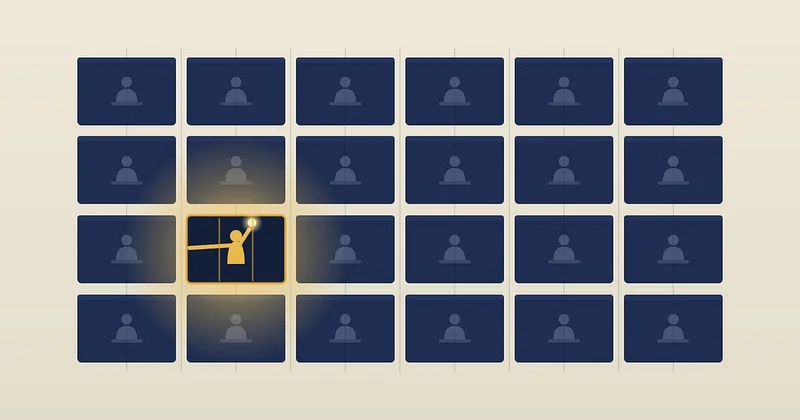
Remember the secret cyborgs from earlier? What actually moves an organization is taking one of those people, giving them real room and the cover to work out loud, and letting everyone else watch what good looks like now. That’s how it snowballs. Somebody credible makes it impossible to ignore and gives everyone else the permission they need to follow suit.
If you’re reading this as the person being held back rather than the one doing the holding, this isn’t permission to be bitter. No org is going to hand you the keys to the castle by default, so stop waiting for it and stop hiding your best work in a locked drawer. Try doing what you’re doing in the open. Show the results, show your reasoning, make it boring for anyone to argue with.
Because trust has to be earned. Stephen M.R. Covey built a career on a simple version of it: trust grows out of character and competence, proven over and over in ways people can actually see. The person for finally forces that company to change earns that spot the hard way. They get so consistently, visibly good that ignoring them starts to look like the real risk.
That can be you.
I know it’s slower and less fair than it should be, but it’s the move that actually works.
The good news is that you don’t have to go find this person. You don’t have to hire them or run a search or buy anything. They’re already on your team, right now, quietly doing the thing and waiting to find out if it’s safe to show you.
The companies that win the next few years won’t be the ones with the best tools. Whatever your company makes, the tools to make it are about to be the same for you and everyone you compete with. The edge that’s left is the human factor. Figuring out fastest how to trust the people who already know what to do, step aside and give them permission to make the changes that need to be made, the improvements and success should follow.
Judgment just became the most valuable thing a person can bring to the table. The only real question left is whether your company is brave enough to let them use it. The good news is that this is the rare kind of problem you could start fixing by Monday.
References and further reading
On the people who already adapted
- Dan Maccarone, Everyone’s Sharpening Knives for the Wrong Fight: once building stops being the hard part, the whole conversation about how to build is aimed at the wrong problem.
- Ethan Mollick, Detecting the Secret Cyborgs: employees quietly use AI and hide it, so the company can’t benefit from what it can’t see.
- Microsoft & LinkedIn, AI at Work Is Here. Now Comes the Hard Part(2024 Work Trend Index): most knowledge workers already use AI, most bring their own tools, and most leaders admit they lack a plan.
- McKinsey, Superagency in the Workplace: leaders underestimate their employees’ AI use threefold, and the bottleneck to scaling is leadership.
On why the org rewards control
- Douglas McGregor, The Human Side of Enterprise: Theory X (control) versus Theory Y (trust), and how most companies preach one and are built as the other.
- Gary Hamel & Michele Zanini, Humanocracy: hierarchy was built to manage scarce information and impose control, and neither the scarcity nor the coordinating skill it prized is rare anymore.
- Steve Blank, Organizational Debt Is Like Technical Debt, but Worse: the accumulated pile of outdated structures and policies that quietly compounds until it holds a company back.
- Marty Cagan, Product vs. Feature Teams: teams you trust to find the right problem versus teams handed a solution to build.
- Das Narayandas, Why Employees Resist AI, and How Companies Can Win Them Over(HBS Working Knowledge): AI rollouts stall because the tools threaten the identity and status of the managers who have to approve them.
On what control costs you
- Amy Edmondson, The Fearless Organization: people only surface their real work when it’s psychologically safe to do so.
- Daniel Pink, Drive: autonomy, mastery, and purpose, not control, are what move knowledge workers.
On why the lag is the org, and how change spreads
- Erik Brynjolfsson, Daniel Rock & Chad Syverson, The Productivity J-Curve: the gains from a general-purpose technology arrive only after organizations rebuild themselves around it.
- Nancy Baym, Eleanor Dillon & Sonia Jaffe, Peer Influence Can Make or Break Your AI Rollout(HBR): adoption stalls because the learning stays invisible, and it spreads through trusted peers, not mandates.
- Stephen M.R. Covey, The Speed of Trust: trust is a function of character and competence, earned by demonstrating results people can see.