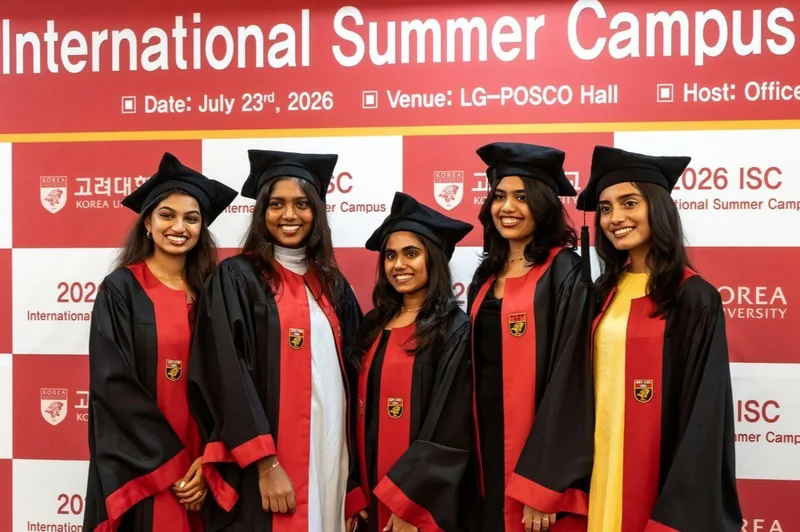
Korea University’s International Summer Campus (ISC) has grown into one of Asia’s premier international summer programs since its inception in 2004.
The university now aims to transform the short-term summer program into a global platform for long-term academic engagement through degree programs, graduate studies or collaborative research.
The university said the ISC’s strength lies in going beyond traditional academic programs and providing international students with firsthand exposure to Korean culture.
The combination of K-study and K-culture is a key factor in establishing the ISC as a global gateway to academic and cultural experiences in Korea.
This year’s ISC was launched on June 27, attracting more than 2,000 students from around 400 universities in some 50 countries for four-week and six-week programs.
Opportunities for K-study, K-culture
Victoria Crooks, one of the international students participating in the 2026 ISC, pointed to cultural experience as one of the most enjoyable programs.
“The cultural activity that I enjoyed most through Korea University so far was visiting the MBC Dream Center for a studio tour and lecture,” said Crooks, a junior at the University of Tennessee, Knoxville.
“As someone who enjoys K-pop and K-drama, I was excited to learn more about the behind-the-scenes details of producing media for these pop cultural phenomena,” she added.
She likewise noted how interesting it was to see the stage where K-pop groups perform for MBC’s Show! Music Core program, adding, “I also enjoyed walking around a set in the studio used for filming a K-drama.”
Crooks was also impressed by a lecture by an MBC producer that provided a deeper insight into the background of MBC and its production processes.
She said her visit to MBC, one of Korea’s major broadcasting stations, helped her understand how K-pop groups are chosen to be featured on the program and how their performances are filmed.
“Now I am more appreciative of how Korean media content is created and look forward to viewing K-pop performances or K-dramas from this new perspective,” she said.
Crooks is taking two academic courses, “North Korea: History, Politics and Society” and “Organizational Behavior,” for the ISC’s six-week program.
Asked about her most memorable experience during the ISC, she said it would be visiting the Demilitarized Zone (DMZ) and learning more about the history between North Korea and South Korea.
“One of the classes that I am taking at Korea University this summer is ‘North Korea: History, Politics and Society’ so I was excited for this excursion to bring the information from that class to life,” she said.
She recalled the surreal experience of viewing the DMZ from the Dora Observatory, walking through the Third Infiltration Tunnel and hearing the powerful story of a North Korean defector through a Q&A session at the North Korea Experience Hall.
“Overall, this excursion gave me a deeper understanding of North Korea, the DMZ and how South Korea is affected by the division to this day,” she added.
Buddy Program offers intercultural experiences
The Buddy Program is also one of the key elements of the ISC. It offers a valuable opportunity for students of diverse backgrounds, cultures and nationalities to connect with one another, build friendships and enjoy genuine cultural exchange.
Lee Seung-hoon, who is serving as a buddy for international students for the second consecutive year in 2026 and chief of the Buddy Program, said one of the ISC’s greatest strengths is the opportunity to learn from distinguished professors from leading universities around the world.
“However, I believe the ISC’s unique appeal lies in the Buddy Program, which offers meaningful cultural exchange while providing international students with genuine day-to-day support,” he said.
Lee, a Korea University junior majoring in electrical and electronics engineering, is also working as a teaching assistant during the 2026 ISC.
“For me, the Buddy Program’s greatest value lies in its ability to create lasting friendships that combine meaningful cultural exchange with practical support,” he said. “That is what makes the ISC such an unforgettable experience for students from around the world.”
Lee said his most memorable moment was unexpectedly reuniting with international friends he had met through the Buddy Program the previous year. They returned to Korea University to participate in the ISC again this year.
What surprised him even more was that one student returned to Korea to pursue a graduate degree.
“Even more remarkably, the student hoped to build a long-term career here and eventually settle in Korea permanently,” Lee said.
He pointed out that Korea is no longer simply a place where foreign students visit because of the popularity of Korean culture. “Instead, many now see Korea as an attractive and stable country where they can pursue their careers, plan their futures and build a life.”
Aiming to become one of world’s top 30 universities
Song Sang-kee, the university’s vice president for international affairs, said the ISC has established itself as a genuine global learning community rather than simply a short-term study program.
He expects that the ISC will continue to evolve as the university’s flagship international education platform, further strengthening its global reputation.
Song pointed out that in the past, many international students came to Korea primarily because of their interest in K-pop, K-dramas and other aspects of Korean popular culture.
“Today, we are seeing a growing number of students who are drawn to Korea because of the strength of its higher education and research,” he said.
“This shift represents one of the most significant changes in global demand for studying in Korea,” he added, noting that interest has been particularly strong in emerging fields such as artificial intelligence, semiconductors, biotechnology and sustainability.
“Our goal is to develop the ISC into a premier global platform through which outstanding students worldwide experience Korea University and subsequently pursue long-term academic engagement, whether through degree programs, graduate studies, or collaborative research,” he said.
Song emphasized that the ISC serves as a key internationalization platform supporting Korea University’s vision of becoming one of the world’s top 30 universities.
The ISC, he said, is the starting point of a lifelong relationship between the university and future global leaders who go on to become members of the university’s international alumni community.
“This expanding network of talented alumni and international partnerships will become one of the key driving forces behind Korea University’s ambition to join the ranks of the world’s top 30 universities,” he added.