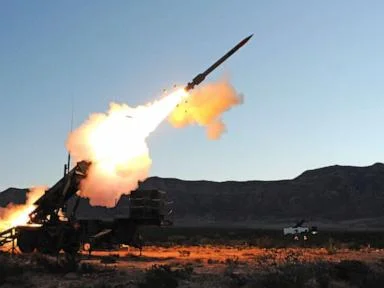
US Patriot interceptor stockpile diminished by some 65% during Iran war, think tank estimates
Trump warns of renewed fighting as interceptor stockpiles decrease.
A Center for Strategic and International Studies (CSIS) report released this week estimates that U.S. stockpiles of its two critical air defense interceptors are dramatically reduced since combat between the U.S. and Iran began on Feb. 28.
The report, titled "Renewed Iran War Would Test Diminished Interceptor Inventories," updates a previous report from April 8 when the two countries entered a ceasefire.
The U.S. and Iran have consistently traded fire over the last several weeks after both sides acknowledged that a Memorandum of Understanding, which initiated a temporary ceasefire, had collapsed. On Wednesday, President Donald Trump said the U.S. would "be hitting [Iran] hard" for an Iranian attack that the U.S. said it intercepted.
The first report found that the U.S. stockpile of Patriot interceptors decreased by 55%. Updated figures -- accounting for a number of conflagrations since the ceasefire -- show the stockpile reduced another 10%, with some 65% of U.S. Patriots now lost, according to findings from CSIS, a bipartisan, nonprofit policy research organization.
That's as few as 759 America's highest-end variety of Patriot missiles in the U.S. stockpile, the analysis says.
The U.S. produces 183 of these interceptors a year and it takes some 3 1/2 years from when a contract is signed for them to be delivered, according to CSIS.
The U.S. stockpile of THAAD interceptors, its highest-end air defense system that has a longer ranger and higher intercept altitude, have remained level since the ceasefire took hold. During combat between Feb. 28 and April 8, U.S. stocks of THAAD interceptors had dropped by roughly half. Experts say THAADs represent the most difficult air defense munition to replace.
CSIS based its reporting on data from Gulf countries, among other methodologies, to ascertain how much the U.S. has fired, and it appraises the U.S. stockpile based on public congressional and Pentagon budget documents.
The Pentagon is requesting $67 billion in supplemental funding from Congress, some of which would address munitions shortfalls. The president and Defense Secretary Pete Hegseth have said the administration inherited an insufficient inventory because the Biden administration sent arms to Ukraine without replacing them.
During the Biden administration the U.S. provided three Patriot missile batteries from U.S. stockpiles under the Presidential Drawdown Authority, but it is unclear if that move led to a decrease in U.S. Patriot battery and missile capability.
Asked for comment by ABC News, chief Pentagon spokesman Sean Parnell said the U.S. "has everything it needs to execute" the president's orders.
“We have executed multiple successful operations across combatant commands while ensuring the U.S. military possesses a deep arsenal of capabilities to protect our people and our interests," he said.
ABC News has asked U.S. Central Command (CENTCOM) about the status of its stockpiles.
Retired Marine Corps Col. Steve Ganyard, an ABC News contributor, told ABC News Live on Monday that munitions shortages are "a very serious situation" that "is not going to get cured anytime soon."
"We've been shooting so many Patriots, so many THAADs, so many of these exquisite missiles that the industrial base just can't catch up and the magazines are going down," he said. "Some of these missiles take two to four years" to build and deliver.
"And if you're the Chinese and you're thinking, 'If we're going to make a move on Taiwan, maybe the time to do it is now,' because the U.S. is losing [at] a very rapid rate the kinds of missiles that they could shoot against...China if [China] invaded Taiwan."
U.S. Pacific Air Forces, the air component of the military's command in East Asia, is considering cutting upcoming exercises in the region, said Gen. Kevin Schneider, commander of Pacific Air Forces, to make sure it can "provide the Air Force options for other parts of the world."
Schneider said senior leaders would take a "hard look at our exercises" and judge which ones were most important for force readiness.
“I think we’ve done a pretty good job of identifying, amongst commanders, where we’re going to take risk or how we manage the risks as we prioritize efforts in Central Command region right now," he said.