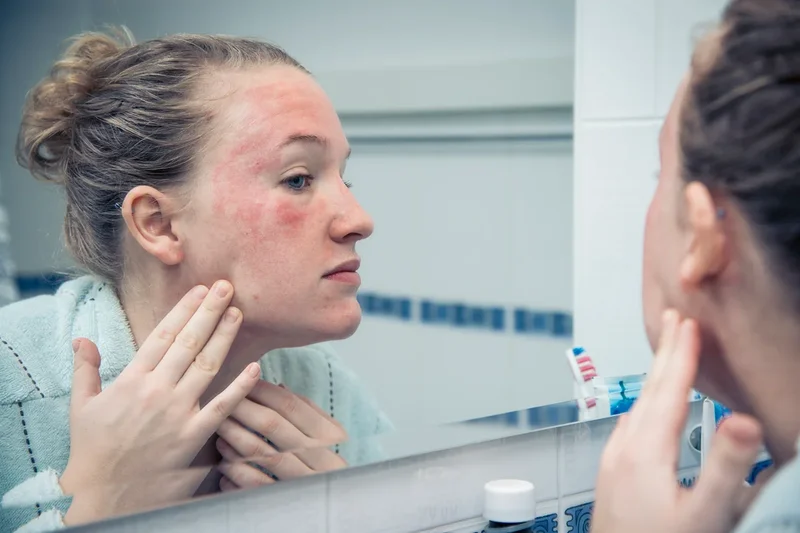
A recent study indicates that prescribing antihistamines to manage eczema symptoms offers no significant benefit and may "probably increase harms".
Experts have welcomed the findings, saying they address "longstanding uncertainty" surrounding the role of these medications in treating the common skin condition, and are now urging for updated medical guidance.
Eczema, also known as atopic dermatitis, is a prevalent skin condition causing itchiness, affecting an estimated one in five children and one in ten adults in the UK.
Despite existing recommendations, approximately one in five eczema patients in the UK currently use antihistamines.
The National Institute for Health and Care Excellence (NICE) already advises against the routine use of antihistamines for managing the condition.
However, they are sometimes offered if flare ups are linked to hives or another allergic reaction, while the short-term use of sedative antihistamines can help those whose itching is severely disturbing sleep.
Experts in Canada reviewed 47 trials including more than 6,200 children and adults with moderate to severe eczema.
They found that, when compared with a placebo, antihistamines led to a “clinically unimportant reduction” in the severity of eczema and itchiness.
Antihistamines may also “not reduce sleep disturbance” and eczema flare ups, the study suggests.
First generation drugs, which often cause drowsiness, may also increase cognitive impairment and could lead to patients discontinuing treatment due to side effects.
Researchers said their findings, published in the BMJ, address the “longstanding uncertainty surrounding the role of antihistamines” in treating eczema, and show “they likely do not” improve patient outcomes and “while probably increasing harms”.
They added: “Our findings do not support their use in routine atopic dermatitis management.
“We have provided a foundation for an evidence-based change in practice, supporting the development of updated atopic dermatitis guidelines that prioritise efficacy, safety, and patient centred care.”
Could eczema diagnosis and treatment be ‘revolutionised’?
A "groundbreaking" new technology developed at Edinburgh's Heriot-Watt University has secured over £475,000 in funding for clinical research, promising to "revolutionise" the diagnosis and treatment of eczema.
The university states its innovative vibroacoustic sensor could alleviate "years of suffering for millions of patients across the UK."
The device operates by emitting small vibrations onto the skin's surface, meticulously measuring material alterations within each layer.
This process identifies crucial changes in tissue stiffness and fluid content, offering a new pathway for understanding and managing the condition.
Professor Michael Crichton, from the university's school of engineering and physical sciences, emphasised the significance of the development, stating the technology "represents a fundamental shift in how we approach eczema management."
He added: “Rather than relying solely on visual assessments, which haven’t evolved in decades and can be particularly unreliable for patients with darker skin tones, our sensor provides objective measurements of what’s happening beneath the skin’s surface.”