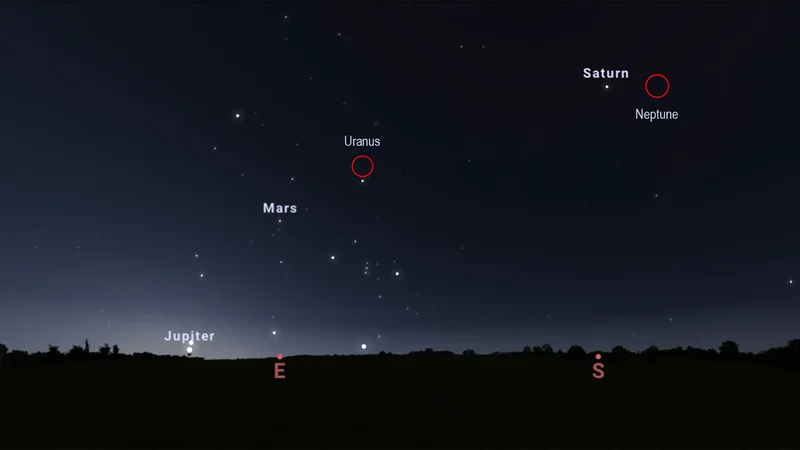
If you’ve been staying inside all summer due to heat domes and poor air quality from the wildfires, August is shaping up to be a good month to get out of the house and look up at the sky. Among the various cool events happening is a planet parade with six planets visible at once.
The show starts the evening of Aug. 12 and continues until around Aug. 17 or 18, depending on your location. This planet parade includes Mercury, Jupiter, Mars, Uranus, Saturn and Neptune, and like most prior parades, the planets line up on a nice curve, so it should be a little easier to see all of them. The parade is visible across the US and Canada.
You need to wake up early for this one, as the best time to see the parade is just before sunrise. This is due to Jupiter and Mercury not popping up above the eastern horizon until about 15 to 20 minutes before the sun. The good news is that Mercury and Jupiter are right next to each other and typically quite visible. A pair of binoculars should help immensely, but make sure to be careful since the sun will follow Mercury and Jupiter over the horizon in pretty short order.
The rest of the planets are much higher in the sky and present less of a visual risk. Mars is higher in the eastern sky and is visible without the need for visual aids. Uranus will be higher in the eastern sky, trending south. Following that curve, you can see Saturn in the southern sky as a yellowish dot. Neptune is nearby at the end of the line. Uranus and Neptune require a telescope or high-powered binoculars to view, and if you want a superior view of Saturn, that amplification will help too.
You have about a week if you want to do this. Before Aug. 12, Jupiter trends too close to the sun to be safely visible, and after around Aug. 17-18, Mercury ends up too close to the sun to be viewed safely. Before and after that date, you can still see a five-planet parade for quite some time.
Venus is also technically visible at night. It sets along the western horizon just after sunset, so it’s not visible at the same time as Mercury and Jupiter. However, if you don’t mind pulling an all-nighter, you can see all seven planets in the sky on the same night.
Do I need any amplification devices for this?
The inclusion of Neptune and Uranus means that you will need some sort of amplification device to see all the planets. Binoculars work, as both Uranus and Neptune can be seen (albeit faintly) with a good pair, and they’ll also help you see Mercury before sunrise.
A telescope is a much better tool since you can more easily see the rings of Saturn along with the other planets. We don’t recommend using a telescope to find Mercury, since you may accidentally catch the sun, which is not a good idea.
Part of a triple feature coming on Aug. 12
If you’re looking for one single day to go out and view the sky for the rest of the year, Aug. 12 makes a compelling case. The planet parade ramps up then, and continues for the next week. It is always fun to see a bunch of planets from the solar system in a single night, but in terms of thrill, it’s arguably the least interesting thing happening on Aug. 12.
The Perseids meteor shower is set to peak on the evening of Aug. 12, which means those who go out to see all the planets can virtually guarantee some meteor sightings as well, since Perseids is one of the most active meteor showers of the year. In a fortuitous turn of events, the Perseus constellation, the point from which the Perseid meteors appear to originate, is right next to Mars and Uranus. That means you can scout out the parade and see meteors at the same time since they’re in the same part of the sky. The timing and placement don’t get much better than that.
If that isn’t cool enough, nature has one more thing to toss into the equation: Aug. 12 is also the date of the next solar eclipse. North America is largely sitting this one out, but if you draw a line from Washington state to North Carolina, all the states north of that line will get at least a partial solar eclipse with about 20% coverage. Since the sun isn’t completely covered, proper safety measures for solar eclipse viewing are highly advisable to avoid eye injuries.
Three prominent celestial events happening in one 24-hour span are pretty rare, so if you’re up for it, it’s a great day to look up.