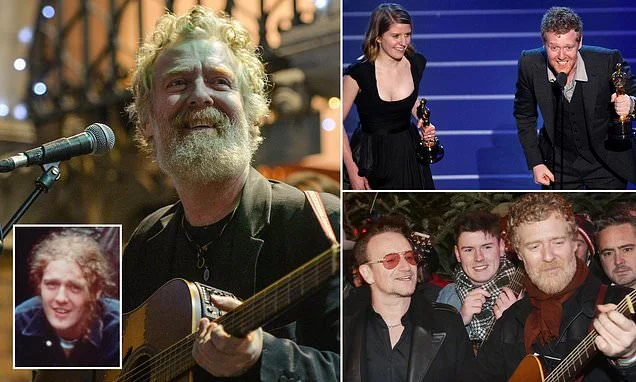
IT HARDLY seemed possible that Glen Hansard was gone. Glen, the lead singer with The Frames, the solo artist of courage and conviction, the man who first came to prominence for a wider audience in The Commitments. The man who busked at Christmas every year to remind us it wasn’t a time of peace and goodwill for those miserably existing on the streets, the man who won an Oscar for Falling Slowly, a hauntingly beautiful song as fragile as gossamer that made a film captivating and spawned a hugely successful stage show. Gone.
Half the country probably heard yesterday morning, on one of the radio traffic bulletins, of the motorcycle accident in Dublin’s Strawberry Beds. Tragic news, of course, but there have been all too many fatalities on the roads this year, and most people just carried on with their day. As the morning progressed, though, the story shifted from dispassion to incomprehension to grief as the news emerged of who had lost his life.
Glen Hansard on Christmas Eve, 2019, at the annual busk outside Dublin's Gaiety Theatre
To his fans, Glen was the voice, the unmistakable growl that often gave way to melodic simplicity, and it defined a generation. U2 had the global success, and to a degree Glen enjoyed it too, lionised by the likes of Bruce Springsteen, Bob Dylan and Pearl Jam’s Eddie Vedder, but he was a quintessential Dubliner, emerging from the cauldron of creativity in the early 1990s that saw the capital lauded as the city that launched a thousand bands.
The television and radio were filled yesterday with tributes to the private Glen Hansard, a man who gladly shared his talent with those who came after. For him to be taken just as he became an elder statesman seems especially cruel, maybe doubly so as he arrived late to fatherhood, a new role that gave him and his wife Maire so much joy.
Glen James Hansard was born in Ballymun on April 21, 1970 to James and Catherine Hansard, one of six siblings. He was educated first at Our Lady Of Victories National School (already taken with music, he was presented, on a return visit just two months after winning the Academy Award, with an AC/DC book confiscated when he was a child), and Holy Spirit Boys National School, then at Ballymun Comprehensive, now known as Trinity Comprehensive School – but he flunked out at 13.
Life could have taken him in many directions, not all of them good, but music proved to be his salvation. He learned how to play guitar and became a busker, and while it initially gave him a precarious living, it also saved him.
Hansard with then president of Ireland Michael D Higgins in 2013
‘I got all my education on the street, basically,’ he later told RTÉ’s Brendan O’Connor.
Glen’s uncle was a musician and, after he left his guitar behind in the Hansard house, it became indispensable. ‘I learned how to play it, and that saved me. I was on a kind of a trajectory, getting into the drugs – only gently getting into them, but getting heavy into drinking; just getting into that slightly dodgy spot.’
That guitar, and a Bob Dylan cassette, changed everything. ‘My girlfriend at the time, Gráinne, her brother gave me a cassette of Bob Dylan. I was about 12 and a half, and I listened to Bob Dylan and my whole world just flipped.
‘I stayed in the bedroom. I played Bob Dylan songs every day. I learned my craft. I decided music was all I cared about. I set sail towards whatever Bob Dylan was doing. I want to be doing whatever that is, it was just playing music and traveling and singing, so that was a real turnaround for me. It was a life change, and I suddenly had my path.’
He also, despite leaving school, had a good relationship with the headmaster Frankie Byrne. ‘I used to get sent down to the principal a lot,’ he reminisced.
‘It wasn’t that I was bad in school, it was just I was a bit of a clown. I didn’t have the attention span to kind of stay with the classes, and I’d end up down with Frankie a lot.’
The headmaster was astonished by Glen’s taste in music, Dylan and Leonard Cohen, Joni Mitchell and Van Morrison. ‘“Wow, how did you hear these people,” he’d say. “Like, your generation is listening to Duran Duran...”’
Glen laughed at one particular memory. ‘One of the great things about Ballymun,’ he said, ‘was that all of the lads, especially the lads who did drugs, they all had great taste in music!’
By 1990, Glen had formed his own band, The Frames, but it was a year later that he came to wider attention in Alan Parker’s film version of Roddy Doyle’s novel The Commitments. He played ‘Outspan’ Foster, so named because he had naturally orangish hair. This dual role brought its own problems.
Glen, front right, with the cast of The Commitments
‘The first Frames gig was in the Purty Loft [in Old Dunleary] and there was a simple clash of dates,’ Glen explained in the RTÉ documentary Back To Barrytown. ‘I was like: “I’m not skipping this gig,” so everybody came out to the Purty Loft. We had a night off, and the next day we were all back at work shooting the film.’
Unbeknown to Glen, though, Parker was seething, and called Glen ‘an awful word I won’t repeat. That did kind of sour the experience for me’.
Hansard threw himself into work with The Frames, so named because of his habit of fixing bicycles for friends. ‘I worked in a bicycle shop for a while but the name came from my back garden at home,’ Hansard later said. ‘It was so full of frames, my house became known as The Frames house, much to my mother’s distaste; she hated it.’
The band had many members over the years, and while they gained a fanbase in North and South America, and in Europe, it was in Ireland and Britain they enjoyed their greatest success.
Hansard, second left, with The Frames in 2003
To date, they had released six studio albums, including the well-received Fitzcarraldo, For The Birds, and Burn The Maps, their only Irish No.1.
In April 2020, the band were forced to postpone a 30th anniversary reunion in Kilmainham when the Covid pandemic restrictions came into force; the gig finally happened in 2022, when over 10,000 fans attended.
In the early days, the bass player and backing vocalist with The Frames was a man called John Carney, and when he became a film director, his friendship with Glen led them to collaborate on Once, the film in which Glen starred and, despite some controversy over its eligibility, also brought Oscar success with the ballad, Falling Slowly.
The song was co-written with Markéta Irglová, who also starred in the film. Glen had a relationship with her despite a big age difference, given that he was 31 when they first met through her music publisher father Marek Irgl in Czechia and she was just 13.
Their musical collaboration began in 2005 when they formed The Swell Season, and continued in the film in 2006, where they became a couple during the shoot and at which stage she was 18. The film had its United States premiere at the Sundance Film Festival in 2007, and received the festival’s World Cinema Audience Award, and plaudits from Steven Spielberg, who memorably said that ‘a little movie called Once gave me enough inspiration to last the rest of the year’.
Glen and Markéta Irglová with their Oscars for Once
Fame did not sit comfortably with Glen, as he told Róisín Ingle in the Irish Times soon after the film was released to such acclaim. ‘It feels very good but when you’ve been in a band and struggling to pay your rent, if all you have known how to do is struggle, then you are going to struggle with success,’ he said. ‘The part of me who was struggling has died, so it’s like mourning someone who has passed. Nobody wrote about The Frames for years and now [rock magazine] Rolling Stone is saying we are this great Irish band.’
Irglová became the youngest non-actor to win an Oscar, while Glen thanked the crowd, first as Gaeilge. ‘Go raibh míle, míle maith agat,’ he said. ‘This is amazing. What are we doing here? This is mad! We made this film two years ago. We shot it on two Handycams. It took us three weeks to make. We made it for €100,000.
‘Thanks for taking this film seriously, all of you. It means a lot to us. Thanks to the Academy, thanks to all the people who’ve helped us; we don’t need to name them, they know who they are.
‘Make art. Make art. Thanks.’
A stage version opened on Broadway in 2012, and was nominated for 12 Tony Awards, winning eight, including Best Musical, and has subsequently enjoyed long runs in London’s West End and in Dublin, bringing Glen financial stability.
His activities over the years have often included the homeless. He started the Christmas busking tradition after seeing a collection for Dublin Simon and wondering what he could do to help. It has become an annual tradition in which he was joined by U2’s Bono, Imelda May, and others.
He also famously gigged at Apollo House, which was slated for demolition, when it was occupied for 27 days in 2017 in the Home Sweet Home campaign. Over 200 people were temporarily housed in the block during the campaign, which was supported by Hozier, Aslan’s late frontman Christy Dignam, film director Jim Sheridan, and the band Kodaline, and which shone a torch on the number of derelict buildings that could be repurposed as homes.
Of late, Glen enjoyed an acclaimed solo career. He released five studio albums, with the first two, Rhythm And Repose, and Didn’t He Ramble, reaching No.3 in the Irish chart. Didn’t He Ramble received a nomination for Best Folk Album at the 58th annual Grammy Awards.
In December 2023, Hansard and Lisa O’Neill memorably performed Fairytale Of New York, backed by The Pogues, at Shane MacGowan’s funeral at St Mary’s Of The Rosary Catholic Church in Nenagh in Co. Tipperary, reprising the 1987 original sung by Shane and Kirsty MacColl.
Glen Hansard and Imelda May busking on Christmas Eve 2018
Glen and his partner, Finnish poet Maire Saaritsa, married in 2022, shortly after Maire gave birth to their son, Christy. Though raised Catholic, Glen became a devotee of the Hare Krishna movement that also is supported by Saaritsa. The couple divided their time between Dublin and Helsinki, and Christy brought a new dimension to the singer’s life.
‘For 52 years, I was the most important person in my own life,’ he told Tony Clayton-Lea in the Irish Times, ‘and then suddenly I got a complete perspective shift, and I’m absolutely loving it.’
Age also allowed him to think about what he did for a living, to become a troubadour whose lyrics were invested with the wisdom only age and experience can bring, and to make peace with his place in the music firmament.
‘I love this life,’ he said. ‘I get to play to people all over the world who are interested in hearing what I have to say.
‘I’m not a pop star, so I’m not restricted by tunes needing to be three and a half minutes. I get to be who I am, and that privilege is not lost on me.’