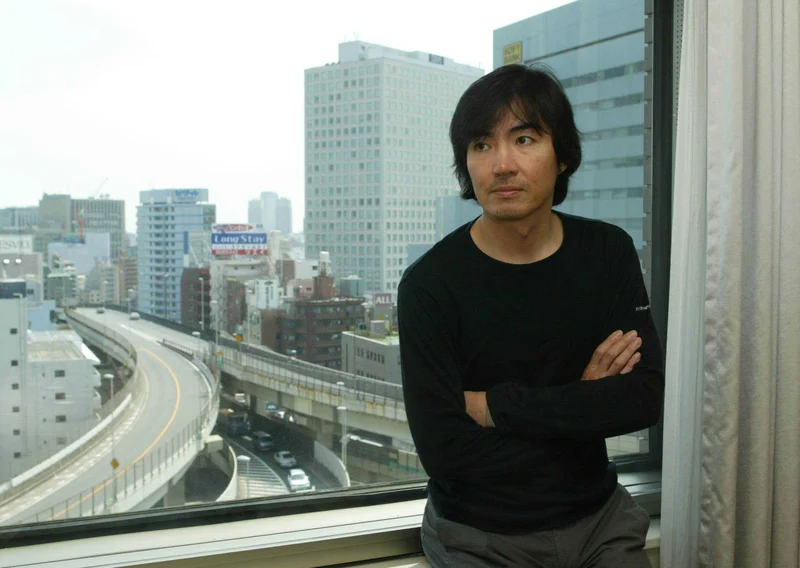
Author Keigo Higashino died July 23 at age 68, leaving behind an enormous body of work spanning more than four decades, with numerous books adapted for film and television.
For English-language readers, Higashino remains one of the most prolifically translated Japanese authors of the mystery genre, with over a dozen titles available — and several forthcoming. Yet this number pales in comparison to the more than 100 novels he penned in Japanese.
What underlies his enduring popularity, not just in Japan but abroad? The Japan Times asked those in the literary field with deep knowledge of Higashino for their views by email.
To Alexander O. Smith, translator of the 2006 Naoki Prize winner “The Devotion of Suspect X,” as well as five other novels by Higashino, including the forthcoming “The Dark Magician,” Higashino’s novels are “deeply rooted in Japan,” but they also center characters with “a striking universality. … They feel immediately recognizable across ages, backgrounds and borders.”
“The Devotion of Suspect X” was Higashino’s first novel-length entry in his series of stories that involve Manabu Yukawa, nicknamed “Galileo,” a brilliant scientist whose incisive observations support the investigative work of his college classmate turned police detective Shunpei Kusanagi.
“The global afterlife of (Higashino’s) work bears this out,” Smith says, noting that “Suspect X” inspired both a Hindi-language film (“Jaane Jaan”) and a South Korean film (“Perfect Number”), among others, a testament to the author’s cultural resonance beyond borders.
“Higashino’s achievement lies in balancing a strong sense of place with narratives that travel effortlessly, allowing his stories to resonate far beyond a local, limited audience,” Smith adds.
Giles Murray, translator of six Higashino novels, including the recently released “Guilt,” describes the author’s style as “predictably surprising, reliably ingenious, reassuringly confounding.”
Murray says Higashino’s portrayals of Tokyo neighborhoods like Ningyocho and Hamacho offer a “familiar, comfortable setting of independent cafes, old craft shops, shrines, temples, Meiji-era bridges and amiable old grannies and grandpas, elements that together give a slightly nostalgic and idealized (but by no means false) picture of Japan.”
Higashino’s “Himitsu” (1998) won the 52nd Mystery Writers of Japan Award for best novel and was adapted into both a Japanese feature film (directed by Yojiro Takita) and a TV drama, as well as a French production. Translated by Kerim Yasar and published in English in 2004 as “Naoko,” it marked the first of more than a dozen books that helped introduce the author to a wider audience.
Yasar says Higashino demonstrated “an engineer’s structural precision with an unpretentious style” in his writing. Meanwhile, the “damaged families, economic insecurity and compromised institutions” that appear often in his work clearly resonated with readers in postbubble Japan as well as other societies.
Like popular postwar author Seicho Matsumoto, Higashino “treated the mystery genre as a form of social inquiry,” says Yasar.
Apart from his more straightforward honkaku (orthodox) mystery novels, Higashino also explored sentimental themes and the popular Japanese narrative conceit of time travel in “The Miracles of the Namiya General Store,” which was adapted three times for the stage, twice in film (a Japanese and Chinese production) and once for South Korean television.
Sam Bett, who translated the book into English, says the author had a “telescopic handling of time and memory … (and) eerie nonchalance, reminding us that memories may disappear or blur but they are no less influential on our lives.”
Higashino’s books have also found success in the Chinese-speaking world, where translations of almost his entire fiction oeuvre are available. Since news of the author’s passing began to circulate on Chinese social media, tributes have continued to pour out on WeChat and Xiaohongshu.
“His books are the most important possessions he leaves behind,” says Du Jing, a Beijing-based book influencer, in a video posted on WeChat, “and his gift to the world.”
Deborah Shamoon, an associate professor at the National University of Singapore, says Higashino’s literary ascendance in his home country coincided with a time when “Japanese detective fiction became a viable, profitable genre in English.”
“I think Higashino has been even more popular than (contemporary crime author Natsuo Kirino) because his novels are more cerebral,” Shamoon says, “so the ending is reassuring in that there is a logical explanation, even if the emotional impacts are devastating.”
Keith Kahla, executive editor of St. Martin’s Press, Higashino’s primary English publisher, compares the writer to “golden age writers such as Agatha Christie or John Dickson Carr, or even the classic Edogawa Rampo.”
Kahla says Higashino’s “brilliantly twisty plots” combined with “large-scale human emotions such as desire for revenge, jealousy, hatred and other such motivating factors” made him a mystery genre mainstay in the Western world.
As fans of Higashino reminisce about his works and a new generation of readers discovers him, the author’s international profile is stronger than ever, his legacy is bolstered by the literary translators who make his fiction accessible to millions more readers and a vibrant media landscape of cross-cultural adaptations.
“He will be seen … as a shokunin, or master craftsman,” Murray says.