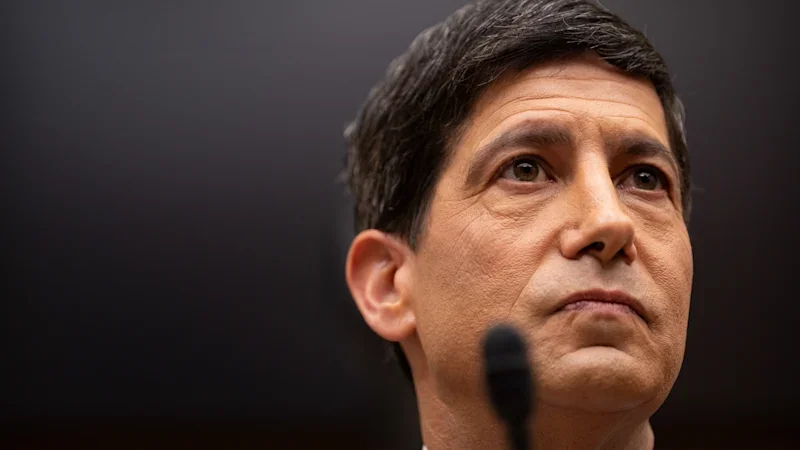
Kevin Warsh, the Trump-appointed chair of the US Federal Reserve Board, talks like a hawk, but has yet to act as one. That’s left it to investors to take matters out of his - and the Fed’s - hands.
Long-term bond yields shot up – the 30-year yield to its highest level since 2007 – and Wall Street slumped after the Fed left US interest rates unchanged and Warsh provided no guidance in his press conference on the future direction of the Fed’s policy rate.
There is some pressure for a rate rise building with the Federal Open Market Committee (FOMC) that sets US monetary policy. For the first time in a decade, three of its members – three regional Fed presidents – voted for a 25 basis point rate hike.
Warsh, however, while continuing to assert that he has “no tolerance” for elevated inflation levels – the US inflation rate has remained above the Fed’s 2 per cent target for more than five years – maintained his stance of providing no guidance to market participants, saying only that “we’re on the job, we will deliver.” How and when the Fed might deliver were left as open questions.
The lack of guidance is deliberate. He has said he wants financial markets to respond to economic developments, rather than the Fed’s signalling, and become a “direct and unfiltered” source of information for the Fed.
That is effectively what he got. The markets, the bond market in particular, took matters into their own hands, with the spike in yields on the longer duration bonds effectively tightening US monetary policy despite the Fed leaving rates unchanged.
The bond market is providing Warsh with the signal he wants: it is saying that it is now questioning whether he is as committed to attacking inflation as he has claimed.
While the yield on two-year US Treasury notes – the securities that are most sensitive to movements, or expectations of movement, in the federal funds rate – actually fell, the yield on 10-year bonds jumped 7 basis points to 4.68 per cent, and that on 30-year bonds rose 11 basis points to 5.2 per cent.
The bond market is providing Warsh with the signal he wants: it is saying that it is now questioning whether he is as committed to attacking inflation as he has claimed.
If he won’t act to protect the holders of the securities most threatened by heightened inflation levels, they’ll act to protect themselves and raise the rates that have the most influence on US businesses and consumers.
The Fed, of course, has been under intense pressure from Donald Trump since he regained the White House and renewed the demands for rate cuts that were a feature of his first term as president, although this time they have included active efforts to gain control of the Fed’s board.
His administration has targeted former Fed chair Jerome Powell and another governor, Lisa Cooke, with transparently political prosecutions to remove them and create an opening for Trump nominees.
Asked about the central bank’s decision to hold rates steady, Trump didn’t criticise Warsh.
“I know he’d love to see lower interest rates, but he’s got a board, and it’s a political board, and they want to keep rates up,” he said.
The dissent from the majority decision by the three regional Fed presidents and comments by other Fed officials in the lead-up to the meeting suggest that, had Warsh maintained the previous Fed policy of providing some guidance in its official statement on monetary conditions, it would have reflected a bias towards raising rates.
The markets, which wouldn’t have been shocked had there been a rate hike at this week’s meeting, are now pencilling one in September, with a further increase possible in December.
If that were to eventuate, Warsh might well find himself also targeted by Trump, given the political implications of a rate rise in the lead-up to America’s mid-term elections in November.
A Democrat majority in the House alone could neuter Trump’s presidency, while exposing him and his family to congressional investigations and, almost inevitably, more impeachment proceedings.
After sitting back and watching the US inflation rate since the start of the year – the Fed has left the federal funds rate unchanged at its past five meetings – the members of the FOMC ought to have a bias towards raising rates.
While the headline consumer price index rate did fall last month for the first time in five months (to 3.5 per cent), the measure the Fed places most weight on – the personal consumption expenditures (PCE) index – was 4.1 per cent in May, the most recent monthly data available. “Core” PCE, which excludes volatile energy and food prices, edged up from 3.3 per cent to 3.4 per cent.
That’s well above the Fed’s target, and moving in the wrong direction.
When Trump regained the presidency in January last year, the headline PCE rate was 2.5 per cent, the core rate 2.6 per cent and the Fed had cut rates three times, by 25 basis points each time.
Since then, Trump’s tariffs, his “One Big Beautiful Bill Act” with its massive tax cuts and increased spending, and the war on Iran have caused the rate to jump.
The war in the Middle East, in particular, has had a marked impact.
When Joe Biden handed over the White House, the national average gasoline price was $US3.11 a gallon and diesel averaged $3.76 a gallon.
On February 27 this year, a day before the US and Israel attacked Iran, the average gasoline price was just under $US3 a gallon and diesel still $US3.76 a gallon. Today, those prices are around $US4.09 and $US5.33 a gallon, respectively.
The Fed has, so far, seemed to have believed that Trump’s tariffs would create a one-off hit to the inflation rate and then, with those costs absorbed, their effects would disappear from the data. There may have been similar thoughts about the effects of a war that Trump boasted would be over within days.
Despite having made two different attempts to impose a global tariff regime that were deemed illegal by the courts, Trump is persevering with his third attempt, while also regularly announcing new tariffs as retaliation for other countries’ policies, or punishment for perceived insults.
The tariffs – a de-facto tax on US businesses and consumers – are continuing to impact the inflation rate.
Despite Trump’s numerous declarations of victory, the conflict in the Middle East continues and is entering its sixth month.
Oil prices remain high, at around $US90 a barrel, and the longer the war continues and oil flows from the Persian Gulf remain restricted, the greater the likelihood that the inflationary effects will spread from fuel prices to the cost of goods and become baked into the inflation rate and expectations of future inflation. The same could be said of Trump’s tariffs.
The inflation rate is also being boosted by the extraordinary boom in investment in artificial intelligence and the infrastructure to support it, which has driven up semiconductor and other IT equipment prices along with construction and energy costs.
In the long run, AI might lift productivity rates without fanning inflation. In the near term, and perhaps well beyond, it is contributing to an inflation rate that is well above the level that the Fed, and Warsh, have declared they will tolerate.
The Fed made the mistake in the aftermath of the pandemic of regarding the inflationary effects of the global supply chain disruptions as “transitory.”
There are plenty of members of the FOMC – including Jerome Powell, who has hung on as a governor while waiting for unequivocal evidence that the administration is longer pursuing him – who won’t want to make the same mistake twice.
Even if they were inclined to extend the period of watching and waiting and gathering more data before the next meeting in September, their inaction, and the absence of any guidance, has forced the markets to come to its own conclusions about the inflation outlook and take action itself.
The Business Briefing newsletter delivers major stories, exclusive coverage and expert opinion. Sign up to get it every weekday morning.
More: