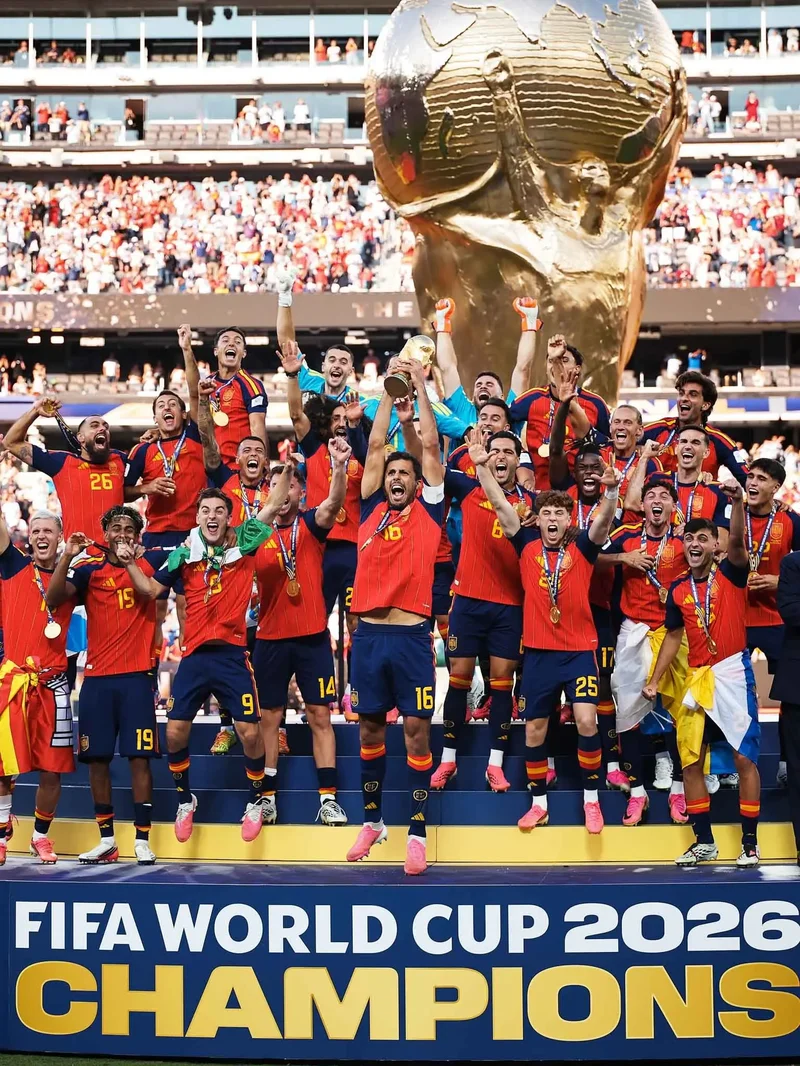
When the final whistle blew at the New York New Jersey Stadium in East Rutherford, New Jersey, relief came before celebration. The best team had won the 2026 Fifa World Cup. That mattered because this was no ordinary tournament. It was the first men's World Cup to feature 48 teams, spread across 16 host cities in Canada, Mexico and the United States and to end with its 104th match. In a competition designed to multiply uncertainty, Spain supplied the antidote: clarity.
To call any side 'the best team' is to invite argument. World Cups are not seminars in justice. They are won through stamina, calculation, luck, refereeing margins and nerves that do not fray. Yet Spain's claim was unusually persuasive. Against Argentina and throughout the tournament, they did not merely prevail. They made the clearest case for how football should be played.
Spain reached the final on defensive stability, midfield control and attacking nerve. Their tournament had its tremors. Several matches strained players and thrilled spectators. But their football rarely lost its shape. They did not overpower opponents. They made them chase shadows. Rhythm, patience and positional intelligence became a form of command. The pass was not decoration but discipline: move the ball, move the opponent, create doubt, then strike.
That is why Spain's campaign felt larger than a run of results. It was an argument in motion. In a World Cup in which too many teams preferred caution, muscle and cynicism, Spain showed that beauty need not be naïve. Their young players brought the courage of youth without its recklessness and the discipline of maturity without its caution. They pressed, recovered, combined and defended as though individual brilliance was most useful when placed in the service of the collective. They played the strings of the beautiful game to the tune of 'Viva España'.
Argentina were the necessary foil. They arrived as world and South American champions, led by Lionel Messi, an icon approaching the twilight of his heroic international arc. Their route to the final was less serene than theatrical: late breakthroughs, tense knockout victories and a familiar reliance on individual invention joined with collective will. If Spain looked like the future announcing itself, Argentina looked like the old champion refusing to leave the stage.
There was greatness in that resistance. It would be dishonest to deny it. Champions do not reach another final by accident. Argentina knew how to suffer, how to slow a match, how to turn pressure into theatre and theatre into advantage. Messi gave them more than technique. He gave them gravity. Opponents faced not just a team but a history: past triumphs, present aura and the mythology of a genius already entered into football annals.
Yet greatness can make excess harder to forgive. Argentina's edge was not simply competitive spirit. Too often, it became a provocation. Every tackle seemed a message, every complaint a tactic and every confrontation a test of the referee's nerve. They knew the dark arts of tournament football and used them well. Effective, yes. Uplifting, rarely.
Compared with Spain, Argentina did not always look like sporting gentlemen. Their game could be hard to the point of intimidation. They shoved, sneered at opponents and crowded referees in visible disapproval. Intensity, when governed, is hunger. Ungoverned, it becomes entitlement: the belief that champions deserve indulgence because they have suffered, conquered and entertained before.
That behaviour fed a perception, fair or not, that Argentina were being treated leniently. Conspiracy theories followed. Did Fifa want the defending champions to survive? Was there excessive deference to Messi? Such claims are difficult to prove and should not be stated as fact. But football is judged not only by the laws of the game and official reports. It is also judged in the court of public feeling, where perception shapes the story of a tournament. Argentina's problem was not that they played close to the edge. It was that they often seemed to expect the edge to move.
In the end, football won. Spain controlled the essential areas of the pitch, even while wasting chances in the final. One involving Lamine Yamal nearly became a story in itself. The now-famous images of Lionel Messi bathing a baby Yamal years ago became an accidental metaphor: one age touching another, one legend blessing the rise of a younger generation.
Spain deserved to win because their case was stronger on every register that matters: technical, tactical, emotional and moral. They offered not only goals and control but a vision of football that was generous without being soft, youthful without being reckless, beautiful without being ornamental. For once, the football gods kept their promise. Luck and serendipity, those old conspirators of tournament football, could not overpower skill, organisation and beauty. Argentina reminded the world how champions survive. Spain reminded us why football is loved.
Anthony Ohemeng-Boamah is an expert in development and socioeconomic transformation, with a particular interest in Africa. He writes on related issues, including the political economy of sports.