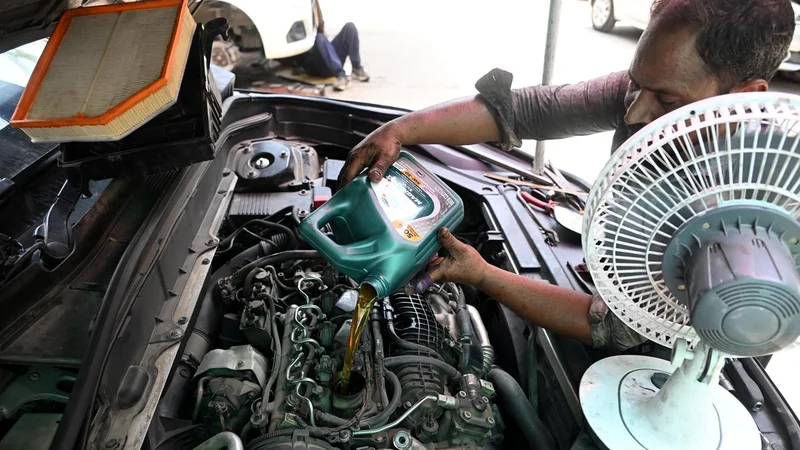
A joint study by Indian Oil Corporation (IOCL), the Indian Institute of Petroleum (IIP), the Society of Indian Automobile Manufacturers (SIAM) and the Automotive Research Association of India (ARAI) found that E20 fuel does not require engine modifications for cars or two-wheelers, according to the government.
What do government-backed studies say about E20’s impact on vehicles and mileage?
Citing the study in the Parliament, which has not been made public, the government said legacy vehicles (i.e., vehicles manufactured before 2023, when E20-compatible vehicles began to be rolled out of factories) did not show any significant deterioration in performance, abnormal wear and tear, or issues relating to drivability, startability, or compatibility with metal and plastic components when operated on E20. The only exception identified was some BS-III vehicles introduced from April 1, 2005, and manufactured before 2016, where certain rubber parts and gaskets may require replacement during routine servicing.
However, a news report on the findings of the above study highlighted that prolonged use of E20 in vehicles designed for E10 could lead to deterioration of hoses, gaskets, seals and O-rings, which may require replacement over time. During engine durability testing lasting 400-806 hours, a BS-VI turbocharged engine reportedly developed issues after about 265 hours of testing, indicating that some engine configurations may require closer evaluation.
On fuel economy, automobile manufacturers have stated that E20 may result in a 3-5% reduction in mileage because ethanol has a lower energy content than petrol. However, the government says that overall fuel efficiency is influenced by several factors beyond fuel type, including driving habits, tyre pressure and alignment, vehicle maintenance, engine oil and air-filter condition, and air-conditioning use.
Real-world experience of drivers and mechanics since E20 rollout
Many motorists and mechanics say that they have seen an increase in fuel-system-related problems since E20 became the default petrol across India in April 2025. Although these observations are anecdotal and do not establish that E20 is the cause, drivers have reported a noticeable drop in fuel efficiency, vehicles jerking while driving, engine misfires, and in some cases, stalling.
Mechanics say the most common issues they are encountering include clogged fuel injectors, blocked fuel filters, excessive carbon deposits in injectors and carburettors of older vehicles, oxygen (O₂) sensor failures, and fuel pump failures. They also report sharply higher repair costs, with routine fuel-system repairs that previously cost ₹3,000-₹4,000 now running into ₹12,000-₹15,000. Severe cases involving engine damage can cost substantially more. Experts caution that similar symptoms can also arise from ageing vehicles, inadequate maintenance, or contaminated fuel, and they say these factors must be evaluated before attributing problems solely to E20.
Experts on E20’s impact on vehicles manufactured after 2023
Experts say that the concerns associated with E20 are largely confined to older vehicles that were not designed or calibrated for higher ethanol blends. Vehicles manufactured from 2023 onwards that have been certified as E20-compatible have been specifically engineered to run on the fuel.
According to automobile consultant and former Executive Director at Ford India, Vinay Piparsania, manufacturers of E20-compliant vehicle review the entire fuel system, including fuel pumps, injectors, seals, hoses, pipes and metallic components, to ensure long-term compatibility with E20. The engine management software is also recalibrated to maintain the correct air-fuel mixture, performance, emissions and cold-start behaviour. These changes are validated through extensive durability testing before certification. Experts therefore say that if a manufacturer has certified a vehicle as E20-compatible, it has undergone significant engineering and validation to support that claim.
Concerns of petrol dealers and experts
Petrol dealers and automotive experts say the challenges surrounding E20 may extend beyond vehicle compatibility to fuel quality, storage infrastructure and consumer awareness. Dealers argue that because ethanol readily absorbs moisture, E20 is more susceptible to water contamination if underground storage tanks and dispensing systems are not properly maintained. They warn that excessive water can cause “phase separation”, where the ethanol-water mixture settles at the bottom of storage tanks and may be dispensed into vehicles, potentially leading to poor drivability, clogged injectors, fuel pump failures and, in severe cases, engine damage. Oil marketing companies have responded by directing petrol pumps to test underground tanks regularly for water contamination, particularly during heavy rains.
Why is the government pushing for E20 petrol?
The government says its push for E20 petrol is driven by four broad objectives: improving India’s energy security, reducing dependence on imported crude oil, cutting emissions, and boosting farmers’ incomes through domestic ethanol production. According to the Ministry of Petroleum and Natural Gas, India imports a large share of its crude oil requirements, making it vulnerable to global price volatility, geopolitical disruptions and supply shocks. By replacing 20% of petrol with domestically produced ethanol, the government aims to insulate a portion of the country’s fuel consumption from fluctuations in international oil markets.
The Centre argues that the E20 rollout was not an abrupt policy change but the culmination of a two-decade programme that began with pilot projects in 2001, followed by policy reforms, the expansion of ethanol feedstocks, investment in dedicated ethanol plants, and consultations with automobile manufacturers, oil companies and testing agencies before the nationwide rollout. It states that the transition was phased, with ethanol blending rising from around 1.5% in 2014 to 20% in 2025-26.
Why isn’t E20 petrol cheaper than regular petrol?
The government says that E20 is not necessarily cheaper than conventional petrol because ethanol itself is purchased at remunerative prices to ensure fair returns for Indian farmers. For instance, maize-based ethanol is procured at around ₹71.86 per litre, even before GST, transportation, storage and handling costs are added. At international crude oil prices of around $70 per barrel, the government states that E20 can actually cost more to produce than pure petrol. However, if global crude prices were to rise to around $120-130 per barrel, ethanol would become the cheaper component.
The government argues that the objective of ethanol blending is not to make petrol cheaper on any given day but to reduce India’s exposure to volatile international crude oil prices. Since nearly 20% of every litre of petrol sold today consists of domestically produced ethanol, that portion of the fuel is insulated from fluctuations in Brent crude prices, geopolitical conflicts and global supply disruptions.
According to the government, this has helped moderate retail fuel price increases during periods of sharp global oil price volatility, while also reducing crude oil imports and supporting domestic ethanol producers and farmers.
Published - July 30, 2026 01:20 pm IST