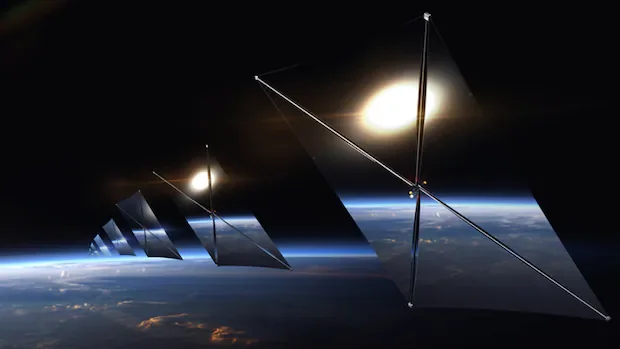
U.S. FCC approves giant space mirror to deliver 'sunlight on demand,' but what are the legal implications?
Company's proposal of 50,000 mirrors would be 'catastrophic for astronomy,' says one professional astronomer
Despite hundreds of public comments opposing a giant space mirror that would shine a beam of light roughly five kilometres wide back down to Earth, the U.S. Federal Communications Commission (FCC), has given it the green light.
The company building the space mirror, Reflect Orbital, is touting its proposal as "sunlight on demand," which could be used for any number of reasons, it says, such as agriculture, solar farms or for search and rescue.
Astronomers and other groups are sounding the alarm about the project, citing numerous reasons, including the threat to species dependent on a pristine night sky, the threat to important astronomical research and more.
"This harm could include damage to sensitive research telescope equipment, potential flash-blinding of pilots and drivers and — as Reflect Orbital stated in its own FCC filings — potential permanent eye damage to anyone looking through a mid-sized telescope," the American Astronomical Society said in a statement.
The FCC said that those concerns are beyond their scope, as they only regulate communications by radio, television, wire and satellite.
So who does regulate where, how and when a giant five-kilometre swath of light can be used? What's stopping someone from paying potentially tens of thousands of dollars for an hour of reflected sunlight at their home? Does that mean neighbours have to endure disruption to their sleep or nightly routines?
While the Reflect Orbital approval is for one satellite, the company proposes launching a whopping 50,000 by 2035.
And this is on top of the millions of satellite proposed by SpaceX and other companies like Blue Origin, which will add to the thousands of satellites already crowding Earth's orbit.
'Far from unregulated'
Internationally, the United Nations Office for Outer Space Affairs (UNOOSA) deals with all aspects related to space, including its applications and space law.
More than 115 countries (referred to as "states") have signed the 1967 Outer Space Treaty. There are several articles in the treaty, but overall the message is that countries are responsible for the peaceful use of outer space and that countries must take into account other "corresponding interests of all other States Parties," a UNOOSA representative told CBC News via email, when asked about Reflect Orbital's project.
"So the honest answer to 'how legal is it' is that it is not a yes or no question. Nothing in the treaties prohibits placing a reflective object in orbit (Article I, freedom to use outer space). But such an activity is very far from unregulated," UNOOSA said. "It is subject to due regard and consultation obligations owed to every other State. And any State that considers itself affected is entitled to raise it."
LISTEN | A company wants to sell sunlight after dark. Here's why astronomers are worried:International space law expert Cassandra Steer said that it could be up to countries to make some sort of laws around the type of reflected sunlight service that Reflect Orbital is aiming to provide.
"I think that there are environmental protection regulations within Canada where the federal government could say, actually, we are not going to allow anybody in Canada to legally purchase and use these services, because we're going to say it's harmful to their environment," Steer said. "How are we going to enforce it is a different question."
Ram Jakhu, professor emeritus at McGill University's faculty of law, agreed that regulations are needed.
"I think, in five, 10 years, you will see something done about it, not only talk and talk," he said.
"The whole issue of night sky, light pollution, these things, they are being addressed, but nothing has been decided yet. But I think there will be serious concerns and discussion, something we can see in the near future. The night sky is very important. But … astronomers are not a major player in geopolitics."
The UNOOSA also said that of the 193 member states that roughly 50 have their own national space legislation, and that, as Steer said, it could be up to individual countries to set their own regulations.
In response to a question about potential regulations, a spokesperson for Reflect Orbital said, "we recognize that responsible deployment at scale requires clear rules. We welcome oversight and want to play an active role in shaping it. We believe it is our responsibility to work alongside governments, scientists and regulators rather than ahead of them."
'Dark and quiet skies'
UNOOSA's Committee on the Peaceful Uses of Outer Space (COPUOS) is already working with International Astronomical Union (IAU), and other international observatories on the "protection of dark and quiet skies," and space-based illumination is included in that, UNOOSA said.
Piero Benvenuti, director of the IAU's Centre for the Protection of Dark and Quiet Sky from Satellite Constellation Interference (CPS), said that they have been speaking with Reflect Orbital from the outset.
The company says on its website that they "maintain strict exclusion zones for astronomy and sensitive environments." But Benvenuti said that, once the CPS showed Reflect Orbital a map of all the observatories contributing to astronomical research, they seemed surprised.
"They probably didn't know that the number of telescopes, including the amateur astronomer telescopes, are huge and are dispersed everywhere in the world," he said.
In the email to CBC News, the company spokesperson said, "We’re an industry member of the International Astronomical Union’s Centre for the Protection of the Dark and Quiet Sky, and feedback from the astronomical community has materially informed the design of our spacecraft and operational plans."
They also noted that they are "committed to ongoing dialogue with scientists, astronomers, environmental researchers and other interested stakeholders."
CPS doesn't have regulatory oversight, but is working with astronomers and satellite providers on reducing the impact satellite constellations will have on the night sky.
WATCH | Light pollution is getting noticeably worse, study confirms:"The other thing they didn't consider is that it is not just the direct illumination of the telescope," Benvenuti said. "They are shining through the atmosphere, their reflected sunlight, and that is illuminating the atmosphere, and the light, obviously, is diffused by particle and by scattering."
He also noted that they are working with Reflect Orbital to study the effects of the first satellite, Earendil-1.
"What we are negotiating with them is a campaign of observations. So, we want to quantify the effect of this prototype. And then once we have these measures, these data, we will verify the simulation and, you know, check if the simulations are correct."
And if they are?
"They're saying we want to launch 50,000 mirrors by 2035," Benvenuti said. "That would be catastrophic for astronomy, that is clear."